

Postdoctoral Research Associate for the Photosynthetic Antenna Research Center
Project Description:
The Center for Structural Molecular Biology (CSMB) of Oak Ridge National Laboratory (ORNL) (http://www.ornl,gov) operates the Biological Small-Angle Neutron Scattering (Bio-SANS) beam line and user research program at the High Flux Isotope Reactor (HFIR). The CSMB conducts biological research on the structure, function and dynamics of macromolecular systems and assemblies, with particular focus and strengths in using small angle scattering, single crystal and membrane diffraction.
CSMB has an immediate opening for a Post-Doctoral Fellow within the Photosynthetic Antenna Research Center (PARC). PARC explores basic science research aimed at understanding the principles of the harvesting of light and funneling of energy as applied to natural photosynthetic, biohybrid and bio-inspired antenna systems, which gather light and carry it to an organism's reaction center, where the chemistry that creates energy takes place. The successful candidate will join a multi-disciplinary research team of chemists and bio-physicists at the Bio-SANS facility to support and develop neutron scattering analysis of biological macromolecules. Successful applicants will be encouraged to develop their own independent and collaborative research. The post represents an excellent opportunity for a young postdoctoral scientist to develop his/her expertise, broaden his/her experience and interact with leading scientists from around the world.
Technical Questions:
For more information about this position please contact Dr. Volker Urban, Center for Structural Molecular Biology, Oak Ridge National Laboratory, P.O. Box 2008, Oak Ridge, TN 37831-6194, or at urbanvs@ornl.gov and reference this position title and number in your correspondence.
A Ph.D. completed within the last 5 years in physics, biophysics, physical chemistry or structural biology is required. Previous experience in either neutron or X-ray scattering is required. Candidates with experience in applying small-angle scattering methods to biological macromolecular complexes are highly encouraged to apply. The candidate should be self-motivated, have good interpersonal, communication and presentational skills and demonstrated ability to interact effectively with staff at all levels and to work within a multi-disciplinary team.
- Degree: Doctoral Degree received within the last 60 month(s).
-
Discipline(s):
- Physics (16 )
I certify that I have completed coursework towards a degree in science, technology, engineering, mathematics, or a related field.

 ORISE GO
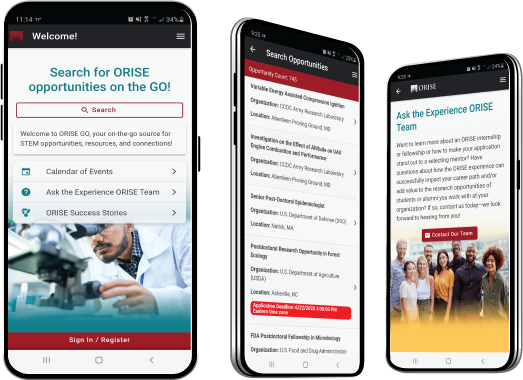
The ORISE GO mobile app helps you stay engaged, connected and informed during your ORISE experience – from application, to offer, through your appointment and even as an ORISE alum!