

Spatial Statistical Network Modelling of River Temperature and Fish Communities
A complete application consists of:
- An application
- Transcripts – Click here for detailed information about acceptable transcripts
- A current resume/CV, including academic history, employment history, relevant experiences, and publication list
- Two educational or professional references
All documents must be in English or include an official English translation.
If you have questions, send an email to EPArpp@orau.org. Please include the reference code for this opportunity in your email.
A postdoctoral research opportunity is currently available at the U.S. Environmental Protection Agency’s (EPA) Office of Research and Development (ORD)/National Health and Environmental Effects Research Laboratory (NHEERL). This appointment will be served with the Atlantic Ecology Division (AED) in Narragansett, RI.
The research participant will be involved with a Region 10 RARE project "Big cold and small cold: Quantifying Thermal Regime Metrics for Policy Development in Pacific Northwest (PNW) Streams." Cold temperatures are critical to the survival of salmonids, the majority of which are listed as endangered or threatened in the Pacific Northwest (PNW). High temperatures in PNW streams are the most prevalent violation of water quality standards in Idaho, Oregon, and Washington with thousands of river miles on the 303(d) impaired waters list for temperature. TMDLs, salmon recovery plans, and other watershed recovery plans have been or are in the process of being developed to address high temperatures that harm salmonids in the Pacific Northwest, and it remains as the foremost issue to be addressed to protect and restore salmonid habitat. Cold water tributaries are a key element to providing conditions for salmon to survive and thrive by 1) providing cold temperatures for spawning; 2) cooling downstream waters which may be warmer; and 3) for heterogeneous river systems, providing cold water pockets during warm summer time afternoon for salmon to rest until temperatures cool. Climate change models showing increasing temperatures in PNW streams further increases the urgency to establish tools to protect and restore cold water necessary for salmon survival. This project will take these new tools to the next level – identifying restored thermal regimes based upon predictor-response relationships that will be developed for different watersheds in the Pacific Northwest.
Despite best efforts to develop a water quality standard that is both protective of salmonids and reflective of the dynamic thermal regimes of river and stream systems, the Region is still struggling with the scientific, technical, administrative and legal challenges to establishing and implementing such a standard. Further, outside of aerial infrared surveys, TMDLs lack the tools to assess the presence and likelihood of cold water and to determine the amount of cold water needed to protect fish. What is missing are methods and metrics that help identify the aspects of restored thermal regimes within PNW watersheds that are critical to support salmonids and identify “where, when, and how much” cold water is available for protection to support different species. One goal of this project is to refine existing spatial statistical network (SSN) models for stream and river temperature (www.fs.fed.us/rm/boise/AWAE/projects/SpatialStreamNetworks.shtml) developed by the USFS for three selected basins in the PNW and extend these to include predictions beyond August to the full growing season. These models will be applied to predict the potential for restoration of thermal regimes in these systems. In addition, SSN models will be developed for monthly means (May, September) and 7dadm (May, August, September) in the Columbia Basin using existing NORWEST metrics plus NHDPlus monthly flows and May/Sept air metrics. Suitable thermal regimes under the current climate regime will be mapped and coldwater refuge locations will be identified at tributary inputs. A second goal of the project is to develop metrics for thermal complexity that are linked to fish community health metrics. Using the model database, thermal regime indices would be extracted and linked to a comprehensive fish database, such that the probability of occurrence of selected salmonids can be predicted based upon the thermal regime, and the apportionment of variability in temperature from natural and anthropogenic activities will be identified.
In addition, the participant will also be involved in evaluating the impact of impervious cover and moderating effects of natural and constructed green infrastructure on biology and habitat quality in streams and rivers of New England and the MidAtlantic, focusing on effects on flow regime metrics (low and peak flows), thermal regime, and substrate quality. The participant will be trained in the development of models predicting flow and thermal regimes, and substrate quality. This may include the development of supporting databases and data frameworks (e.g., stream network), model development and application, application of geographic information systems, development and documentation of methods, and report or manuscript writing.
This program, administered by ORAU through its contract with the U.S. Department of Energy to manage the Oak Ridge Institute for Science and Education, was established through an interagency agreement between DOE and EPA.
Applicants must be pursuing or have received a doctoral degree in ecology, environmental science, geography, natural resources or a closely related field within five years of the desired start date. Familarity with the R programming language and with statistics, including linear models is desired.
The appointment is for twelve months and may be renewed upon recommendation of EPA and contingent on the availability of funds. The participant will receive a monthly stipend. Funding may be made available to reimburse the participant’s travel expenses to present the results of his/her research at scientific conferences. No funding will be made available to cover travel costs for pre-appointment visits, relocation costs, tuition and fees, or participant’s health insurance. The participant must show proof of health and medical insurance. The participant does not become an EPA employee.
The mentor for this project is Naomi Detenbeck (detenbeck.naomi@epa.gov). The desired start date is October 26, 2016.

 ORISE GO
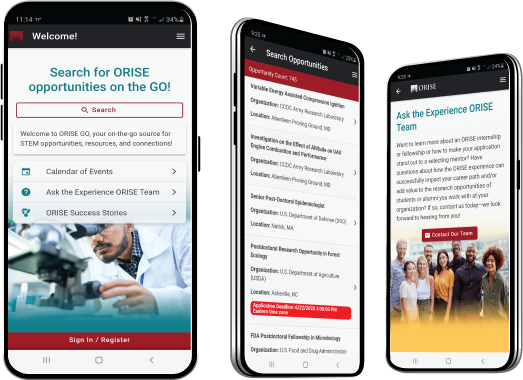
The ORISE GO mobile app helps you stay engaged, connected and informed during your ORISE experience – from application, to offer, through your appointment and even as an ORISE alum!