

Research Opportunities at the US Forest Service Research and Development (R&D)
A complete application consists of:
- An application
- A current resume/CV, including academic history, employment history, relevant experiences, and publication list
- Transcripts – For this opportunity, an unofficial transcript or copy of the student academic records printed by the applicant or by academic advisors from internal institution systems may be submitted. Selected candidate may be required to provide proof of completion of the degree before the appointment can start.
All documents must be in English or include an official English translation.
If you have questions, please send an email to USForestService@orise.orau.gov. Please include the reference code for this opportunity in your email.
Research opportunities routinely become available at the US Forest Service Research and Development (R&D), a component of the U.S. Department of Agriculture. R&D works at the forefront of science to improve the health and use of our Nation's forests and grasslands. Research has been part of the Forest Service mission since the agency's inception.
The organization consists of seven research stations and 80 experimental forests and ranges. Forest Service R&D interacts with national forests in nine regions and with the agency's State and Private Deputy Area throughout the United States. Forest Service R&D also partners with other federal agencies, non-governmental organizations, universities, and the private sector.
More than 500 Forest Service researchers work in a range of biological, physical, and social science fields to promote sustainable management of the Nation's diverse forests and rangelands. Their research covers a lot of territory, with programs in all 50 States, U.S. territories, and commonwealths.
The work has a steady focus on informing policy and land-management decisions, whether it addresses invasive insects, degraded river ecosystems, or sustainable ways to harvest forest products. The researchers work independently and with a range of partners, including other agencies, academia, nonprofit groups, and industry. The information and technology produced through basic and applied science programs is available to the public for its benefit and use.
R&D research is organized into the primary topics listed below:
- Invasive Species: Reduces, minimizes, or eliminates the introduction, establishment, spread, and effects of invasive species.
- Inventory, Monitoring & Analysis: Identifies current status and trends of forests; management options and effects; and threats and their effects on the Nation’s forests and grasslands species.
- Outdoor Recreation: Examines to understand and manage outdoor environments, activities, and experiences that connect people with the natural world.
- Resource Management & Use: Explores forest and range resources and products, including Agroforestry, Forest Products, Landscape Science, Management & Operations, and Urban Research.
- Water, Air & Soil: Enables clear air and safe drinking water, protection of lives and property from wildfire and smoke, and adapting to climate variability and change.
- Wildland Fire & Fuel: Focuses on reducing the negative and enhancing the beneficial effects of fire.
- Wildlife & Fish: Investigates the complex interactions among species, ecosystem dynamics and processes, land use and management, and emerging threats.
This basic and applied research informs the work in the R&D Priority Areas.
The R&D Priority Areas are:
- Biomass & Bioenergy: Research focused on alternative energy sources, new products and new markets that contribute to U.S. energy security, environmental quality, and economic opportunity.
- Climate Change: Adaptation research to improve the resiliency of forests, rangelands, and aquatic areas and to mitigate the adverse impacts of climate change on trees, forests, and forest ecosystems.
- Nanotechnology: Leading cutting-edge innovations in the development of wood products.
- Urban Natural Resources Stewardship: Research for the management, protection, and care of urban natural resources to improve people’s lives.
- Watershed Management & Restoration: Watershed-scale research to understand where water shortages will occur, identify how future climate will affect rain and snow fall, and find ways to reduce water pollution and protect water sources.
For additional information about the US Forest Service Research Participation Program, please visit http://www.orau.gov/usfs_rpp/index.html.
Participant Benefits
Research opportunities are typically full-time for one year and may be extended for up to four additional years upon recommendation of the Forest Service and are contingent on the availability of funds. The stipend rates will be determined by Forest Service officials and are based on the participant’s academic and professional background. A stipend supplement may be provided to cover the cost of an individual or family health insurance plan. Relocation expenses may be reimbursed. Funding may be made available to reimburse travel-related expenses to scientific and professional development activities.
Nature of the Appointment
Participants will not enter into an employee/employer relationship with ORISE, ORAU, USDA, or any other office or agency. Instead, the participant will be affiliated with ORISE for the administration of the appointment through the ORISE appointment letter and Terms of Appointment.
This is a continuous posting. Applications will be reviewed and selected as opportunities become available.
To be eligible candidates must fall into one of the following categories:
- Postgraduate: Have received an associate, bachelor's, master's or doctorate degree in an appropriate discipline within five years of the desired starting date.
- Undergraduate or Graduate Students: Be enrolled in an accredited U.S. college, university, technical institute, or pre-college school, or in an institution approved by the USFS.
This program is available to U.S. citizens, Legal Permanent Residents, or foreign nationals. Note that some projects may require U.S. citizenship for security reasons.
- Degree: Associate's Degree, Bachelor's Degree, Master's Degree, or Doctoral Degree.
-
Discipline(s):
- Business (11 )
- Chemistry and Materials Sciences (12 )
- Communications and Graphics Design (6 )
- Computer, Information, and Data Sciences (16 )
- Earth and Geosciences (21 )
- Engineering (27 )
- Environmental and Marine Sciences (14 )
- Life Health and Medical Sciences (45 )
- Mathematics and Statistics (10 )
- Other Non-Science & Engineering (13 )
- Physics (16 )
- Science & Engineering-related (1 )
- Social and Behavioral Sciences (28 )

 ORISE GO
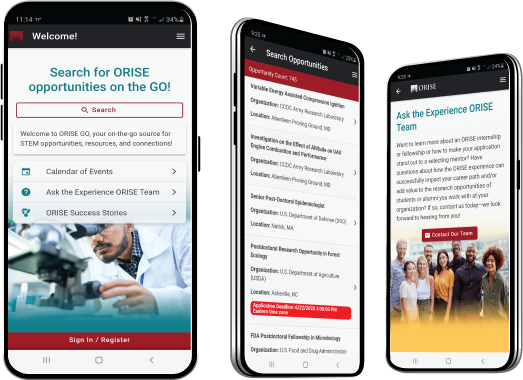
The ORISE GO mobile app helps you stay engaged, connected and informed during your ORISE experience – from application, to offer, through your appointment and even as an ORISE alum!