

USDA Forest Service Postdoctoral Fellowship in Forest Watershed Resources
To submit your application, scroll to the bottom of this opportunity and click APPLY.
A complete application consists of:
- An application
- Transcript(s) – For this opportunity, an unofficial transcript or copy of the student academic records printed by the applicant or by academic advisors from internal institution systems may be submitted. Click here for detailed information about acceptable transcripts.
- A current resume/CV, including academic history, employment history, relevant experiences, and publication list
- Two educational or professional recommendations. At least one recommendation must be submitted in order for the mentor to view your application.
All documents must be in English or include an official English translation.
Connect with ORISE...on the GO! Download the new ORISE GO mobile app in the Apple App Store or Google Play Store to help you stay engaged, connected, and informed during your ORISE experience and beyond!
*Applications will be reviewed on a rolling-basis.
USDA Forest Service Office/Lab and Location: A fellowship opportunity is available with the US Department of Agriculture (USDA) Forest Service (FS) Southern Research Station (SRS) located in Otto, North Carolina.
At the heart of the USDA Forest Service's mission is their purpose. Everything they do is intended to help sustain forests and grasslands for present and future generations. Why? Because their stewardship work supports nature in sustaining life. This is the purpose that drives the agency’s mission and motivates their work across the agency. It’s been there from the agency’s very beginning, and it still drives them. To advance the mission and serve their purpose, the USDA Forest Service balances the short and long-term needs of people and nature by: working in collaboration with communities and our partners; providing access to resources and experiences that promote economic, ecological, and social vitality; connecting people to the land and one another; and delivering world-class science, technology and land management.
The mission of the SRS is to create the science and technology needed to sustain and enhance southern forest ecosystems and the benefits they provide. SRS is part of the Nation's largest forestry research organization—USDA Forest Service Research and Development—the leading organization for research on natural resource management and sustainability in the United States. Headquartered in Asheville, North Carolina, the Southern Research Station serves 13 southern states and beyond.
The fellowship will be located at the Coweeta Hydrologic Laboratory in Otto, NC in the beautiful southern Appalachians of western North Carolina. Coweeta is the longest-running experimental forest in the Nation, including continuous climate and streamflow records extending back to the 1930s. There are abundant recreational and cultural activities in the area including hiking, kayaking, mountain biking, and skiing. Nearby cities include the thriving town of Franklin, NC about 20 minutes from Coweeta, Asheville, NC about 1.5 hours away, and Atlanta, GA about 2 hours away.
Research Project: The quantity and quality of water delivered by forest watersheds are influenced by forest management and natural processes, including extreme meteorological events. Over long timescales, water quantity (yield) reflects the balance between precipitation and evapotranspiration, the latter being strongly controlled by the amount, type, and growth of above-ground biomass (i.e., carbon stocks). Recent catastrophic flooding in the Southern Appalachian’s associated with Hurricane Helene highlights the need to better understand how interactions between management, forest disturbance, and precipitation patterns influence the ability of forests to attenuate flooding in mountainous landscapes.
This research fellowship will use long-term (since 1934) experimental data (meteorology, streamflow, stream chemical exports, forest composition) at the Coweeta Hydrologic Laboratory to assess trends and variability in water yield and chemistry as affected by multiple underlying drivers. Analyses will consider watersheds throughout the Coweeta basin including a range of historical and recent treatments and their paired reference watershed. There will be significant flexibility for the fellow, in collaboration with the mentor and other project members, to refine the focus of these activities based on the knowledge base, skill sets, and interest of the participant.
Learning Objectives: The fellow will be mentored by a Research Physical Scientist/Project Leader in the Southern Research Station Center for Forest Watershed Research. The fellow will also learn from and collaborate closely with other research scientists at the Coweeta Hydrologic Laboratory. Specifically, the fellow will be able to:
- Apply statistical methods to assess changes in precipitation characteristics and water yield over time, with focus on increasing variability and extreme events in watersheds.
- Expand knowledge of process-based modeling approaches to assess relationships between forest species composition, biomass, and water yield
- Develop techniques for spatial prediction and mapping of forest species composition at the watershed and larger scales.
- Develop novel analyses to assess the effects of prescribed fire and understory removal on forest regeneration, water quantity and quality.
- Strengthen data management and analysis competencies through processing and management of large long-term datasets.
- Understand how environmental monitoring and research operations uses legacy and modern methods
- Understand the role of harvesting, prescribed fire, and other practices on water quantity and quality and forest productivity.
- Document, present, and publish research activities
Mentor(s): The mentor for this opportunity is John T. Walker (john.walker3@usda.gov). If you have questions about the nature of the research, please contact the mentor.
Anticipated Appointment Start Date: May 2026. Start date is flexible and will depend on a variety of factors.
Appointment Length: The appointment will initially be for one year but may be renewed upon recommendation of SRS and is contingent on the availability of funds.
Level of Participation: The appointment is full-time at the Coweeta Hydrologic Laboratory.
Participant Stipend: The participant will receive a monthly stipend commensurate with educational level and experience. The anticipated stipend is $8,200 monthly.
Citizenship Requirements: This opportunity is available to U.S. citizens, Lawful Permanent Residents (LPR), and foreign nationals. Non-U.S. citizen applicants should refer to the Guidelines for Non-U.S. Citizens Details page of the program website for information about the valid immigration statuses that are acceptable for program participation. Foreign national candidates may have a mandatory in-person requirement depending on visa status.
ORISE Information: This program, administered by ORAU through its contract with the U.S. Department of Energy (DOE) to manage the Oak Ridge Institute for Science and Education (ORISE), was established through an interagency agreement between DOE and USDA Forest Service. Participants do not become employees of USDA, USDA Forest Service, DOE or the program administrator, and there are no employment-related benefits. Proof of health insurance is required for participation in this program. Health insurance can be obtained through ORISE.
Questions: Please visit our Program Website. After reading, if you have additional questions about the application process, please email ORISE.USFS.SRS@orau.org and include the reference code for this opportunity.
The qualified candidate should be currently pursuing or have received a doctoral degree in one of the relevant fields. Degree must have been received within the past five years or anticipated to be received by 5/31/2026.
Preferred skills:
- R, Python, and Microsoft software
- Statistical analysis tools.
- Familiarity with ArcGIS
- Familiarity with data post-processing, quality control, and management of environmental datasets such as meteorology, streamflow, soil and stream chemistry, and vegetation biometrics
- Familiarity with forested ecosystems and watershed hydrology
- Possesses the oral and written communication skills necessary to document research activities, to communicate clearly and effectively with other researchers, present and report results, and generate manuscripts for peer-reviewed publication.

 ORISE GO
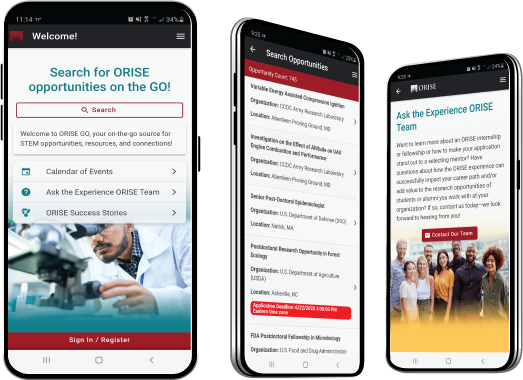
The ORISE GO mobile app helps you stay engaged, connected and informed during your ORISE experience – from application, to offer, through your appointment and even as an ORISE alum!