

USDA-ARS Postdoctoral Fellow in Crustacean Disease Research
To submit your application, scroll to the bottom of this opportunity and click APPLY.
A complete application consists of:
- An application
- Transcript(s) – For this opportunity, an unofficial transcript or copy of the student academic records printed by the applicant or by academic advisors from internal institution systems may be submitted. Click here for detailed information about acceptable transcripts.
- A current resume/CV, including academic history, employment history, relevant experiences, and publication list
- Two educational or professional recommendations
- A copy of an abstract or reprint of an article
All documents must be in English or include an official English translation.
Connect with ORISE...on the GO! Download the new ORISE GO mobile app in the Apple App Store or Google Play Store to help you stay engaged, connected, and informed during your ORISE experience and beyond!”
*Applications are reviewed on a rolling-basis.
ARS Office/Lab and Location: A research opportunity is currently available with the U.S. Department of Agriculture (USDA), Agricultural Research Service (ARS), Aquatic Animal Health Research Unit located in Auburn, Alabama.
The Agricultural Research Service (ARS) is the U.S. Department of Agriculture's chief scientific in-house research agency with a mission to find solutions to agricultural problems that affect Americans every day from field to table. ARS will deliver cutting-edge, scientific tools and innovative solutions for American farmers, producers, industry, and communities to support the nourishment and well-being of all people; sustain our nation’s agroecosystems and natural resources; and ensure the economic competitiveness and excellence of our agriculture. The vision of the agency is to provide global leadership in agricultural discoveries through scientific excellence.
To support the continued growth, sustainability and profitability of the aquaculture industry, prevention strategies are essential for reducing significant economic losses caused by diseases and parasites. The specific research objectives of the Aquatic Animal Health Research Unit are the development of vaccines, rapid detection tests and shrimp and crawfish diets that will enhance disease resistance to infectious bacteria and parasites. The Unit's research also determines pathogen and host factors that influence virulence and immune responses.
Research Project: Disease is one of the leading causes of production losses for shrimp and crawfish farmers. In this fellowship, you will apply molecular tools to survey, monitor, and detect White Spot Syndrome Virus (WSSV) across shrimp and crawfish aquaculture systems. Learning under the guidance of a mentor, you will use in-vitro microbiology and molecular biology approaches to identify and confirm the presence of WSSV in pond water, sediment, and farmed shrimp and crawfish, providing insight into the virus movement and transmission pathways. The data generated through this will advance our understanding of WSSV ecology and transmission dynamics, support the development of improved diagnostic tools, and inform new strategies for disease prevention. These efforts directly align with ongoing ARS research priorities aimed at reducing disease-related losses in crustacean aquaculture.
Learning Objectives: Under the guidance of a mentor, you will:
- Learn about the impact of disease on shrimp and crawfish aquaculture, with a focus on White Spot Syndrome Virus (WSSV).
- Gain hands-on experience applying molecular tools to survey, monitor, and detect WSSV in aquaculture systems.
- Develop skills in in-vitro microbiology and molecular biology techniques to identify and confirm WSSV in pond water, sediment, and farmed shrimp and crawfish.
- Investigate virus movement and transmission pathways to better understand WSSV ecology and spread.
- Learn about generating data that supports the development of improved diagnostic tools and disease prevention strategies.
- Align research efforts with ARS priorities aimed at reducing disease-related losses in crustacean aquaculture.
Mentor(s): The mentor for this opportunity is Julio C. Garcia (julioc.garcia@usda.gov). If you have questions about the nature of the research, please contact the mentor(s).
Anticipated Appointment Start Date: September 2026. Start date is flexible and will depend on a variety of factors.
Appointment Length: The appointment will initially be for one year, but may be renewed upon recommendation of ARS and is contingent on the availability of funds.
Level of Participation: The appointment is full time.
Participant Stipend: The participant will receive a monthly stipend commensurate with educational level and experience. The anticipated stipend range is $60,000 - $78,000 annually.
Citizenship Requirements: This opportunity is available to U.S. citizens only.
ORISE Information: This program, administered by ORAU through its contract with the U.S. Department of Energy (DOE) to manage the Oak Ridge Institute for Science and Education (ORISE), was established through an interagency agreement between DOE and ARS. Participants do not become employees of USDA, ARS, DOE or the program administrator, and there are no employment-related benefits. Proof of health insurance is required for participation in this program. Health insurance can be obtained through ORISE.
Questions: Please visit our Program Website. After reading, if you have additional questions about the application process, please email ORISE.ARS.Southeast@orau.org and include the reference code for this opportunity.
The qualified candidate should have received or will receive a doctoral degree by the start of the appointment in one of the relevant fields (Fisheries, Aquaculture and Aquatic Sciences, Microbiology, Molecular Biology, Bioinformatics, or a related field in Biological Sciences).
Preferred skills:
- Knowledge and background in aquaculture, microbiology, molecular biology, virology and bioinformatics.
- Demonstrated flexibility and self-motivation.
- Experience with experimental design as well as performing experiments and interpreting results.
- Functional knowledge of molecular techniques such as PCR, quantitative polymerase chain reaction (qPCR), DNA sequencing and viral analysis.
- Excellent organizational skills, ability to multitask, collaborate and be in a team.
- Proficiency in technical writing, oral communication, interpersonal and organizational skills.

 ORISE GO
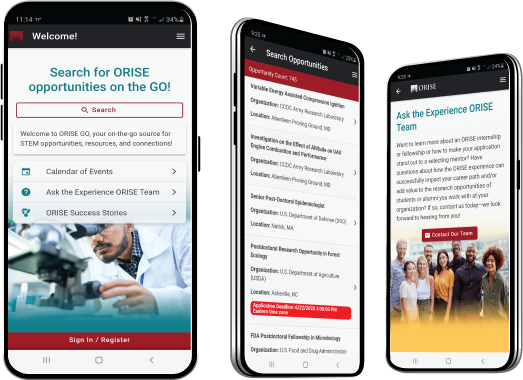
The ORISE GO mobile app helps you stay engaged, connected and informed during your ORISE experience – from application, to offer, through your appointment and even as an ORISE alum!