

USDA-ARS SCINet/AI-COE Postdoctoral Fellowship in Computational Analysis of Viral Disease Progression and Outcomes in Swine
To submit your application, scroll to the bottom of this opportunity and click APPLY.
A complete application consists of:
- An application
- Transcript(s) – For this opportunity, an unofficial transcript or copy of the student academic records printed by the applicant or by academic advisors from internal institution systems may be submitted. Click here for detailed information about acceptable transcripts.
- A current resume/CV, including academic history, employment history, relevant experiences, and publication list
- Two educational or professional recommendations
All documents must be in English or include an official English translation.
Connect with ORISE...on the GO! Download the new ORISE GO mobile app in the Apple App Store or Google Play Store to help you stay engaged, connected, and informed during your ORISE experience and beyond!”
ARS Office/Lab and Location: A postdoctoral research opportunity is available with the U.S. Department of Agriculture (USDA), Agricultural Research Service (ARS), Virus and Prion Research Unit, National Animal Disease Center, Ames, Iowa.
The Agricultural Research Service (ARS) is the U.S. Department of Agriculture's chief scientific in-house research agency with a mission to find solutions to agricultural problems that affect Americans every day from field to table. ARS delivers cutting-edge, scientific tools and innovative solutions for American farmers, producers, industry, and communities to support the nourishment and well-being of all people; sustain our nation’s agroecosystems and natural resources; and ensure the economic competitiveness and excellence of our agriculture. The vision of the agency is to provide global leadership in agricultural discoveries through scientific excellence.
ARS’s SCINet/Artificial Intelligence (AI) Center of Excellence Research Participation Program offers research opportunities to motivated postdoctoral fellows interested in solving agriculture-related problems at a range of spatial and temporal scales, from the genome to the continent, and sub-daily to evolutionary time scales. One of the goals of the SCINet Initiative is to develop and apply new technologies, including AI and machine learning (ML), to help solve complex agricultural problems that also depend on collaboration across scientific disciplines and geographic locations. In addition, many of these technologies rely on the synthesis, integration, and analysis of large, diverse datasets that benefit from high-performance computing (HPC). The objective of these fellowships is to facilitate cross-disciplinary, cross-location research through collaborative research on problems of interest to each applicant and amenable to or requiring HPC resources. Training will be provided in data science, scientific computing, AI/ML, and related topics as needed for the fellow to complete their research. Additional funds are available for supplies and travel essential for the fellow's research.
Research Project: Under the guidance of a mentor, you will apply computational methods for identifying predictors and facilitators of immune protection against highly virulent strains of porcine reproductive and respiratory syndrome viruses (PRRSVs) that have recently emerged and caused high morbidities and mortalities in United States swine herds. Efforts may result in identifying novel biological targets for more effective PRRSV prevention and treatment strategies that modulate early host immune responses. During this training opportunity, you will have the opportunity to be involved in the development of a training model to predict PRRSV disease outcomes in field-collected samples from pigs infected with unknown PRRSV strains and present a portfolio of biomarkers, cell populations, and/or immune processes to target for revised immunomodulatory design strategies that are catered towards prevention/treatment of diverse PRRSV strains causing extreme pathogenesis and disease. Transcriptomics datasets have been generated via bulk and single-cell RNA sequencing from blood and disease-affected tissues and will be analyzed alongside clinical readouts and additional laboratory assay measures of disease to generate novel tools and resources for PRRSV control strategies that benefit United States pork producers.
You will also be a member of a scientific team that advances a comprehensive research program in virology, immunology, and computational biology to develop solutions for protecting United States swine herds from viral disease threats. Research endeavors are intrinsically collaborative and foster synergistic relationships with scientists across multiple ARS research institutions/national programs, academic institutions, and research consortiums. Uniquely, you will also have collaborative interactions with the ultimate targeted audience of their research: swine industry stakeholders, such as practicing swine veterinarians, pork producers, and members of the veterinary biologics industry.
Learning Objectives: During this appointment, you will learn to: a) handle multiple bulk and single-cell transcriptomics datasets through established and newly developed computational pipelines to identify patterns of gene expression, cell populations, and immune processes; and b) evaluate additional clinical, blood, and tissue sample data collected longitudinally across the post-infection study time course to optimize machine learning methods that predict disease outcomes and identify host factors and interactions that most heavily influence outcomes based on early immune response dynamics. Opportunities for additional training, communication of findings, and professional networking will also be available.
Mentor(s): The mentor for this opportunity is Jayne Wiarda (jayne.wiarda@usda.gov), Research Microbiologist at the National Animal Disease Center. If you have questions about the nature of the research, please contact the mentor.
Anticipated Appointment Start Date: Targeted start date is between December 2026 to May 2027. Start date is flexible and will depend on a variety of factors.
Appointment Length: The appointment will initially be for one year but may be renewed for a second year upon recommendation of the mentor and ARS.
Level of Participation: The appointment is full-time.
Participant Stipend: The participant(s) will receive a monthly stipend commensurate with educational level and experience. The current stipend range for this opportunity is $100,000 - $110,000/year plus a supplement to offset health/dental insurance costs. Funding is also available to help offset relocation costs, if applicable. Funds will also be available for travel to present research.
Citizenship Requirements: This opportunity is available to U.S. citizens only.
ORISE Information: This program, administered by ORAU through its contract with the U.S. Department of Energy (DOE) to manage the Oak Ridge Institute for Science and Education (ORISE), was established through an interagency agreement between DOE and ARS. Participants do not become employees of USDA, ARS, DOE or the program administrator, and there are no employment-related benefits. Proof of health insurance is required for participation in this program. Health insurance can be obtained through ORISE.
Questions: Please visit our Program Website. After reading, if you have additional questions about the application process, please email ORISE.ARS.SCINet@orau.org and include the reference code for this opportunity.
The qualified candidate should be currently pursuing or have received a doctoral degree in the one of the relevant fields.
Preferred Skills:
- Awareness of the biological relevancy of and applications for developed computational models and workflows
- Experience analyzing host/eukaryote RNA sequencing data
- Experience with predictive modeling of long-term outcomes from early disease biomarker data
- Ability to write and execute scripts in shell environments and with R and/or Python
- Experience developing, testing, and refining machine learning models
- Experience developing HPC workflows
- Excellent written and oral communication skills
- Ability to function as a teammate in a collaborative research environment
- Willingness to learn skills and obtain new knowledge

 ORISE GO
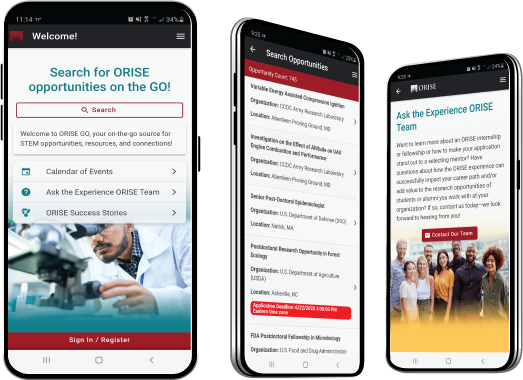
The ORISE GO mobile app helps you stay engaged, connected and informed during your ORISE experience – from application, to offer, through your appointment and even as an ORISE alum!