

USDA-ARS Mapping and Monitoring Soil Moisture and Salinity Across Orchard Crops Using Non-Invasive Tools - Postdoctoral Fellowship
To submit your application, scroll to the bottom of this opportunity and click APPLY.
A complete application consists of:
- An application
- Transcript(s) – For this opportunity, an unofficial transcript or copy of the student academic records printed by the applicant or by academic advisors from internal institution systems may be submitted. Click here for detailed information about acceptable transcripts.
- A current resume/CV, including academic history, employment history, relevant experiences, and publication list
- Two educational or professional recommendations
All documents must be in English or include an official English translation.
Connect with ORISE...on the GO! Download the new ORISE GO mobile app in the Apple App Store or Google Play Store to help you stay engaged, connected, and informed during your ORISE experience and beyond!”
*Applications are reviewed on a rolling-basis.
ARS Office/Lab and Location: A research opportunity is currently available with the U.S. Department of Agriculture (USDA), Agricultural Research Service (ARS), located in Davis, California.
The Agricultural Research Service (ARS) is the U.S. Department of Agriculture's chief scientific in-house research agency with a mission to find solutions to agricultural problems that affect Americans every day from field to table. ARS will deliver cutting-edge, scientific tools and innovative solutions for American farmers, producers, industry, and communities to support the nourishment and well-being of all people; sustain our nation’s agroecosystems and natural resources; and ensure the economic competitiveness and excellence of our agriculture. The vision of the agency is to provide global leadership in agricultural discoveries through scientific excellence.
Research Project: Cover crops are used to improve soil health in orchard crops, e.g., by improving nutrient/moisture retention in soils, reducing soil compaction, attracting pollinators, etc., but the overall impact of cover crops on rootzone soil moisture availability and deep percolation is not well understood. This creates large uncertainties when modelling orchard water and nutrient fluxes as well as deep percolation below the root zone, critical topics in semi-arid, agriculturally productive regions such as California’s Central Valley. In this educational research project, we want to quantify spatial variations in root zone soil moisture variations in orchard crops as a function of cover cropping. In order to map moisture content, we will use laterally extensive time-lapse electrical resistivity tomography (ERT) surveys as well as co-located borehole nuclear magnetic resonance (bNMR) logging to quantify water content. Additionally, we intend to measure root water uptake using sap flow meters. The data will be integrated using recently developed physics-informed neural networks in order to translate apparent resistivity data to spatial maps of water content.
All research will be conducted at the Sustainable Agricultural Water Systems (SAWS) unit, a part of the Agricultural Research Service (ARS), the U.S. Department of Agriculture's chief scientific in-house research agency with a mission to find solutions to agricultural problems that affect Americans every day from field to table. The mission of the SAWS unit is to increase the efficiency and sustainability of irrigated agriculture in California under changing environmental conditions, with a special focus on vine and tree orchard crops in the Central Valley. This is accomplished by: (i) improving irrigation efficiency; (ii) optimizing on-farm strategies for managed aquifer recharge; and (iii) assessing the long-term impacts of irrigated agriculture on crop production, soil health, and groundwater quantity and quality under changing environmental conditions.
The SAWS unit, located in Davis, CA, hosts researchers studying water, carbon and nutrient fluxes in agricultural lands, as well as groundwater geophysicists, hydrologists and economists. Participation with the SAWS unit will grant access to USDA physical and computational resources, including geophysical instrumentation, soil and plant sensors, laboratory and greenhouse space, as well as cloud and supercomputing resources. We also engage closely with researchers at University of California campuses, especially those in Davis.
Learning Objectives: Under the guidance of a mentor, you will:
- Learn electrical geophysics and bNMR survey design.
- Understand the deployment and maintenance of buried ERT arrays and bNMR access tubes for time-lapse data acquisition.
- Gain experience in installation and maintenance of sensors for sapflow, soil moisture/salinity, etc.
- Build experience in the integration of diverse data streams, including field measurements and remote sensing data products, in a unified data processing workflow to recover models of subsurface water content variation.
- Learn about the use of physics-informed neural networks developed by collaborating researchers for hydrogeophysical modelling applications.
- Hone skills in the preparation of manuscripts and presentation of results at professional meetings.
Mentor(s): The mentor for this opportunity is Gordon Osterman (Gordon.Osterman@usda.gov). If you have questions about the nature of the research, please contact the mentor(s).
Anticipated Appointment Start Date: Fall 2026. Start date is flexible and will depend on a variety of factors.
Appointment Length: The appointment will initially be for one year, but may be renewed upon recommendation of ARS and is contingent on the availability of funds.
Level of Participation: The appointment is full time.
Participant Stipend: The participant will receive a monthly stipend commensurate with educational level and experience.
Citizenship Requirements: This opportunity is available to U.S. citizens only.
ORISE Information: This program, administered by ORAU through its contract with the U.S. Department of Energy (DOE) to manage the Oak Ridge Institute for Science and Education (ORISE), was established through an interagency agreement between DOE and ARS. Participants do not become employees of USDA, ARS, DOE or the program administrator, and there are no employment-related benefits. Proof of health insurance is required for participation in this program. Health insurance can be obtained through ORISE.
Questions: Please visit our Program Website. After reading, if you have additional questions about the application process, please email ORISE.ARS.PacificWest@orau.org and include the reference code for this opportunity.
The qualified candidate should be currently pursuing or have received a doctoral degree in the one of the relevant fields. Degree must have been received within the past five years. Applicants currently pursuing a doctoral degree must obtain the degree before starting the appointment.
Preferred Skills:
- Practical experience setting up and maintaining geophysical, soil and/or agronomic sensor networks.
- Ability to lift and operate heavy equipment (at least 50 lbs) in hot, dry field conditions.
- Ability to engage with, process, and integrate diverse data streams.
- Coding experience (Python preferred, but others accepted)
- Experience with either:
- Near-surface geophysical survey design, acquisition, processing, inversion and interpretation, or,
- Measuring and modelling root-zone soil moisture and nutrient dynamics.
Other Preferred Skills:
- Experience using field instruments such as electrical resistivity tomography (ERT) and borehole nuclear magnetic resonance (bNMR) methods for time-lapse subsurface investigation in the shallow subsurface (<10 meters depth).
- Experience with soil moisture/salinity and sapflow sensors.
- Experience using neural networks and machine learning tools.
- Citizenship: U.S. Citizen Only
- Degree: Doctoral Degree received within the last 60 months or currently pursuing.
- Discipline(s):
- Veteran Status: Veterans Preference, degree received within the last 120 month(s).

 ORISE GO
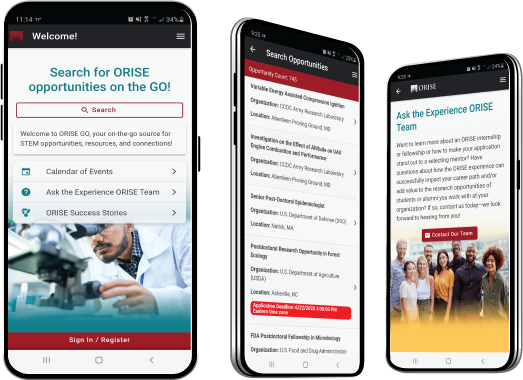
The ORISE GO mobile app helps you stay engaged, connected and informed during your ORISE experience – from application, to offer, through your appointment and even as an ORISE alum!