

USDA-ARS Postdoctoral Research Computational Biology Fellowship
To submit your application, scroll to the bottom of this opportunity and click APPLY.
A complete application consists of:
- An application
- Transcript(s) – For this opportunity, an unofficial transcript or copy of the student academic records printed by the applicant or by academic advisors from internal institution systems may be submitted. Click here for detailed information about acceptable transcripts.
- A current resume/CV, including academic history, employment history, relevant experiences, and publication list
- Two educational or professional recommendations
All documents must be in English or include an official English translation.
Connect with ORISE...on the GO! Download the new ORISE GO mobile app in the Apple App Store or Google Play Store to help you stay engaged, connected, and informed during your ORISE experience and beyond!”
*Applications are reviewed on a rolling-basis.
ARS Office/Lab and Location: A research opportunity is currently available with the U.S. Department of Agriculture (USDA), Agricultural Research Service (ARS), located in Beltsville, Maryland.
The Agricultural Research Service (ARS) is the U.S. Department of Agriculture's chief scientific in-house research agency with a mission to find solutions to agricultural problems that affect Americans every day from field to table. ARS will deliver cutting-edge, scientific tools and innovative solutions for American farmers, producers, industry, and communities to support the nourishment and well-being of all people; sustain our nation’s agroecosystems and natural resources; and ensure the economic competitiveness and excellence of our agriculture. The vision of the agency is to provide global leadership in agricultural discoveries through scientific excellence.
Research Project: Research will focus on the development of bioinformatics and genomics tools to characterize the structure and function of the ruminant genomes and the application of those datasets to accelerate genetic improvement and discover genetic variation affecting economically important traits. Under the guidance of a mentor, the fellow will have the opportunity to be involved in the following aspects of the project:
- Developing and customizing pipelines for automation of data processing required for discovering genetic (e.g., SNP, CNV) and epigenetic (e.g., DNA methylation) variations, as well as generating genome assemblies and pangenomes using short- and long-read sequencing in cattle and other ruminants.
- Developing better statistical methods to incorporate new reference genomes, pangenomes and improve association studies with QTL and enhancing genetic prediction tools for automation of data processing required for SNP use in livestock selection programs.
Learning Objectives: By the end of this training/research experience, the fellow will be able to:
- Explain the structure and functional organization of the bovine genome and describe how genomic tools are used to characterize genetic and epigenetic variation.
- Identify and differentiate types of genomic variation (e.g., SNPs, CNVs, DNA methylation patterns) and functional genomic elements (e.g., enhancers, promoters) in cattle.
- Customize bioinformatics pipelines for automated processing and analysis of short- and long-read sequencing data.
- Apply computational approaches to detect genetic and epigenetic variation from sequencing datasets in livestock species.
- Generate genome assemblies from long-read sequence data and build pangenomes.
- Design and implement statistical methods for QTL mapping and association studies, and interpret their results in the context of economically important traits.
- Evaluate and improve genomic prediction models for use in livestock selection programs.
- Integrate genomic data into applied breeding strategies to accelerate genetic improvement in cattle.
Mentor(s): The mentor for this opportunity is Benjamin Rosen (ben.rosen@usda.gov). If you have questions about the nature of the research, please contact the mentor(s).
Anticipated Appointment Start Date: June 2026. Start date is flexible and will depend on a variety of factors.
Appointment Length: The appointment will initially be for one year, but may be renewed upon recommendation of ARS and is contingent on the availability of funds.
Level of Participation: The appointment is full time.
Participant Stipend: The participant will receive a monthly stipend commensurate with educational level and experience. The anticipated stipend range is $63,940 - $68,202 annually.
Citizenship Requirements: This opportunity is available to U.S. citizens only.
ORISE Information: This program, administered by ORAU through its contract with the U.S. Department of Energy (DOE) to manage the Oak Ridge Institute for Science and Education (ORISE), was established through an interagency agreement between DOE and ARS. Participants do not become employees of USDA, ARS, DOE or the program administrator, and there are no employment-related benefits. Proof of health insurance is required for participation in this program. Health insurance can be obtained through ORISE.
Questions: Please visit our Program Website. After reading, if you have additional questions about the application process, please email ORISE.ARS.Northeast@orau.org and include the reference code for this opportunity.
The qualified candidate should be currently pursuing or have received a doctoral degree in the one of the relevant fields.

 ORISE GO
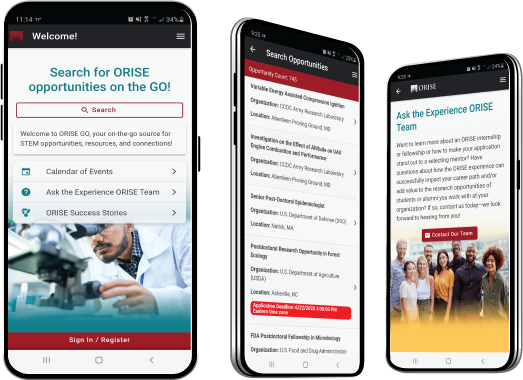
The ORISE GO mobile app helps you stay engaged, connected and informed during your ORISE experience – from application, to offer, through your appointment and even as an ORISE alum!