

USDA-ARS Seasonal Student Trainee Measuring Plant Response to Abiotic Production Factors
To submit your application, scroll to the bottom of this opportunity and click APPLY.
A complete application consists of:
- An application
- Transcript(s) – For this opportunity, an unofficial transcript or copy of the student academic records printed by the applicant or by academic advisors from internal institution systems may be submitted. Click here for detailed information about acceptable transcripts.
- A current resume/CV, including academic history, employment history, relevant experiences, and publication list
- Two educational or professional recommendations
All documents must be in English or include an official English translation.
Connect with ORISE...on the GO! Download the new ORISE GO mobile app in the Apple App Store or Google Play Store to help you stay engaged, connected, and informed during your ORISE experience and beyond!”
*Applications are reviewed on a rolling-basis.
ARS Office/Lab and Location: A research opportunity is currently available with the U.S. Department of Agriculture (USDA), Agricultural Research Service (ARS), located in Beltsville, Maryland.
The Agricultural Research Service (ARS) is the U.S. Department of Agriculture's chief scientific in-house research agency with a mission to find solutions to agricultural problems that affect Americans every day from field to table. ARS will deliver cutting-edge, scientific tools and innovative solutions for American farmers, producers, industry, and communities to support the nourishment and well-being of all people; sustain our nation’s agroecosystems and natural resources; and ensure the economic competitiveness and excellence of our agriculture. The vision of the agency is to provide global leadership in agricultural discoveries through scientific excellence.
The Adaptive Cropping Systems Laboratory (ACSL) at the USDA-ARS Beltsville Agricultural Research Center (BARC) in Beltsville, Maryland conducts integrated experimental and modeling research to understand how crops respond to key abiotic factors such as weather, soil conditions, and management practices. Our team designs and carries out controlled experiments and develops, validates, and applies advanced mathematical models to investigate a wide range of agricultural challenges, including the impacts of extreme weather on crop production, land suitability assessment, food security, on-farm resource management, and farmer competitiveness.
Research Project: Students will participate in seasonal controlled-environment experiments (e.g., greenhouses and growth chambers) aimed at improving our understanding of how crop production responds to environmental conditions. Data generated from these studies supports scientists in identifying management strategies that enhance farm profitability and strengthen food security. Students will gain hands-on experience across multiple stages of seasonal experimental research.
Students will collaborate closely with laboratory scientist mentors and technical staff on a variety of seasonal experimental activities. Opportunities may include helping with low-voltage sensor calibration, testing, and operation; contributing to the design of plant experiments; caring for and harvesting plant materials; collecting and recording measurements; entering and organizing data; and performing basic statistical analyses using a range of software tools.
Learning Objectives: They will learn how plants and soils respond to genetic, environmental, and management inputs, and why understanding these interactions is essential for improving food security and promoting sustainable farming systems. Participants will also gain hands-on experience with low-voltage environmental sensing technologies and data-collection devices.
Participants will develop new professional skills in experimental design, operation of scientific instruments, data measurement and record keeping, basic statistical analysis, and plant husbandry. They will collaborate closely with established scientists, benefiting from daily mentorship that often includes informal, big-picture discussions about agricultural systems, environmental sustainability, and food security. Students will also gain valuable insight into the day-to-day experience of academic research.
Mentor(s): The mentors for this opportunity are Christine Chang (christine.chang@usda.gov) and David Fleisher (david.fleisher@usda.gov). If you have questions about the nature of the research, please contact the mentors.
Anticipated Appointment Start Date: May 1, 2026. Start date is flexible and will depend on a variety of factors.
Appointment Length: The appointment will initially be for one year, but may be renewed upon recommendation of ARS and is contingent on the availability of funds.
Level of Participation: The appointment is full-time for the summer and have the potential for reduced hours during the off-season as well.
Participant Stipend: The participant will receive a monthly stipend commensurate with educational level and experience. The anticipated stipend range is $760 - $1,000 weekly.
Citizenship Requirements: This opportunity is available to U.S. citizens only.
ORISE Information: This program, administered by ORAU through its contract with the U.S. Department of Energy (DOE) to manage the Oak Ridge Institute for Science and Education (ORISE), was established through an interagency agreement between DOE and ARS. Participants do not become employees of USDA, ARS, DOE or the program administrator, and there are no employment-related benefits. Proof of health insurance is required for participation in this program. Health insurance can be obtained through ORISE.
Questions: Please visit our Program Website. After reading, if you have additional questions about the application process, please email ORISE.ARS.Northeast@orau.org and include the reference code for this opportunity.
The qualified candidate should have received or be currently pursuing an associate's, bachelor's, master's, or doctoral degree in the one of the relevant fields.
Preferred skills:
- Comfortable performing outside or in greenhouses, and on their feet, for up to several hours a day.
- Citizenship: U.S. Citizen Only
- Degree: Associate's Degree, Bachelor's Degree, Master's Degree, or Doctoral Degree received within the last 60 months or currently pursuing.
-
Discipline(s):
- Chemistry and Materials Sciences (12 )
- Communications and Graphics Design (6 )
- Computer, Information, and Data Sciences (17 )
- Earth and Geosciences (21 )
- Engineering (29 )
- Environmental and Marine Sciences (14 )
- Life Health and Medical Sciences (51 )
- Mathematics and Statistics (11 )
- Other Non-Science & Engineering (13 )
- Physics (16 )
- Science & Engineering-related (2 )
- Social and Behavioral Sciences (30 )
- Age: Must be 18 years of age

 ORISE GO
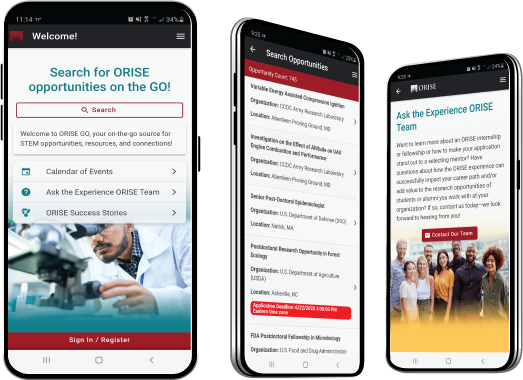
The ORISE GO mobile app helps you stay engaged, connected and informed during your ORISE experience – from application, to offer, through your appointment and even as an ORISE alum!