

USDA-ARS Research Fellowship in Vector Entomology
To submit your application, scroll to the bottom of this opportunity and click APPLY.
A complete application consists of:
- An application
- Transcript(s) – For this opportunity, an unofficial transcript or copy of the student academic records printed by the applicant or by academic advisors from internal institution systems may be submitted. Click here for detailed information about acceptable transcripts.
- A current resume/CV, including academic history, employment history, relevant experiences, and publication list
- Two educational or professional recommendations
All documents must be in English or include an official English translation.
Connect with ORISE...on the GO! Download the new ORISE GO mobile app in the Apple App Store or Google Play Store to help you stay engaged, connected, and informed during your ORISE experience and beyond!”
*Applications are reviewed on a rolling-basis.
ARS Office/Lab and Location: A research opportunity is currently available with the U.S. Department of Agriculture (USDA), Agricultural Research Service (ARS), Crop Improvement and Protection Research Unit in Salinas, California.
The Agricultural Research Service (ARS) is the U.S. Department of Agriculture's chief scientific in-house research agency with a mission to find solutions to agricultural problems that affect Americans every day from field to table. ARS will deliver cutting-edge, scientific tools and innovative solutions for American farmers, producers, industry, and communities to support the nourishment and well-being of all people; sustain our nation’s agroecosystems and natural resources; and ensure the economic competitiveness and excellence of our agriculture. The vision of the agency is to provide global leadership in agricultural discoveries through scientific excellence.
This specific opportunity is part of the ARS's Crop Improvement and Protection Research Unit in Salinas, California and the focus is on biology and management of insect vectors and viruses of vegetables.
Research Project: The project focuses on understanding ecological interactions among insect vectors, plant hosts, and plant pathogens that influence disease risk in vegetable crops in California's Salinas Valley. Research outcomes are expected to contribute to sustainable pest and disease management strategies that support agricultural productivity, environmental stewardship, and long-term agroecosystem resilience.
Impatiens necrotic spot virus (INSV) is an economically important pathogen of lettuce in California. The virus is transmitted by western flower thrips (Frankliniella occidentalis), a highly polyphagous insect that utilizes a wide range of cultivated and non-crop plant species. Although many native plants, cover crops, and beneficial vegetation provide valuable ecosystem services, including pollinator resources, biological control habitat, erosion control, and weed suppression, their susceptibility to INSV and potential role in disease ecology remain poorly understood.
You will collaborate with USDA-ARS scientists to investigate plant-virus-vector interactions and evaluate the susceptibility of native plants, cover crops, and other beneficial plant species to INSV under controlled greenhouse conditions. Research activities may include propagating and maintaining diverse plant species; conducting greenhouse inoculation experiments; evaluating symptom development; collecting plant tissue samples; and applying serological and molecular diagnostic approaches to detect and quantify virus infection. Opportunities may also be available to investigate relationships among plant characteristics, virus infection, and western flower thrips ecology, including host suitability, vector behavior, vector competence, and factors that influence pathogen transmission and disease risk across agricultural landscapes.
Opportunities will be available to integrate concepts from entomology, plant pathology, disease ecology, agroecology, and integrated pest management while collaborating with researchers from USDA-ARS, universities, and agricultural industry partners. The research will contribute to the development of science-based recommendations for selecting vegetation that supports ecosystem services while minimizing risk associated with insect-transmitted plant diseases.
Learning Objectives: Under the guidance of a mentor, you will have opportunities to:
- Gain hands-on experience designing and conducting greenhouse experiments focused on interactions among insect vectors, plant hosts, and plant pathogens.
- Develop knowledge of the biology, ecology, epidemiology, and management of western flower thrips and thrips-transmitted plant viruses.
- Learn to investigate ecological factors that influence disease risk in native plants, cover crops, beneficial vegetation, and agricultural systems.
- Build technical skills in serological and molecular diagnostic methods for plant pathogen detection, quantification, and disease assessment.
- Explore relationships among host plants, vector ecology, pathogen acquisition, and transmission processes that contribute to disease development.
- Participate in vector-mediated transmission studies to better understand mechanisms of pathogen spread.
- Strengthen scientific communication skills through contributions to manuscripts, presentations, and other scholarly products.
- Contribute to research supporting sustainable pest and disease management strategies for specialty crop agriculture.
Mentor(s): The mentor for this opportunity is Daniel Hasegawa (daniel.hasegawa@usda.gov). If you have questions about the nature of the research, please contact the mentor(s).
Anticipated Appointment Start Date: January 2027. Start date is flexible and will depend on a variety of factors.
Appointment Length: The appointment will initially be for two years.
Level of Participation: The appointment is full time.
Participant Stipend: The participant will receive a monthly stipend commensurate with educational level and experience. The anticipated stipend range is $93,000 - $96,000 annually.
Citizenship Requirements: This opportunity is available to U.S. citizens only.
ORISE Information: This program, administered by ORAU through its contract with the U.S. Department of Energy (DOE) to manage the Oak Ridge Institute for Science and Education (ORISE), was established through an interagency agreement between DOE and ARS. Participants do not become employees of USDA, ARS, DOE or the program administrator, and there are no employment-related benefits. Proof of health insurance is required for participation in this program. Health insurance can be obtained through ORISE.
Questions: Please visit our Program Website. After reading, if you have additional questions about the application process, please email ORISE.ARS.HQPostdoc@orau.org and include the reference code for this opportunity.
The qualified candidate should be currently pursuing or have received a doctoral degree in the one of the relevant fields. Degree must have been received within the past four years or be currently pursuing.
Preferred skills:
- Experience conducting research in vector entomology, plant pathology, disease ecology, epidemiology, integrated pest management, or related disciplines.
- Experience designing, conducting, and analyzing greenhouse, laboratory, or field-based biological experiments.
- Experience with insect vectors, plant viruses, plant-insect interactions, or host-pathogen systems.
- Experience rearing insects, conducting insect bioassays, or performing vector transmission studies.
- Experience with serological, molecular, or diagnostic techniques used in plant pathology, entomology, or related biological sciences.
- Experience collecting, organizing, and analyzing biological data using statistical software such as R.
- Experience preparing scientific figures, reports, manuscripts, presentations, or other scholarly products.
- Demonstrated ability to communicate scientific findings effectively through written and oral presentations to target audiences.
- Experience researching independently and collaboratively within multidisciplinary research teams.
- Citizenship: U.S. Citizen Only
- Degree: Doctoral Degree received within the last 48 months or currently pursuing.
-
Discipline(s):
- Life Health and Medical Sciences (8 )
- Veteran Status: Veterans Preference, degree received within the last 120 month(s).

 ORISE GO
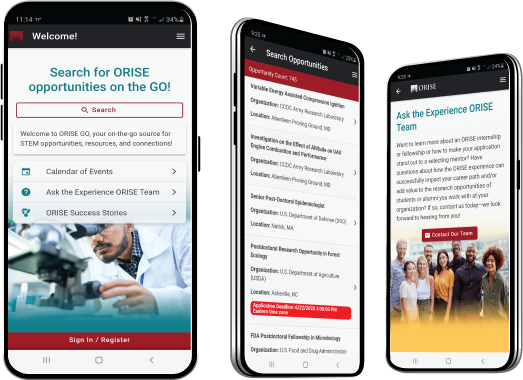
The ORISE GO mobile app helps you stay engaged, connected and informed during your ORISE experience – from application, to offer, through your appointment and even as an ORISE alum!