

USDA-ARS Postdoctoral Fellow in Agroecosystem Performance and Tradeoffs
To submit your application, scroll to the bottom of this opportunity and click APPLY.
A complete application consists of:
- An application
- Transcript(s) – For this opportunity, an unofficial transcript or copy of the student academic records printed by the applicant or by academic advisors from internal institution systems may be submitted. Click here for detailed information about acceptable transcripts.
- A current resume/CV, including academic history, employment history, relevant experiences, and publication list
- Two educational or professional recommendations
All documents must be in English or include an official English translation.
Connect with ORISE...on the GO! Download the new ORISE GO mobile app in the Apple App Store or Google Play Store to help you stay engaged, connected, and informed during your ORISE experience and beyond!”
*Applications are reviewed on a rolling-basis.
ARS Office/Lab and Location: A research opportunity is currently available with the U.S. Department of Agriculture (USDA), Agricultural Research Service (ARS), National Sedimentation Laboratory in Oxford, Mississippi.
The Agricultural Research Service (ARS) is the U.S. Department of Agriculture's chief scientific in-house research agency with a mission to find solutions to agricultural problems that affect Americans every day from field to table. ARS will deliver cutting-edge, scientific tools and innovative solutions for American farmers, producers, industry, and communities to support the nourishment and well-being of all people; sustain our nation’s agroecosystems and natural resources; and ensure the economic competitiveness and excellence of our agriculture. The vision of the agency is to provide global leadership in agricultural discoveries through scientific excellence.
RESEARCH PROBLEM: Stakeholder feedback has demonstrated that producers desire more directed research on reducing inputs to cropping systems to increase profit margins or hedge commodity price fluctuations. Cover crops and reduced tillage are practices that may show benefits for producers by reducing input costs from fertilizer, diesel, and herbicides, while increasing environmental benefits. However, more research is needed in the midsouth to quantify and evaluate financial and environmental costs and benefits of these practices. We will utilize data collected in a large-scale experiment on commercial farms near Clarksdale, MS to conduct a systems-level analysis of environmental and production data from a farm utilizing innovative practices, and a farm with prevailing agricultural practices.
OBJECTIVE: Systems-level analysis and integration of environmental and production data from a field-level experiment including cover crops and reduced tillage practices. Data integration will determine environmental sustainability benefits of cover crop treatments compared to economic benefits and costs.
APPROACH and GOAL: Delta producers could benefit from cover crop adoption via reduced pest pressure, erosion protection, enhanced infiltration, improved soil water holding capacity, and higher soil nutrient availability. These benefits all increase agricultural sustainability. A cover crop field-scale experiment has been implemented at several farms in the Mississippi Alluvial Plain (Clarksdale, MS). The experiment will compare cover crop treatment, which includes varieties of mustard greens, turnips and rye, in addition to a control (no cover crop). Measurements will include soil physical, chemical, and biological characteristics, soil moisture, runoff quantity and quality, pesticide plant residues, biomass quantity and quality of cash crop and cover crops, and nutrient balances in cover crop and control fields. A collaborative team is responsible for collection and analysis of each measurement. A research fellow will integrate these measurements to assess ecosystem service benefits and tradeoffs.
EXPECTED RESULTS: We expect that innovative practices will yield positive environmental benefits, such as reduced soil erosion, improved soil infiltration, more efficient nutrient budgets, and reduced diesel and input costs. There will likely be an inflection point where commodity prices and yield relationships will enhance economic returns of innovative practices compared to prevailing.
Learning Objectives: During the appointment, the participant will gain practical knowledge and skills in agroecosystem research and analysis. They will learn how to construct nutrient budgets for agroecosystems, apply best practices for analyzing agroecosystem data—including soils, runoff, yield, and biomass—and develop economic budgets that evaluate inputs and outputs of cropping systems. The appointment will also strengthen the participant’s abilities in data wrangling and data analysis, scientific manuscript preparation for peer-reviewed publications, and effective public speaking and scientific communication.
Mentor(s): The mentor for this opportunity is Lindsey Witthaus (lindsey.witthaus@usda.gov). If you have questions about the nature of the research, please contact the mentor(s).
Anticipated Appointment Start Date: June 1, 2026. Start date is flexible and will depend on a variety of factors.
Appointment Length: The appointment will initially be for two years.
Level of Participation: The appointment is full time.
Participant Stipend: The participant will receive a monthly stipend commensurate with educational level and experience. The anticipated stipend range is $74,678 annually.
Citizenship Requirements: This opportunity is available to U.S. citizens only.
ORISE Information: This program, administered by ORAU through its contract with the U.S. Department of Energy (DOE) to manage the Oak Ridge Institute for Science and Education (ORISE), was established through an interagency agreement between DOE and ARS. Participants do not become employees of USDA, ARS, DOE or the program administrator, and there are no employment-related benefits. Proof of health insurance is required for participation in this program. Health insurance can be obtained through ORISE.
Questions: Please visit our Program Website. After reading, if you have additional questions about the application process, please email ORISE.ARS.HQPostdoc@orau.org and include the reference code for this opportunity.
The qualified candidate should be currently pursuing or have received a doctoral degree in the one of the relevant fields.
Preferred skills:
- Background in environmental science, agronomy, soil science, natural resource management, economics, or a combination of above.
- Experience using statistics to analyze multi-faceted datasets and strong organizational skills to link multiple datasets into a cohesive analysis.
- Strong communication skills are desired, with a willingness to improve oral presentation and writing skills.

 ORISE GO
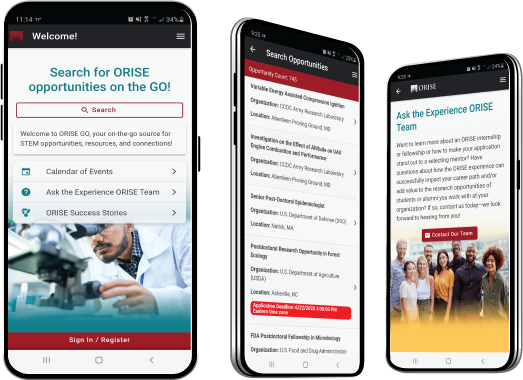
The ORISE GO mobile app helps you stay engaged, connected and informed during your ORISE experience – from application, to offer, through your appointment and even as an ORISE alum!