

Translational Antiviral Drug Discovery & Protein Chemistry Postdoctoral Research Opportunity
Click on Apply at the bottom of the opportunity to start your application.
The Department of Defense (DoD) is offering a postdoctoral fellowship at the U.S. Army Medical Research and Development Command – Medical Research Institute of Infectious Diseases (USAMRDC MRIID).
What will I be doing?
As an Oak Ridge Institute for Science and Education (ORISE) participant, you will engage in efforts to advance translational antiviral drug discovery. Research activities will include recombinant protein expression and purification, biochemical screening assay development, computational structural modeling, cell-based antiviral validation studies, and exposure to preclinical small-animal research models.
Why Should I Apply?
Under the guidance of a mentor, you will engage in research activities that include, but are not limited to:
- Designing, collecting, and analyzing of recombinant protein expression and purification pipelines to yield high-quality, stable viral and host targets.
- Optimizing and evaluating biochemical small-molecule library screening assays using purified protein targets to identify potential therapeutic candidates.
- Applying computational structural tools to model target structures, map binding pockets, and integrate structural insights with laboratory assays.
- Designing and executing cell-based assays to analyze compound-mediated target inactivation, degradation, or inhibition of viral replication.
- Translating benchtop biochemical findings into in vivo preclinical small animal models to evaluate therapeutic efficacy and pharmacokinetic profiles.
- Gaining exposure to cutting-edge transcriptomic, proteomic, and "imageomic" (high-content image informatics) datasets, as well as exploring the application of research findings to advanced 3D models such as organoids and 3D bioprinted tissues
- Learning about high-content, automated phenotypic drug screening pipelines against high-consequence pathogens of biodefense interests.
- Learning non-infectious surrogate viral systems, including pseudotyped viruses, minigenome systems, and virus-like particles (VLPs).
- Learning the operational, scientific, and regulatory steps required to translate in vitro molecular hits into small animal preclinical evaluation models.
- Processing and integrating complex transcriptomic, proteomic, and image-based data to map host-pathogen interactions and drug mechanisms of action.
- Developing a comprehensive, systems-level understanding of the viral life cycle, host-virus dynamics, and the pharmacological mechanisms of small-molecule therapeutics.
Where will I be located?
Frederick, Maryland
Appointments are initially for one year with the option to extend the appointment for up to four additional years, contingent upon project needs and funding availability.
What are the provisions?
USAMRIID's reputation has been built over the years by numerous scientists and technical staff working to protect both military personnel and civilians from the threat of infectious diseases. The Institute participates in support of emerging disease investigations, working alongside colleagues from the Centers for Disease Control and Prevention and the World Health Organization. As a reference laboratory for the Department of Defense, USAMRIID sets the standard for identification of biological agents. The Institute's workforce represents some of the top infectious disease and biological defense experts in the Nation—indeed, in the world. For more information about the MRIID, please visit https://usamriid.health.mil/.
The qualified candidate will be completing (by October 31, 2026) or have an earned doctoral degree in Biochemistry, Biophysics, Cellular & Molecular Biology, Structural Biology or other eligible discipline. Postdoctoral degree must have been received within five years of the appointment start date.
Preferred Skills:
- Experience with recombinant protein expression systems and chromatography-based purification techniques (FPLC/AKTA).
- Exposure to or an enthusiastic willingness to learn—computational structural biology tools (such as AlphaFold, PyMOL, Rosetta, or basic molecular docking software) to visualize protein-protein interactions and guide bench-level assay design.
- Exposure to small-molecule library screening and or DNA-Encoded Libraries (DEL).

 ORISE GO
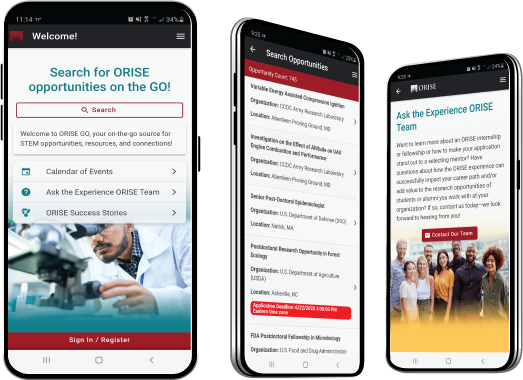
The ORISE GO mobile app helps you stay engaged, connected and informed during your ORISE experience – from application, to offer, through your appointment and even as an ORISE alum!