

Assessing the Vulnerability of Harvested Shellfish to Climate Change - EPA
A complete application consists of:
- An application
- Transcripts – Click here for detailed information about acceptable transcripts
- A current resume/CV, including academic history, employment history, relevant experiences, and publication list
- Two educational or professional references
All documents must be in English or include an official English translation.
If you have questions, send an email to EPArpp@orau.org. Please include the reference code for this opportunity in your email.
A research opportunity is currently available at the U.S. Environmental Protection Agency’s (EPA) Office of Research and Development (ORD)/National Health and Environmental Effects Research Laboratory (NHEERL). The appointment will be served with the Western Ecology Division (WED) Pacific Coastal Ecology laboratory in Newport, OR.
Research to develop methods to assess the vulnerability of harvested species of shellfish (bivalves, crabs, and shrimp) in US estuaries to climate change is being conducted at WED. The research will include evaluating risk at local, regional and national spatial scales using a combination of population modeling, GIS, and field research. One goal will be to demonstrate the methodology by developing spatially-explicit risk assessments for multiple shellfish species for climate change scenarios at one or more estuarine locations.
The research participant will be involved with identifying environmental models useful for predicting the production of harvested species of bivalves, crabs and shrimp, and estimating how the predictor variables for each model may be affected by projected changes to atmospheric, aquatic, and terrestrial features due to climate change. This generalized framework will be adapted to local spatial scales (an estuary), and may be tested at one or more locations where other on-going EPA research can provide critical atmospheric, hydrologic, aquatic, and terrestrial data needed to parameterize the models. After testing, model algorithms should then be generalized and adapted to make predictions at locations where data availability is more limited.
The research participant may gain experience by:
- Identifying or developing ecological models linking the production of estuarine shellfish species to climate-affected environmental factors
- Developing a framework for assessing the risks of climate change to harvested shellfish species
- Applying the framework to estimate the risk of change shellfish availability due to climate-related stressors at specific locations
- Assessing the uncertainty associated with climate risk assessments and developing ways to communicate those uncertainties to decision-makers
- Integrating the location-specific risk modeling to other modeling efforts at one or more locations
- Developing summaries and other communications for technical and nontechnical audiences
- Conducting research for scientific synthesis, data analysis, report preparation and literature searches
- Documenting and maintaining QA/QC methods and reporting requirements for the activities
- Filling key gaps with new data collection
The research participant will learn about final ecosystem services (particularly food-production services) for coastal environments and associated communities; models that are useful for estimating the production of estuarine shellfish populations; down-scaled climate change projections; linking those models to changes in environmental factors that are predicted to be affected by climate change; modeling the risk of change to populations of harvested shellfish species due to one or more down-scaled scenarios of climate change.
This program, administered by ORAU through its contract with the U.S. Department of Energy to manage the Oak Ridge Institute for Science and Education, was established through an interagency agreement between DOE and EPA.
The mentor for this project is Ted DeWitt (dewitt.ted@epa.gov).
Applicants must have received a master’s degree in marine sciences, natural resource management, environmental sciences, ecology, or closely related field within five years of the desired starting date, or completion of all the requirements for the degree should be expected prior to the starting date.
Knowledge of species and coastal ecosystems of the Pacific Northwest, and experience conducting field experiments with marine or estuarine invertebrates would be beneficial to this research oppurtunity.
The appointment is full time for one year and may be renewed upon recommendation of EPA and contingent on the availability of funds. The participant will receive a monthly stipend. Funding may be made available to reimburse the participant’s travel expenses to present the results of his/her research at scientific conferences. No funding will be made available to cover travel costs for pre-appointment visits, relocation costs, tuition and fees, or participant’s health insurance. The participant must show proof of health and medical insurance. The participant does not become an EPA employee.
The expected start date for this project is 02/01/2016.

 ORISE GO
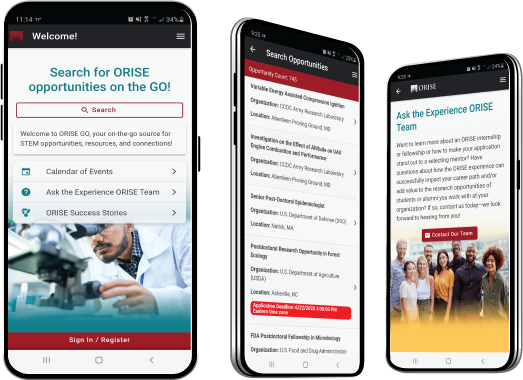
The ORISE GO mobile app helps you stay engaged, connected and informed during your ORISE experience – from application, to offer, through your appointment and even as an ORISE alum!