

NGA: Advanced Research in Imaging Science
To be considered for an ORISE fellowship with NGA, please submit the following:
- Resume or CV
- Transcripts - Transcript verifying receipt of Degree/or identifying current enrollment.
- 2 References
- An email with a link to the reference form will be emailed to the applicant upon completion of the on-line application. Please send this email to persons you have selected to complete a reference.
- References should be from persons familiar with your educational and professional qualifications (include your thesis or dissertation advisor, if applicable). Personal references are NOT acceptable.
- Statement of Research Interests
- The statement of research interests should describe previous research experience and outline the relevance to this project. The research interest statement is a significant component of the selection criteria and should be no longer than four-pages. NGA and the selected candidate will cooperatively define mutual research assignments and goals in support of the NGA mission and the candidate’s educational pursuits.
NGA is conducting advanced research in Imaging Science. The NGA Research Spectral Pod researches capabilities that expand the information gained from sensing the spectrum of light to solve GEOINT hard problems. It advances the understanding of how objects reflect, absorb, and emit light and applies that knowledge to the identification of discrete observables and/or activities of interest. Researchers characterize the ability of sensors to detect objects, entities and activity under varying environmental and geometric conditions. They prototype efforts that maximize the utility of current and near-term systems to detect, type and trend dynamic entities and systems. And they support future sensor and algorithm development and risk reduction through technical studies, analysis and the assessment of alternatives. Join the Spectral Pod to investigate new sensors and processing techniques that expand GEOINT product content and context. NGA is looking for scientists to aid our research efforts in this unique problem set that has special application to the Intelligence Community and the Department of Defense.
NGA Visiting Scientists apply the scientific method across one or more disciplines to advance Geospatial Science and enhance Agency Tradecraft through systematic experimentation and exploitation. They serve as principle investigators for scientific research projects and facilitate collaboration among diverse domains to further scientific inquiry and application. These Scientists plan and conduct research, provide technical guidance and oversight, report results, and advise management on new and evolving technology.
The National Geospatial-Intelligence Agency (NGA) delivers world-class geospatial intelligence that provides a decisive advantage to policymakers, warfighters, intelligence professionals and first responders. Anyone who sails a U.S. ship, flies a U.S. aircraft, makes national policy decisions, fights wars, locates targets, responds to natural disasters, or even navigates with a cellphone relies on NGA. NGA enables all of these critical actions and shapes decisions that impact our world through the indispensable discipline of geospatial intelligence (GEOINT).
Headquartered in Springfield, VA, with facilities in St. Louis, MO, NGA is a member of the U.S. Intelligence Community and a Department of Defense (DoD) Combat Support Agency.
- Student applicants must be completing a Ph.D. or post-doctoral appointment with backgrounds in Geospatial Information Science, Physics, Mathematics, Statistics, Geography, Computer Science, Geometry, Visual Cognition, Nuclear Physics, Astrophysics, Remote Sensing, or a related field.
- Current college or university faculty members on sabbatical are also eligible. Other applicants will be considered on a case-by-case basis.
- Applicants must demonstrate experience applying the scientific method and modern research techniques in a field directly applicable or highly related to the Research Pod.
- Applicants should have experience conducting research in a research environment and show an ability to conceptualize a broad research agenda, to plan and execute specific research projects, and to meet research expectations. Applicants should have excellent verbal and written communication skills.
- U.S. citizenship is required for the applicant. Please see further eligibility under Security Requirements. - If the research project is classified, a background check will be conducted for a Sensitive Compartmented Information (SCI) security clearance and completion of a Questionnaire for National Security Positions will be required. Visiting scientists are also subject to Counterintelligence Polygraph examinations and drug testing in order to maintain access to Top Secret information. Please refer to section on Security Requirements.

 ORISE GO
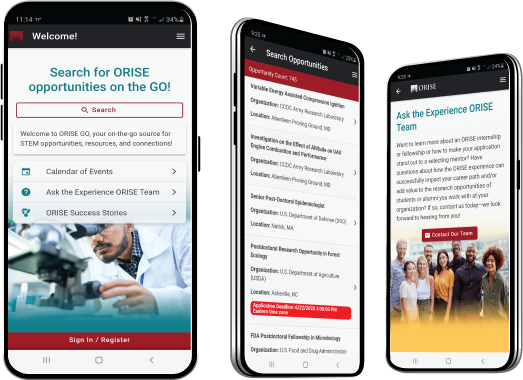
The ORISE GO mobile app helps you stay engaged, connected and informed during your ORISE experience – from application, to offer, through your appointment and even as an ORISE alum!