

FDA Fellowship - Assessing Rare Safety Signals in Psychiatric Clinical Trials
To submit your application, scroll to the bottom of this opportunity and click APPLY.
A complete application consists of:
- An application
- Transcripts – Click here for detailed information about acceptable transcripts
- A current resume/CV, including academic history, employment history, relevant experiences, and publication list
- One educational or professional recommendation
All documents must be in English or include an official English translation.
If you have questions, send an email to ORISE.FDA.CDER@orau.org. Please include the reference code for this opportunity in your email.
*Applications will be reviewed on a rolling-basis.
FDA Office and Location: A research opportunity is available immediately with the Food and Drug Administration (FDA), Center for Drug Evaluation and Research (CDER), located in White Oak, Maryland.
The Center for Drug Evaluation and Research (CDER) performs an essential public health task by making sure that safe and effective drugs are available to improve the health of people in the United States. As part of the U.S. Food and Drug Administration (FDA), CDER regulates over-the-counter and prescription drugs, including biological therapeutics and generic drugs. These efforts cover more than just medicines.
Research Project: Safety assessments for medications intended to treat psychiatric conditions present unique challenges in signal detection due to the complex interaction between underlying conditions, medication effects, and patient vulnerability factors. Rare psychiatric safety signals are particularly problematic because they often involve serious outcomes such as mortality and suicide. Traditional clinical trial designs to assess safety and efficacy of psychiatric drugs are inadequately powered to detect rare safety signals. Post-market surveillance systems suffer from underreporting bias, confounding by indication, and unclear temporal relationships. Meta-analyses based on pooled study-level or subject-level clinical data play a significant role in the evaluation of rare safety signals. However, traditional statistical methods used in these analyses may have poor performance properties with rare events. Given that psychiatric safety signals, such as mortality and suicide, are often confounded by worsening disease progression, traditional approaches also do not account for time-varying clinical outcomes that may be temporally associated with the safety event.
Based on meta-analyses of pooled clinical trial data, labels for two major psychiatric drug classes—antipsychotics and antidepressants—currently include boxed warnings for the increased risk for mortality associated with antipsychotics in elderly patients with dementia and the increased risk for suicidal ideation and behavior associated with antidepressants in children and young adults. Since the emergence of these boxed warnings in the early 2000s, the Agency has evaluated other newer antipsychotics and antidepressants. Given the emergence of new data, the Division of Psychiatry (DP) plans to re-evaluate these rare safety signals and to determine whether additional regulatory actions are needed.
Learning Objectives: Under the guidance of a mentor, you will have the following research project objectives:
- You will investigate mortality patterns in elderly patients receiving antipsychotics, analyzing clinical trial data and real-world evidence to quantify the mortality risk estimate and to characterize temporal patterns, dose-dependent relationships, and potential underlying mechanisms.
- You will investigate the occurrence of suicidal ideation and behavior in adults and pediatric patients receiving an antidepressant. Analyses will include a comparison of event ascertainment based on unsolicited adverse event reporting and use of a prospective clinical outcome measure between adults and pediatrics.
For both research activities, you will research innovative approaches for detecting rare adverse events and consider the impact of baseline patient characteristics, psychiatric comorbidities, and changes in the underlying condition. Through these efforts, you will also have the opportunity to gain experience in contributing to peer-reviewed manuscript preparation, presentation of research findings at internal and external scientific meetings and communicating complex research initiatives.
Mentor: The mentor for this opportunity is Shamir Kalaria (Shamir.Kalaria@fda.hhs.gov). If you have questions about the nature of the research, please contact the mentor.
Anticipated Appointment Start Date: 2026. Start date is flexible and will depend on a variety of factors.
Appointment Length: The appointment will initially be for one year, but may be renewed upon recommendation of FDA and is contingent on the availability of funds.
Level of Participation: The appointment is full time or part time.
Participant Stipend: The participant will receive a monthly stipend commensurate with educational level and experience.
Citizenship Requirements: This opportunity is available to U.S. citizens and Lawful Permanent Residents (LPR) only.
This program, administered by ORAU through its contract with the U.S. Department of Energy to manage the Oak Ridge Institute for Science and Education, was established through an interagency agreement between DOE and FDA. The participant will receive a monthly stipend commensurate with educational level and experience. Proof of health insurance is required for participation in this program. Participants do not become employees of FDA, DOE or the program administrator, and there are no employment-related benefits.
Completion of a successful background investigation by the Office of Personnel Management is required for an applicant to be on-boarded at FDA. OPM can complete a background investigation only for individuals, including non-US Citizens, who have resided in the US for a total of three of the past five years.
FDA Ethics Requirements
If an ORISE Fellow, to include their spouse and minor children, reports what is identified as a Significantly Regulated Organization (SRO) or prohibited investment fund financial interest in any amount, or a relationship with an SRO, except for spousal employment with an SRO, and the individual will not voluntarily divest the financial interest or terminate the relationship, then the individual is not placed at FDA. For additional requirements, see FDA Ethics for Nonemployee Scientists.
FDA requires ORISE participants to read and sign their FDA Education and Training Agreement within 30 days of his/her start date, setting forth the conditions and expectations for his/her educational appointment at the agency. This agreement covers such topics as the following:
- Non-employee nature of the ORISE appointment;
- Prohibition on ORISE Fellows performing inherently governmental functions;
- Obligation of ORISE Fellows to convey all necessary rights to the FDA regarding intellectual property conceived or first reduced to practice during their fellowship;
- The fact that research materials and laboratory notebooks are the property of the FDA;
- ORISE fellow’s obligation to protect and not to further disclose or use non-public information.
The qualified candidate should be currently pursuing or have received a master's or doctoral degree in the one of the relevant fields.
I am a U.S. citizen, or I have lived in the United States for at least 36 out of the past 60 months. (36 months do not have to be consecutive.)
and
I have read the FDA Ethics Requirements.

 ORISE GO
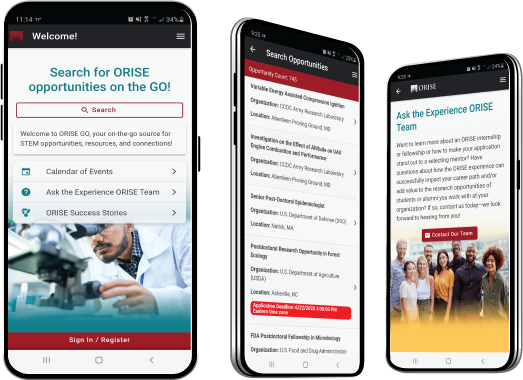
The ORISE GO mobile app helps you stay engaged, connected and informed during your ORISE experience – from application, to offer, through your appointment and even as an ORISE alum!