

FDA Dosage Optimization of Antibody-Drug Conjugates
To submit your application, scroll to the bottom of this opportunity and click APPLY.
A complete application consists of:
- An application
- Transcripts – Click here for detailed information about acceptable transcripts
- A current resume/CV, including academic history, employment history, relevant experiences, and publication list
- One educational or professional recommendation
All documents must be in English or include an official English translation.
If you have questions, send an email to ORISE.FDA.CDER@orau.org. Please include the reference code for this opportunity in your email.
*Applications will be reviewed on a rolling-basis.
FDA Office and Location: A research opportunity is available immediately with the Food and Drug Administration (FDA), Center for Drug Evaluation and Research (CDER), located in White Oak, Maryland.
The Center for Drug Evaluation and Research (CDER) performs an essential public health task by making sure that safe and effective drugs are available to improve the health of people in the United States. As part of the U.S. Food and Drug Administration (FDA), CDER regulates over-the-counter and prescription drugs, including biological therapeutics and generic drugs. This effort covers more than just medicines.
Research Project: The project will collect data on the characteristics and exposure-response relationships for currently approved or late-stage antibody-drug conjugates (ADCs) in the premarket space to aid selection of safe and appropriate dosages of ADCs. The specific aims are to improve our understanding of the current landscape of dose selection of currently approved or late-stage ADCs to inform scientific and regulatory policy and processes in Office of Clinical Pharmacology (OCP).
The fellow will help:
- Collect information regarding the characteristics of the ADC (antibody target, payload, linker, drug-antibody ratio), dose-finding (dose escalation, dose expansion, randomized dosage optimization, recommended phase 2 dose [RP2D], maximum tolerated dosage [MTD], maximum administered dosage [MAD], dose-limiting toxicities [DLTs]), relevant pharmacokinetic and pharmacologic characteristics, exposure-response (E-R) relationships of currently approved or investigational new drug (IND) applications for ADCs in the premarket space.
- Analyze large datasets to identify patterns, trends, and challenges in ADC dose selection across different products and development programs.
- Participate in discussions with the Division of Cancer Pharmacology (DCP) leadership, clinical pharmacology reviewers, and team leads regarding how the results of the project may impact regulatory decisions and/or guidance that protects public health.
- Present the results of the project and their conclusions to the DCP and/or a broader clinical pharmacology audience.
- Contribute to a manuscript regarding the results of the project.
Learning Objectives: The fellow will gain regulatory science experience and policy development insight that supports advancement in clinical pharmacology, drug development, and regulatory affairs across multiple sectors.
Expected Learning Outcomes:
- Understand the components of ADCs including antibody targets, payload mechanisms, linker chemistry, and drug-antibody ratios, along with how these characteristics influence therapeutic efficacy and safety profiles.
- Understand dose-finding methodologies, including dose escalation and expansion strategies, randomized dosage optimization approaches, and the determination of key dosing parameters (RP2D, MTD, MAD, DLTs).
- Proficiency in navigating and extracting relevant data from Investigational New Drug applications, including clinical protocols, pharmacology sections, and dose-finding study results.
- Competency in systematically collecting and organizing complex regulatory and clinical data from multiple sources within FDA's information systems.
Mentor: The mentor for this opportunity is Lily Leu (lily.leu@fda.hhs.gov). If you have questions about the nature of the research, please contact the mentor.
Anticipated Appointment Start Date: July 2026. Start date is flexible and will depend on a variety of factors.
Appointment Length: The appointment will initially be for one year, but may be renewed upon recommendation of FDA and is contingent on the availability of funds.
Level of Participation: The appointment is full time.
Participant Stipend: The participant will receive a monthly stipend commensurate with educational level and experience.
Citizenship Requirements: This opportunity is available to U.S. citizens, Lawful Permanent Residents (LPR), and foreign nationals. Non-U.S. citizen applicants should refer to the Guidelines for Non-U.S. Citizens Details page of the program website for information about the valid immigration statuses that are acceptable for program participation.
This program, administered by ORAU through its contract with the U.S. Department of Energy to manage the Oak Ridge Institute for Science and Education, was established through an interagency agreement between DOE and FDA. The participant will receive a monthly stipend commensurate with educational level and experience. Proof of health insurance is required for participation in this program. Participants do not become employees of FDA, DOE or the program administrator, and there are no employment-related benefits.
Completion of a successful background investigation by the Office of Personnel Management is required for an applicant to be on-boarded at FDA. OPM can complete a background investigation only for individuals, including non-US Citizens, who have resided in the US for a total of three of the past five years.
FDA Ethics Requirements
If an ORISE Fellow, to include their spouse and minor children, reports what is identified as a Significantly Regulated Organization (SRO) or prohibited investment fund financial interest in any amount, or a relationship with an SRO, except for spousal employment with an SRO, and the individual will not voluntarily divest the financial interest or terminate the relationship, then the individual is not placed at FDA. For additional requirements, see FDA Ethics for Nonemployee Scientists.
FDA requires ORISE participants to read and sign their FDA Education and Training Agreement within 30 days of his/her start date, setting forth the conditions and expectations for his/her educational appointment at the agency. This agreement covers such topics as the following:
- Non-employee nature of the ORISE appointment;
- Prohibition on ORISE Fellows performing inherently governmental functions;
- Obligation of ORISE Fellows to convey all necessary rights to the FDA regarding intellectual property conceived or first reduced to practice during their fellowship;
- The fact that research materials and laboratory notebooks are the property of the FDA;
- ORISE fellow’s obligation to protect and not to further disclose or use non-public information.
The qualified candidate should be currently pursuing or have received a bachelor's, master's, or doctoral degree in the one of the relevant fields.
I am a U.S. citizen, or I have lived in the United States for at least 36 out of the past 60 months. (36 months do not have to be consecutive.)
and
I have read the FDA Ethics Requirements.

 ORISE GO
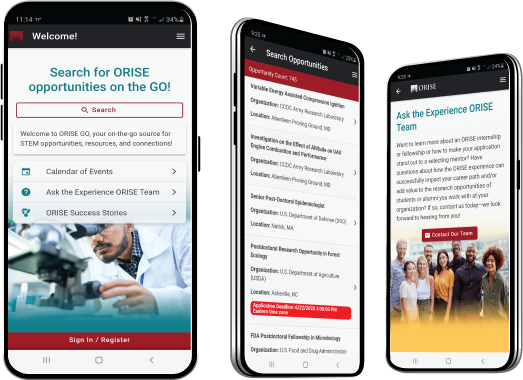
The ORISE GO mobile app helps you stay engaged, connected and informed during your ORISE experience – from application, to offer, through your appointment and even as an ORISE alum!