

EPA Fellowship in Protection and Restoration of Great Lakes Ecosystem Health
- An application
- Transcript(s) – For this opportunity, an unofficial transcript or copy of the student academic records printed by the applicant or by academic advisors from internal institution systems may be submitted. All transcripts must be in English or include an official English translation. Click here for detailed information about acceptable transcripts.
- A current resume/CV, including academic history, employment history, relevant experiences, and publication list
- Two educational or professional recommendations.
*Applications may be reviewed on a rolling-basis and this posting could close before the deadline.
EPA Office/Lab and Location: Four research opportunities are available at the Environmental Protection Agency (EPA) Great Lakes National Program Office (GLNPO) located in Chicago, Illinois.
GLNPO brings together federal, state, tribal, local, and industry partners under the strategic framework of the Great Lakes Restoration Initiative (GLRI) to accomplish the objectives of the GLRI Action Plan IV, working to accelerate environmental progress in five Focus Areas: 1) Toxic Substances and Areas of Concern; 2) Invasive Species; 3) Nonpoint Source Pollution; 4) Habitats and Species; 5) Foundations for Future Restoration Actions.
Restoring U.S. Great Lakes Areas of Concern (AOCs) is one of the top priorities of the GLRI. EPA GLNPO and other federal and state agencies are working to restore the 23 remaining U.S. AOCs in the Great Lakes basin. Cleaning up Great Lakes AOCs involves implementing projects to address Beneficial Use Impairments (BUIs)., which include contaminated sediment remediation, habitat restoration, beach health improvements, local and state-wide AOC BUI studies/analyses, and other actions. Once actions have been taken to clean up and restore sites, verification monitoring is conducted to determine whether restoration goals have been achieved. Ensuring that EPA uses environmental data to support its decisions is critical to both effective implementation of those projects and effective reporting on progress.
EPA GLNPO conducts surveys of water quality and biology within each of the five Great Lakes aboard the R/V Lake Guardian to fulfill EPA's statutory obligation in Clean Water Act Section 118(c)(B) to establish a Great Lakes system-wide surveillance network to monitor the water quality of the Great Lakes. For information about the Great Lakes Monitoring programs, visit: https://www.epa.gov/great-lakes-monitoring.
Research Project:
Under the guidance of a mentor, participants may be involved in the following research projects:
1. Great Lakes Monitoring Program Projects – 2 participants
Great Lakes Monitoring Program Support: Performing statistical data analysis and data visualization activities in support of GLNPO’s seven long-term Great Lakes monitoring programs, as well as developing content for manuscripts, presentations, and other materials to communicate technical topics to the public.
Great Lakes Indicator Reporting: Identifying sources of environmental data, analysis of environmental data, and preparation of web content and reports.
Supporting Great Lakes data collection activities aboard the EPA R/V Lake Guardian: Participating on surveys of water quality and biology within each of the five Great Lakes aboard the 180’ EPA Research Vessel (R/V) Lake Guardian. Water samples are collected and analyzed for nutrients and standard limnological parameters. Phytoplankton, zooplankton and benthic samples are collected and analyzed to assess the status of lower food web health. Participation requires living onboard the R/V Lake Guardian up to several weeks on any or all of the Great Lakes, as well as physical abilities and stamina required to conduct field activities (walking, stooping, lifting, bending, and climbing).
Participants will be encouraged to identify opportunities to use R-scripts and AI to increase efficiencies in data analysis and reporting.
Learning Objectives: You will gain hands-on experience in activities that include, but not limited to: 1) Statistical analysis of environmental data; 2) Performing data visualization activities in support of monitoring programs; 3) Developing content/materials to communicate technical information to the public; 4) Assisting with special studies, as directed; 5) Supporting data collection activities aboard the EPA R/V Lake Guardian.
2. U.S. Areas of Concern Project – 1 participant
Supporting Remediation and Restoration of Areas of Concern (AOC): The participant will learn about the U.S. Areas of Concern (AOC) and help with assessing and reporting on various aspects of the AOC program, including: management action lists, BUI removals, reports to Congress and domestic reporting on program progress, website updates, and helping plan and execute the Great Lakes AOC Summit. The participant will also learn about the AOC restoration process and will interact with multiple partners within EPA, as well as other federal and state agencies and local community groups in each AOC.
Participants will be encouraged to identify opportunities to use R-scripts and AI to increase efficiencies in AOC environmental data analysis and reporting.
Supporting Great Lakes data collection activities aboard the EPA R/V Lake Guardian: Participating on surveys of water quality and biology within each of the five Great Lakes aboard the 180’ EPA Research Vessel (R/V) Lake Guardian. Water samples are collected and analyzed for nutrients and standard limnological parameters. Phytoplankton, zooplankton and benthic samples are collected and analyzed to assess the status of lower food web health. Participation requires living onboard the R/V Lake Guardian up to several weeks on any or all of the Great Lakes, as well as physical abilities and stamina required to conduct field activities (walking, stooping, lifting, bending, and climbing).
Learning Objectives: You will gain hands-on experience in activities that include, but not limited to: 1) Understanding the AOC delisting and restoration program/process; 2) Assessment and reporting on BUI removals and management action lists; 3) Help with Reports to Congress and other domestic progress reports; 4) Helping plan and execute AOC Cross Agency Partnership Summits; 5) Learning how to interact and coordinate with other Great Lakes partners; 6) Supporting data collection activities aboard the EPA R/V Lake Guardian.
3. Business Operations and Process Automation Project – 1 participant
The participant will collaborate with EPA GLNPO teams of budget analysts, project officers and environmental scientists to help develop and test tools to streamline workflows, customize reports, and create interactive dashboards to assist in analysis and progress reporting of GLRI-funded projects implemented to protect and restore the Great Lakes.
Learning Objectives: You will gain hands-on experience in activities that include, but not limited to: 1) Database management, data analysis and visualization; 2) Learning project management skills; 3) EPA’s automation and AI tool packages; 4) Utilize Microsoft Power Platforms (to include Power BI and Power Apps).
Mentor(s): The mentor for this opportunity is Elizabeth LaPlante (LaPlante.Elizabeth@epa.gov). If you have questions about the nature of the research, please contact the mentor.
Anticipated Appointment Start Date: July 20, 2026. All start dates are approximate and vary depending on numerous factors including applicant availability, EPA security clearance process, etc.
Appointment Length: The appointment will initially be for one year and may be renewed for up to two additional years upon EPA recommendation and subject to availability of funding.
Level of Participation: The appointment is full-time.
Participant Stipend: The participant will receive a monthly stipend commensurate with educational level and experience. A health insurance stipend supplement allowance will be provided.
Citizenship Requirements: This opportunity is available to U.S. Citizens only.
EPA Security Clearance: Completion of a successful background investigation by the Office of Personnel Management (OPM) is required for an applicant to be on-boarded at EPA.
ORISE Information: This program, administered by ORAU through its contract with the U.S. Department of Energy (DOE) to manage the Oak Ridge Institute for Science and Education (ORISE), was established through an interagency agreement between DOE and EPA. Participants do not become employees of EPA, DOE or the program administrator, and there are no employment-related benefits. Proof of health insurance is required for participation in this program. Health insurance can be obtained through ORISE.
ORISE offers all ORISE EPA graduate students and Postdocs a free 5 year membership to the National Postdoctoral Association (NPA).
The successful applicant(s) will be required to comply with Environmental, Safety and Health (ES&H) requirements of the hosting facility.
Questions: Please see the FAQ section of our website. After reading, if you have additional questions about the application process please email ORISE.EPA.Other@orau.org and include the reference code for this opportunity.
The qualified candidate should be currently pursuing or have received a bachelor's, master's, or doctoral degree in one of the relevant fields. Degree must have been received within the past five years or by the anticipated start date.
Ability to participate in occasional travel (duration ranging from a few days up to several weeks at a time) is preferred.
Desired skills/knowledge for all opportunities (*except where indicated):
- Experience in field sampling and laboratory analysis in freshwater and/or marine environments (*Opportunity 1 and 2 only)
- Demonstrated technical writing skills
- Experience communicating technical topics to non-technical audiences
- Independent research experience (e.g., undergraduate or graduate research project)
- Familiarity with ESRI and ArcGIS mapping
- Familiarity with statistical analysis and visualization techniques, including analysis software such as R and/or Python
- Familiarity with Microsoft Power Apps, Power BI, Database Management, Excel, and AI and Automation (*Opportunity 3 only)
- Ability to collaborate simultaneously and effectively on multiple projects and areas of interest; detail oriented.
- Citizenship: U.S. Citizen Only
- Degree: Bachelor's Degree, Master's Degree, or Doctoral Degree received within the last 60 months or currently pursuing.
-
Discipline(s):
- Chemistry and Materials Sciences (3 )
- Communications and Graphics Design (1 )
- Computer, Information, and Data Sciences (10 )
- Earth and Geosciences (5 )
- Engineering (2 )
- Environmental and Marine Sciences (10 )
- Life Health and Medical Sciences (4 )
- Mathematics and Statistics (7 )
- Other Non-Science & Engineering (1 )
- Social and Behavioral Sciences (2 )
- Age: Must be 18 years of age

 ORISE GO
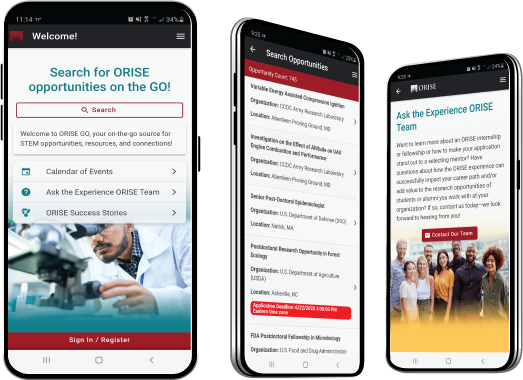
The ORISE GO mobile app helps you stay engaged, connected and informed during your ORISE experience – from application, to offer, through your appointment and even as an ORISE alum!