

EPA Quantifying the Impact of Chemical Exposure on the Thyroid System of Developing Amphibians
To submit your application, scroll to the bottom of this opportunity and click APPLY.
A complete application consists of:
- An application
- Transcripts – Click here for detailed information about acceptable transcripts
- A current resume/CV, including academic history, employment history, relevant experiences, and publication list
- Two educational or professional recommendations. Your application will be considered incomplete, and will not be reviewed until one recommendation is submitted.
All documents must be in English or include an official English translation.
Connect with ORISE...on the GO! Download the new ORISE GO mobile app in the Apple App Store or Google Play Store to help you stay engaged, connected, and informed during your ORISE experience and beyond!
*Applications may be reviewed on a rolling-basis and this posting could close before the deadline.
EPA Office/Lab and Location: A research opportunity is currently available at the Environmental Protection Agency (EPA), Office of Chemical Safety and Pollution Prevention (OCSPP), Great Lakes Coastal Environmental Science Laboratory located in Duluth, Minnesota.
The mission of EPA is to protect human health and the environment. EPA works to ensure that: Americans have clean air, land and water; National efforts to reduce environmental risks are based on the best available scientific information; Federal laws protecting human health and the environment are administered and enforced fairly, effectively and as Congress intended; Environmental stewardship is integral to U.S. policies concerning natural resources, human health, economic growth, energy, transportation, agriculture, industry, and international trade, and these factors are similarly considered in establishing environmental policy; All parts of society have access to accurate information sufficient to effectively participate in managing human health and environmental risks; Contaminated lands and toxic sites are cleaned up; and chemicals in the marketplace are reviewed for safety.
Research Project: The US EPA is mandated to address the endocrine disrupting potential of thousands of chemicals. For the majority of these chemicals there is a lack of information regarding whether they have the potential to cause adverse effects from impacts on thyroid hormone status. Understanding the important targets within the network of processes involved in maintaining normal functioning thyroid hormone levels, and what approaches to best assess activity at those targets are critical to developing a comprehensive approach to evaluating thyroid hormone disrupting potential of large numbers of chemicals.
Recently, a number of thyroid-related in vitro high-throughput screening (HTS) assays have been developed to broaden assay coverage for molecular targets potentially leading to thyroid disruption and were implemented to screen US EPA’s ToxCast Phase 1, 2 and E1K chemical libraries. This battery of thyroid-related in vitro HTS assays can be employed to rapidly assess potential interference with these targets. However, this screening approach leaves uncertainties regarding the meaning of in vitro activity data as it relates to in vivo adverse outcomes. Part of this research effort aims to develop a translational process that integrates relevant information, models, and data streams to provide richer context to interpret in vitro results related to thyroid disruption. As part of the translational process, this research opportunity will focus on the development of a bio-assay to quantitative monitor thyroid hormone synthesis as a complimentary assay to existing in vitro thyroid-related assays. Assay development will be followed by the analysis of canonical and suspected thyroid disrupting chemicals to understand whether, or how, in vitro activity of chemicals translates to in vivo outcomes. Additionally, this research will employ existing computational tools such as the octanol-water partition coefficient (logKow) and quantitative structure-activity relationships (QSAR) models to provide deeper interpretation of in vitro data and further prioritize chemicals most likely to impact thyroid function in aquatic systems. The translational principles employed will have much broader applicability across ToxCast HTS assays and aquatic vertebrates.
With guidance from the mentor, you may be involved in any or all of the following training activities:
- Analyzing gene expression using real-time polymerase chain reaction and developing novel primers, probes, and standards for gene expression analyses.
- Developing high-throughput techniques for collection, batch processing, and analysis of biofluid and tissue samples suitable for molecular, biochemical, and/or histological analyses.
- Conducting aquatic toxicology experiment using flow-through exposure systems.
- Developing and evaluating exposure strategies suitable for methodologically-challenging chemicals such as highly non-polar substances (e.g., high octanol-water partitioning coefficients), volatile chemicals, reactive chemicals, etc.
- Performing quality assurance and quality control of experimental data and processes.
- Processing and analyzing large, high content, data sets using both existing and novel computational pipelines.
- Analyzing experimental data and generating tables, figures, and other summaries of results.
- Conducting statistical analyses including the use of hypothesis testing, regression-based approaches, multi-variate statistics, concordance analyses, etc.
- Presenting research results at scientific meetings and participating in written reports and journal articles.
Learning Objectives: You will join and learn from a transdisciplinary research team engaged in multiple aspects of project planning, communication, research implementation, and analysis. You will have the opportunity to interact with internationally recognized leaders, both within and outside EPA.
During this appointment, you will:
- Learn how to participate in and/or publish original research.
- Learn a breadth of laboratory, analytical, and computational techniques which can be applied across life sciences research fields.
- Learn to operate and use a range of scientific equipment.
- Learn to evaluate data quality, trouble shoot research results, apply statistical methods for data analysis and interpretation.
Mentor(s): The mentor for this opportunity is Sigmund Degitz (Degitz.Sigmund@epa.gov). If you have questions about the nature of the research please contact the mentor.
Anticipated Appointment Start Date: September 2026. All start dates are flexible and vary depending on numerous factors.
Appointment Length: The appointment will initially be for one year, and may be renewed three to four additional years upon EPA recommendation and subject to availability of funding.
Level of Participation: The appointment is full time.
Participant Stipend: The participant will receive a monthly stipend commensurate with educational level and experience.
Citizenship Requirements: This opportunity is available to U.S. citizens and Lawful Permanent Residents (LPR) only.
EPA Security Clearance: Completion of a successful background investigation by the Office of Personnel Management (OPM) is required for an applicant to be on-boarded at EPA.
ORISE Information: This program, administered by ORAU through its contract with the U.S. Department of Energy (DOE) to manage the Oak Ridge Institute for Science and Education (ORISE), was established through an interagency agreement between DOE and EPA. Participants do not become employees of EPA, DOE or the program administrator, and there are no employment-related benefits. Proof of health insurance is required for participation in this program. Health insurance can be obtained through ORISE.
ORISE offers all ORISE EPA graduate students and Postdocs a free 5 year membership to the National Postdoctoral Association (NPA).
The successful applicant(s) will be required to comply with Environmental, Safety and Health (ES&H) requirements of the hosting facility.
Questions: Please see the FAQ section of our website. If you have additional questions about the application process please email ORISE.EPA.Other@orau.org and include the reference code for this opportunity.
The qualified candidate should have received a master's or bachelor's degree in one of the relevant fields (Toxicology, Biochemistry, Biology or related sub-disciplines like molecular biology, fisheries biology, computational biology). Candidates with a bachelor's degree may be considered if they can demonstrate strong laboratory experience. Degree must have been received within the past 5 years.
Preferred Skills:
- Experience conducting bioassays at the in vitro and in vivo.
- Previous experience with aquatic organisms such as fish and amphibians.
- Experience with basic molecular biology techniques used for analysis of proteins and nucleic acids (e.g., gel electrophoresis, PCR, quantitative real-time PCR, use of thermocyclers and/or bioanalyzers, DNA sequencer etc.)
- Previous research experience, beyond lab-oriented coursework alone.
- Previous experience writing peer reviewed journal articles.
- Previous experience with science communication to a diversity of technical and non-technical audiences.
- Computational skills (e.g., programming, R-based statistics)
- Previous experience engaging with omics data and/or high throughput data sets such as those from EPA's ToxCast program.
- Citizenship: LPR or U.S. Citizen
- Degree: Bachelor's Degree or Master's Degree received within the last 60 month(s).
- Discipline(s):

 ORISE GO
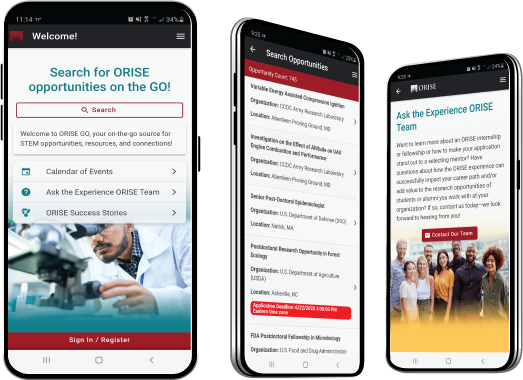
The ORISE GO mobile app helps you stay engaged, connected and informed during your ORISE experience – from application, to offer, through your appointment and even as an ORISE alum!