

EPA Fellowship Regarding Biologically Active Drinking Water Filtration
-
An application
-
Transcript(s) – For this opportunity, an unofficial transcript or copy of the student academic records printed by the applicant or by academic advisors from internal institution systems may be submitted. All transcripts must be in English or include an official English translation. Click here for detailed information about acceptable transcripts.
-
A current resume/CV, including academic history, employment history, relevant experiences, and publication list
-
Two educational or professional recommendations. Click here for detailed information about recommendations.
*Applications may be reviewed on a rolling-basis and this posting could close before the deadline. Click here for information about the selection process.
EPA Office/Lab and Location: A research opportunity is available at the Environmental Protection Agency (EPA), Office of Research and Development (ORD), Center for Environmental Solutions and Emergency Response (CESER), Water Infrastructure Division (WID) located in Cincinnati, Ohio.
- Preparation of Quality Assurance Project Plans and Standard Operating Procedures for biologically active filtration and microbiological analysis which includes basic knowledge of microbiological techniques, molecular analysis, and bioinformatics tools
- Nucleic acid extraction of processed samples using in-house developed protocols and/or commercially available kits
- Characterization of microbial community using molecular techniques (e.g., qPCR and sequencing)
- Basic Laboratory Practice
- Participating in relevant meetings and communications between researchers and stakeholders
- Understanding how to develop and test biological treatment setup for water treatment
- Learning the conditions that enhance the treatment efficacy of biologically active filtration in drinking water treatment application
- Learning about microbial populations of filter media through the treatment process
- Understanding the use of microbiological analysis tools
- Advancing the research participant’s knowledge in project management and scientific communication
Mentor(s): The mentor for this opportunity is Hodon Ryu (ryu.hodon@epa.gov). If you have questions about the nature of the research please contact the mentor(s).
Anticipated Appointment Start Date: September 12, 2022. All start dates are flexible and vary depending on numerous factors. Click here for detailed information about start dates.
Appointment Length: The appointment will initially be for one year and may be renewed three to four additional years upon EPA recommendation and subject to availability of funding.
Level of Participation: The appointment is full-time.
Participant Stipend: The participant will receive a monthly stipend commensurate with educational level and experience. Click here for detailed information about full-time stipends.
EPA Security Clearance: Completion of a successful background investigation by the Office of Personnel Management (OPM) is required for an applicant to be on-boarded at EPA.
ORISE Information: This program, administered by ORAU through its contract with the U.S. Department of Energy (DOE) to manage the Oak Ridge Institute for Science and Education (ORISE), was established through an interagency agreement between DOE and EPA. Participants do not become employees of EPA, DOE or the program administrator, and there are no employment-related benefits. Proof of health insurance is required for participation in this program. Health insurance can be obtained through ORISE.
ORISE offers all ORISE EPA graduate students and Postdocs a free 5 year membership to the National Postdoctoral Association (NPA).
The successful applicant(s) will be required to comply with Environmental, Safety and Health (ES&H) requirements of the hosting facility, including but not limited to, COVID-19 requirements (e.g. facial covering, physical distancing, testing, vaccination).
Questions: Please see the FAQ section of our website. After reading, if you have additional questions about the application process please email ORISE.EPA.ORD@orau.org and include the reference code for this opportunity.
The qualified candidate should have received a doctoral degree in one of the relevant fields (e.g. Environmental Engineering). Degree must have been received within five years of the appointment start date.
- At least one year of biological filtration study and research experience related to pilot-scale column setup.
- Coursework and lab work related to biological/environmental engineering principles or related fields
- Basic knowledge of microbiological techniques, molecular biology research, including nucleic acid extraction, PCR, RT-PCR, gel
electrophoresis, and sequencing - Ability to analyze data using statistical analyses and bioinformatics: R and QIIME.

 ORISE GO
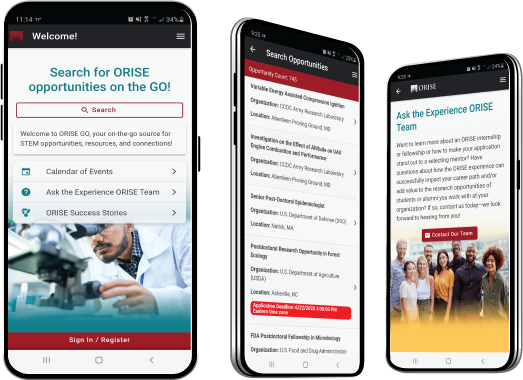
The ORISE GO mobile app helps you stay engaged, connected and informed during your ORISE experience – from application, to offer, through your appointment and even as an ORISE alum!