

EPA Predicting Toxicity Outcomes Fellowship
-
An application
-
Transcript(s) – For this opportunity, an unofficial transcript or copy of the student academic records printed by the applicant or by academic advisors from internal institution systems may be submitted. All transcripts must be in English or include an official English translation. Click here for detailed information about acceptable transcripts.
-
A current resume/CV, including academic history, employment history, relevant experiences, and publication list
-
Two educational or professional recommendations. Click here for detailed information about recommendations.
*Applications may be reviewed on a rolling-basis and this posting could close before the deadline. Click here for information about the selection process.
EPA Office/Lab and Location: A research opportunity is available at the Environmental Protection Agency (EPA), Office of Research and Development (ORD), Center for Computational Toxicology and Exposure (CCTE), Chemical Characterization & Exposure Division (CCED) located in Research Triangle Park, North Carolina.
Research Project: The EPA Center for Computational Toxicology & Exposure (CCTE) provides scientific leadership for New Approach Methodologies (NAMs) and innovative in vivo models to evaluate human health and ecological hazards as well as computational and advanced analytical chemistry approaches for characterizing exposure. The Center's research integrates advances in biology, biotechnology, chemistry, statistics, and computer modeling to advance chemical safety. This research project aims to exploit cheminformatics approaches to assess the ToxCast/Tox21 chemical library coverage of putative reactivity and toxicity mechanistic space as captured by Adverse Outcome Pathways (AOPs), (Quantitative) Structure Activity Relationships ((Q)SARs) for toxicity and biotransformation such as available within commercially and publicly available expert systems and knowledge-bases. The insights will be used to augment development of objective read-across approaches to predict toxicity outcomes that can be applied for risk assessment purposes.
The research participant will be a part of a multidisciplinary research team including scientists at EPA and other partners. Participant learning activities will include: (1) generating and evaluating QSAR/structural alert predictions for chemical inventories; (2) assisting in the development of mechanistically informed chemical groupings to facilitate read-across; (3) assisting in the development of prototype tools for data visualization and predictive models and (4) assisting CCTE researchers and collaborators in the application of read-across models to diverse research projects. The participant will be assisted to develop new read-across predictive models and prototype tools for read-across.
Learning Objectives: In the course this project, research findings will be disseminated and communicated through web-based dashboards, work-in-progress seminars, peer-reviewed publications, and national meetings of professional societies. The participant will be involved in highly visible predictive toxicology efforts as part of the computational toxicology research projects and will be engaged with researchers world-wide. The participant may be published in peer-reviewed journals and present research results at local and national meetings. The participant will gain education in the general areas of computational toxicology, data analysis and data management in preparation for future graduate studies.
Mentor(s): The mentor for this opportunity is Grace Patlewicz (patlewicz.grace@epa.gov). If you have questions about the nature of the research please contact the mentor(s).
Anticipated Appointment Start Date: Winter 2020/2021. All start dates are flexible and vary depending on numerous factors. Click here for detailed information about start dates.
Appointment Length: The appointment will initially be for one year and may be renewed up to three to four additional years upon EPA recommendation and subject to availability of funding.
Level of Participation: The appointment is full-time.
Participant Stipend: The participant will receive a monthly stipend commensurate with educational level and experience. Click here for detailed information about full-time stipends.
EPA Security Clearance: Completion of a successful background investigation by the Office of Personnel Management (OPM) is required for an applicant to be on-boarded at EPA.
ORISE Information: This program, administered by ORAU through its contract with the U.S. Department of Energy (DOE) to manage the Oak Ridge Institute for Science and Education (ORISE), was established through an interagency agreement between DOE and EPA. Participants do not become employees of EPA, DOE or the program administrator, and there are no employment-related benefits. Proof of health insurance is required for participation in this program. Health insurance can be obtained through ORISE.
Questions: Please see the FAQ section of our website. After reading, if you have additional questions about the application process please email EPArpp@orau.org and include the reference code for this opportunity.
The qualified candidate should have received a master's or doctoral degree in one of the relevant fields, or be currently pursuing the degree with completion by the anticipated appointment start date. Degree must have been received within five years of the appointment start date.
- Experience in interpreting scientific data
- Skill and experience in oral and written communication
- Proficiency with the Python or R programming language for scientific computing, including: development, revision, and release of packages for public use
- Familiarity in developing graphical user interfaces using JavaScript frameworks and using RESTful web-services
- Citizenship: U.S. Citizen Only
- Degree: Master's Degree or Doctoral Degree received within the last 60 months or anticipated to be received by 12/21/2020 11:59:00 PM.
- Discipline(s):
- Veteran Status: Veterans Preference, degree received within the last 120 month(s).

 ORISE GO
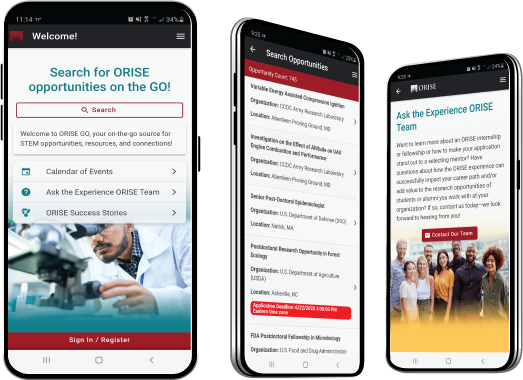
The ORISE GO mobile app helps you stay engaged, connected and informed during your ORISE experience – from application, to offer, through your appointment and even as an ORISE alum!