

EPA Fellowship in Environmental Economics
To submit your application, scroll to the bottom of this opportunity and click APPLY.
A complete application consists of:
- An application
- Transcripts – Click here for detailed information about acceptable transcripts
- A current resume/CV, including academic history, employment history, relevant experiences, and publication list
- Two educational or professional recommendations. Your application will be considered incomplete, and will not be reviewed until one recommendation is submitted.
All documents must be in English or include an official English translation.
Connect with ORISE...on the GO! Download the new ORISE GO mobile app in the Apple App Store or Google Play Store to help you stay engaged, connected, and informed during your ORISE experience and beyond!
*Applications may be reviewed on a rolling-basis and this posting could close before the deadline.
EPA Office/Lab and Location: A research training opportunity is currently available at the U.S. Environmental Protection Agency’s (EPA) National Center for Environmental Economics Division in the Office of Policy and Regulatory Management, located at the EPA Headquarters in Washington, D.C.
The mission of EPA is to protect human health and the environment. EPA works to ensure that: Americans have clean air, land and water; National efforts to reduce environmental risks are based on the best available scientific information; Federal laws protecting human health and the environment are administered and enforced fairly, effectively and as Congress intended; Environmental stewardship is integral to U.S. policies concerning natural resources, human health, economic growth, energy, transportation, agriculture, industry, and international trade, and these factors are similarly considered in establishing environmental policy; All parts of society have access to accurate information sufficient to effectively participate in managing human health and environmental risks; Contaminated lands and toxic sites are cleaned up; and chemicals in the marketplace are reviewed for safety.
Pillars of EPA’s work include Clean Air, Land, and Water for Every American; Restoring American Energy Dominance; and Protecting and Bringing Back American Auto Jobs. EPA's National Center for Environmental Economics (NCEE) specializes in analyzing the costs, benefits, and economic impacts of environmental regulations and policies that advance these pillars. Economists at NCEE assist the Agency in applying sound economic science to important policy decisions. NCEE is recognized for pursuing new research to develop improved methods for measuring the economic consequences of environmental policies, consistent with legal and Executive Order requirements for analysis. Visit https://www.epa.gov/environmental-economics to learn more about NCEE's work.
Research Project: The participant will have the opportunity to collaborate with NCEE’s team of economists on research projects that advance the agency’s ability to conduct analysis on the costs, benefits, and economic impacts of environmental policies and programs, as required by key environmental and regulatory process laws (e.g., Clean Air Act, Clean Water Act, Toxic Substances Control Act, Unfunded Mandates Reform Act) and Executive Orders. The participant will engage on one or more projects drawn from those described below, with the opportunity to engage in additional research projects of mutual interest during the course of the appointment.
1. The EPA seeks to improve its capacity to account for the economic impacts of environmental policies and programs, including its ability to estimate the full cost of regulations and their impact on Americans’ cost of living. These efforts may include data collection and statistical analysis to examine the economy-wide impacts of compliance costs borne by specific sectors, such as electricity and oil and gas, using EPA’s computable general equilibrium modeling framework and other economic modeling tools estimate household economic impacts.
2. The EPA also seeks to improve its capacity to evaluate the impact of regulations of labor market outcomes (e.g., demand for employment, shifts in occupations, changes in wages). The participant will help develop peer-reviewed methods and datasets to quantify changes in employment and/or wages within different sectors of the economy as a result of regulatory and deregulatory actions. This may include an examination of geographic or occupational reallocation of jobs across the U.S. or transitional costs for displaced workers.
3. Evaluation of EPA programs is a requirement under the Foundations for Evidence-Based Policymaking Act of 2018. A different research project may involve supporting EPA in researching the effectiveness of EPA grant programs at improving human health and the environment. EPA grants programs are an important investment in environmental protection and human health, and the Agency seeks to understand the return on that investment and ensure it is being a good steward of American tax dollars. This research can help the EPA better understand the tangible outcomes of their grant programs, enabling informed decision-making and improved the public health and environmental protection outcomes per tax dollar spent.
4. Another project will involve improving EPA’s ability to efficiently, consistently, and transparently quantify and monetize the health and ecosystem benefits of environmental regulations. The EPA conducts benefit-cost analysis for all economically significant regulations as required under Executive Order 12866. The participant will have the opportunity to conduct research that will strengthen EPA’s ability to monetize the benefits of changes in environmental quality and to characterize uncertainty in these benefits. The participant may contribute to data collection and statistical modeling to improve models for economic analysis of water quality changes that are designed to increase efficiency and transparency while meeting requirements for economic analysis.
Learning Objectives: Based on the project, the participant may:
- Have the opportunity to learn about and contribute to research and analysis that traces out the impact of environmental regulations in the economy through their effect on market prices and the decisions of firms and households.
- Have the opportunity to learn about and contribute to research and analysis that uses empirical methods to estimate the effect of regulatory and deregulatory actions on key labor market outcomes.
- Have the opportunity to learn about statistical techniques and social return on investment methods and apply them to estimate the environmental and human health outcomes of EPA grants.
- Have the opportunity to learn data collection and statistical modeling to improve models for economic analysis of water quality changes that are designed to increase efficiency and transparency while meeting requirements for economic analysis.
Mentor(s): The mentor for this opportunity is Heather Klemick (klemick.heather@epa.gov). If you have questions about the nature of the research please contact the mentor.
Anticipated Appointment Start Date: August 17, 2026. All start dates are flexible and vary depending on numerous factors.
Appointment Length: The appointment will initially be for one year and may be renewed three to four additional years upon EPA recommendation and subject to availability of funding.
Level of Participation: The appointment is full time.
Participant Stipend: The participant will receive a monthly stipend commensurate with educational level and experience. The anticipated stipend range is $4,848 - $5,930 monthly.
Citizenship Requirements: This opportunity is available to U.S. citizens only.
EPA Security Clearance: Completion of a successful background investigation by the Office of Personnel Management (OPM) is required for an applicant to be on-boarded at EPA.
ORISE Information: This program, administered by ORAU through its contract with the U.S. Department of Energy (DOE) to manage the Oak Ridge Institute for Science and Education (ORISE), was established through an interagency agreement between DOE and EPA. Participants do not become employees of EPA, DOE or the program administrator, and there are no employment-related benefits. Proof of health insurance is required for participation in this program. Health insurance can be obtained through ORISE.
ORISE offers all ORISE EPA graduate students and Postdocs a free 5 year membership to the National Postdoctoral Association (NPA).
The successful applicant(s) will be required to comply with Environmental, Safety and Health (ES&H) requirements of the hosting facility, including but not limited to, COVID-19 requirements (e.g. facial covering, physical distancing, testing, vaccination).
Questions: If you have additional questions about the application process please email ORISE.EPA.Other@orau.org and include the reference code for this opportunity.
The qualified candidate should be currently pursuing or have received a bachelor's or master's degree in the one of the relevant fields (e.g. economics, statistics, or public policy). Degree must have been received within the past five years, or anticipated to be received by 8/17/2026.
Only candidates with multiple courses in economics will be considered.
Preferred skills:
- Solid understanding of microeconomics
- Strong quantitative skills
- Experience using analytic software (e.g., R, Python, STATA, Julia, etc.) and AI tools for data cleaning and management, and statistical analysis
- Citizenship: U.S. Citizen Only
- Degree: Bachelor's Degree or Master's Degree received within the last 60 months or anticipated to be received by 8/17/2026 12:00:00 AM.
- Discipline(s):

 ORISE GO
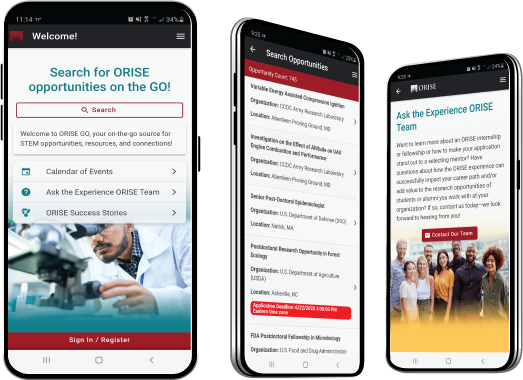
The ORISE GO mobile app helps you stay engaged, connected and informed during your ORISE experience – from application, to offer, through your appointment and even as an ORISE alum!