USGS Biomonitoring of Marine Ecosystems Using Environmental DNA Metabarcoding
To submit your application, scroll to the bottom of this opportunity and click APPLY.
A complete application consists of:
- An application
- Transcript(s) – For this opportunity, an unofficial transcript or copy of the student academic records printed by the applicant or by academic advisors from internal institution systems may be submitted. Click here for detailed information about acceptable transcripts.
- A current resume/CV, including academic history, employment history, relevant experiences, and publication list
- Two educational or professional recommendations. At least one recommendation must be submitted in order for the mentor to view your application.
- A copy of an abstract or reprint of an article
All documents must be in English or include an official English translation.
Connect with ORISE...on the GO! Download the new ORISE GO mobile app in the Apple App Store or Google Play Store to help you stay engaged, connected, and informed during your ORISE experience and beyond!”
*Applications will be reviewed on a rolling-basis.
USGS Office/Lab and Location: A research opportunity is currently available with the U.S. Geological Survey (USGS), Eastern Ecological Science Center at the Leetown Research Laboratory, Kearneysville, West Virginia.
The USGS mission is to monitor, analyze, and predict current and evolving dynamics of complex human and natural Earth-system interactions and to deliver actionable intelligence at scales and timeframes relevant to decision makers. As the Nation's largest water, earth, and biological science and civilian mapping agency, USGS collects, monitors, analyzes, and provides science about natural resource conditions, issues, and problems.
Additional information about research happening at EESC can be found at: Eastern Ecological Science Center | U.S. Geological Survey
Research Project: The USGS Eastern Ecological Science Center is searching for a highly motivated fellow interested in turning high throughput sequencing amplicon datasets generated from environmental DNA (eDNA) collected from various ocean habitats into interpretable biomonitoring data that describe “who is there”, and how these communities differ temporally and spatially.
This fellowship will provide an opportunity to learn how existing bioinformatic pipelines are developed, evaluated, improved, and applied to eDNA datasets from diverse marine environments for analyzing eDNA datasets from ongoing projects in the Gulf of America and the Aleutian Basin, as well as other marine environments as project objectives continue to expand. The general analytical approach is referred to as “eDNA metabarcoding”. Data analysis activities will include processing raw sequencing runs of multiple metabarcoding markers into amplicon sequence variant tables using custom scripts and open-source statistical analyses and visualization software like R. Under the guidance of a mentor, you will gain experience collaborating with federal, academic, and Tribal partners who are interested in integrating eDNA results with other environmental monitoring data. among federal, academic and tribal partners where these groups will be interested in integrating the eDNA results with other monitoring and experimental data collected concurrent with eDNA samples such as water column nutrients, benthic infauna, ocean currents, coral density, etc.
You will have ample opportunity to gain hands-on experience with data that will help address conservation challenges facing marine ecosystems, contribute to peer-reviewed publications, interact with scientists from other USGS science centers as well as other federal agencies, and to build up their bioinformatic capabilities.
Learning Objectives: Under the guidance of a mentor, you will:
- Learn how environmental DNA (eDNA) metabarcoding is used to characterize marine biodiversity and determine how biological communities vary across locations and time.
- Gain experience processing high-throughput sequencing data from marine environmental samples into amplicon sequence variant (ASV) tables.
- Learn to develop and improve bioinformatic pipelines for analyzing eDNA datasets from the Gulf of America, Aleutian Basin, and other marine environments.
- Build skills in custom scripting, open-source bioinformatics tools, statistical analysis, and data visualization in R.
- Learn to integrate eDNA metabarcoding results with complementary ocean-monitoring data, such as nutrient levels, benthic infauna, ocean currents, and coral density.
- Gain experience applying bioinformatic and biomonitoring data to marine-conservation questions and ecosystem-management challenges.
- Strengthen collaborative research and scientific-communication skills with federal, academic, and Tribal partners, USGS scientists, and peer-reviewed publication opportunities.
Mentor: The mentor for this opportunity is Aaron Aunins (aaunins@usgs.gov). If you have questions about the nature of the research please contact the mentor(s).
Anticipated Appointment Start Date: November 9, 2026. Start date is flexible and will depend on a variety of factors.
Appointment Length: The appointment will initially be for one year, but may be renewed upon recommendation of DOI and is contingent on the availability of funds.
Level of Participation: The appointment is full time.
Citizenship Requirements: This opportunity is available to U.S. citizens only.
ORISE Information: This program, administered by ORAU through its contract with the U.S. Department of Energy (DOE) to manage the Oak Ridge Institute for Science and Education (ORISE), was established through an interagency agreement between DOE and USGS. Participants do not become employees of USGS, DOE or the program administrator, and there are no employment-related benefits. Proof of health insurance is required for participation in this program. Health insurance can be obtained through ORISE.
Questions: If you have questions about the application process please email USGS@orau.org and include the reference code for this opportunity.
The qualified candidate should have received a doctoral degree in one of the relevant fields. Degree must have been received within the past four years.
Preferred skills:
- An understanding of the generation eDNA metabarcoding data from field collection of eDNA samples to data produced on the sequencer. While this fellowship will deal primarily with sequence data from already processed samples, complete understanding of this process helps troubleshoot and identify areas for optimization and improvement of results.
- Familiarity with open-source bioinformatic software commonly used for analyzing amplicon/metabarcoding datasets in Linux or Unix based computing environments including both command line software (e.g., bbmap, blastn) and graphical software (fastqc).
- Knowledge of R packages used commonly for metabarcoding and data visualization approaches (e.g., Phyloseq).
- Ability to communicate clearly and frequently with external partners and collaborators.
- Ability to explain complicated technical concepts to a non-technical audience.

 ORISE GO
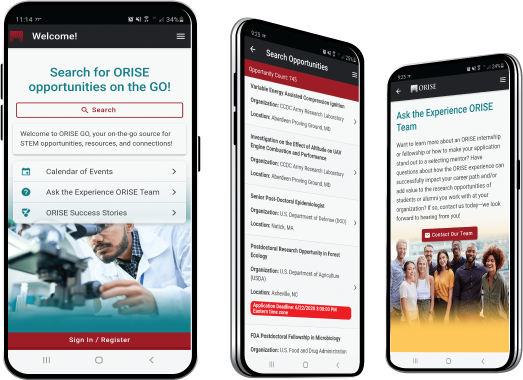
The ORISE GO mobile app helps you stay engaged, connected and informed during your ORISE experience – from application, to offer, through your appointment and even as an ORISE alum!