

USGS The Use of Comprehensive Fish Health Assessments for Invasive Catfish in the Chesapeake Bay Drainage
To submit your application, scroll to the bottom of this opportunity and click APPLY.
A complete application consists of:
- An application
- Transcript(s) – For this opportunity, an unofficial transcript or copy of the student academic records printed by the applicant or by academic advisors from internal institution systems may be submitted. Click here for detailed information about acceptable transcripts.
- A current resume/CV, including academic history, employment history, relevant experiences, and publication list
- Two educational or professional recommendations. At least one recommendation must be submitted in order for the mentor to view your application.
All documents must be in English or include an official English translation.
Connect with ORISE...on the GO! Download the new ORISE GO mobile app in the Apple App Store or Google Play Store to help you stay engaged, connected, and informed during your ORISE experience and beyond!”
*Applications will be reviewed on a rolling-basis.
USGS Office/Lab and Location: A research opportunity is currently available with the U.S. Geological Survey (USGS) located in Kearneysville, West Virginia.
The USGS mission is to monitor, analyze, and predict current and evolving dynamics of complex human and natural Earth-system interactions and to deliver actionable intelligence at scales and timeframes relevant to decision makers. As the Nation's largest water, earth, and biological science and civilian mapping agency, USGS collects, monitors, analyzes, and provides science about natural resource conditions, issues, and problems.
Research Project: Many types of environmental contaminants, individually and in combination, have become ecological and human health concerns. In the Chesapeake Bay drainage, elevated contaminant concentrations in fish can affect recreational, subsistence, and commercial fisheries by creating fish consumption concerns. In recent years, there has also been increased interest in promoting consumption of invasive blue catfish (Ictalurus furcatus), including within state institutions such as hospitals, correctional facilities, and schools. Although mercury and per- and polyfluoroalkyl substances (PFAS) have been measured in fish from select Maryland locations, other contaminants capable of accumulating in blue catfish remain understudied.
This research will use previously collected blue catfish from multiple Chesapeake Bay tributaries to evaluate relationships between contaminant concentrations and fish health endpoints, including visual examinations, morphometrics, histopathology, and gene expression. Plasma will be analyzed for PFAS, and muscle tissue will be analyzed for microplastics, polychlorinated biphenyls (PCBs), 6PPD-quinone (6PPD-Q), and heavy metals. You will receive training in RNA extraction and quality assessment, preparation and evaluation of samples for RNA sequencing, and bioinformatic analysis of transcriptomic data. You will also learn to integrate transcriptomic results with contaminant concentrations and fish health data to evaluate biological responses associated with contaminant exposure.
A complementary component will focus on invasive flathead catfish (Pylodictis olivaris). Flathead catfish are highly prized by some recreational and subsistence anglers, and their large body size has contributed to unauthorized introductions into new waterways for trophy fisheries. Such movement creates questions regarding contaminants and pathogens that may occur in these fish and potentially accompany introductions into additional aquatic systems. Despite these concerns, contaminant concentrations and health endpoints in flathead catfish remain understudied within the Chesapeake Bay drainage.
Flathead catfish will be sampled from approximately three to four locations within the Chesapeake Bay drainage during spring 2027. Fish will undergo comprehensive health assessments comparable to those conducted for blue catfish, and samples will be evaluated for heavy metals, PFAS, PCBs, 6PPD-Q, microplastics, and selected pathogens. You will receive training in field-based fish health assessments, including fish necropsy, blood and tissue collection, tissue preservation and skin swabs for molecular analyses, morphometric measurements, and identification of gross abnormalities. Laboratory experiences will include molecular techniques, histological methods, and histopathological assessment. Sampling will occur collaboratively, providing experience with team-based research and opportunities to interact with scientists and research partners.
The overarching goal is to improve understanding of contaminant exposure and associated biological responses in invasive catfish within the Chesapeake Bay drainage. The blue catfish component will evaluate associations among contaminant concentrations, transcriptomic responses, histopathology, morphometrics, and other indicators of fish health. RNA-sequencing and bioinformatic approaches will be used to identify molecular responses associated with contaminant exposure and observed health effects. The flathead catfish component will characterize contaminant burdens, pathogen occurrence, and fish health endpoints at multiple locations. Comparable assessments across blue and flathead catfish will allow similarities and differences between these invasive species to be examined. Collectively, the research will address data gaps relevant to environmental contaminants, fish health, invasive species ecology, and potential human health concerns associated with fish consumption.
Learning Objectives:
- Develop proficiency in field-based fish health assessments, including necropsy techniques, blood and tissue collection, morphometric measurements, tissue preservation, and identification of gross abnormalities.
- Gain laboratory experience with RNA extraction and quality assessment, preparation and evaluation of samples for RNA sequencing, histological techniques, and fish histopathology.
- Develop bioinformatics skills for processing and interpreting RNA-sequencing data and identifying transcriptomic responses associated with contaminant exposure and fish health endpoints.
- Gain experience analyzing and integrating contaminant, transcriptomic, morphometric, and histopathological datasets using statistical and data-visualization approaches.
- Develop experience interpreting relationships between contaminant exposure and biological responses across molecular, tissue, and organismal levels.
- Strengthen collaborative research and professional communication skills through multidisciplinary field sampling and interactions with scientists and research partners.
- Develop scientific communication skills through data interpretation and visualization, presentation of findings, and preparation of scientific manuscripts.
- Gain experience with the scientific publication process, including the opportunity to lead preparation of a first-author manuscript describing findings from the blue catfish research.
Mentor: The mentor for this opportunity is Heather Walsh (hwalsh@usgs.gov). If you have questions about the nature of the research please contact the mentor(s).
Anticipated Appointment Start Date: November 2, 2026. Start date is flexible and will depend on a variety of factors.
Appointment Length: The appointment will initially be for one year, but may be renewed upon recommendation of DOI and is contingent on the availability of funds.
Level of Participation: The appointment is full time.
Citizenship Requirements: This opportunity is available to U.S. citizens only.
ORISE Information: This program, administered by ORAU through its contract with the U.S. Department of Energy (DOE) to manage the Oak Ridge Institute for Science and Education (ORISE), was established through an interagency agreement between DOE and USGS. Participants do not become employees of USGS, DOE or the program administrator, and there are no employment-related benefits. Proof of health insurance is required for participation in this program. Health insurance can be obtained through ORISE.
Questions: If you have questions about the application process please email USGS@orau.org and include the reference code for this opportunity.
The qualified candidate should have received a doctoral degree in one of the relevant fields.
Preferred skills:
- At least 3 years of experience in the field.

 ORISE GO
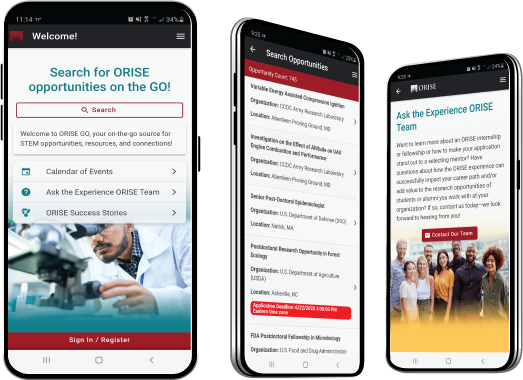
The ORISE GO mobile app helps you stay engaged, connected and informed during your ORISE experience – from application, to offer, through your appointment and even as an ORISE alum!