

USGS Data Science – Geothermal Energy Fellowship
To submit your application, scroll to the bottom of this opportunity and click APPLY.
A complete application consists of:
- An application
- Transcript(s) – For this opportunity, an unofficial transcript or copy of the student academic records printed by the applicant or by academic advisors from internal institution systems may be submitted. Click here for detailed information about acceptable transcripts.
- A current resume/CV, including academic history, employment history, relevant experiences, and publication list
- Two educational or professional recommendations. At least one recommendation must be submitted in order for the mentor to view your application.
All documents must be in English or include an official English translation.
Connect with ORISE...on the GO! Download the new ORISE GO mobile app in the Apple App Store or Google Play Store to help you stay engaged, connected, and informed during your ORISE experience and beyond!”
*Applications will be reviewed on a rolling-basis.
USGS Office/Lab and Location: A research opportunity is currently available with the U.S. Geological Survey (USGS). This opportunity is with the USGS Conventional Geothermal Assessments Task within the Energy Resources Program. Team-members are affiliated with the Geology, Minerals, Energy, and Geophysics Science Center, headquartered at Moffett Field, California, but with offices in each of the advertised locations.
The USGS mission is to monitor, analyze, and predict current and evolving dynamics of complex human and natural Earth-system interactions and to deliver actionable intelligence at scales and timeframes relevant to decision makers. As the Nation's largest water, earth, and biological science and civilian mapping agency, USGS collects, monitors, analyzes, and provides science about natural resource conditions, issues, and problems.
Research Project: Under the guidance of a mentor, you will participate as part of an assessment team learning to compile and analyze spatial datasets using modern data-driven tools (e.g., machine learning) to map and estimate conventional geothermal energy resources for the western United States (includes Alaska and Hawaii). You will have the opportunity to collaborate with a wide range of scientists across the USGS, possibly including geologists, geophysicists, GIS specialists, volcanologists, machine learning experts, and geostatisticians. You will train with a team and will have the opportunity to expand your skills into adjacent and complementary toolkits.
Learning Objectives:
- Learn how conventional geothermal energy resources are identified, mapped, and estimated across the western United States, including Alaska and Hawaii.
- Develop experience compiling, managing, and analyzing large spatial datasets for energy-resource assessment.
- Build practical GIS and geospatial-analysis skills for integrating geologic, geophysical, volcanic, and other relevant datasets.
- Gain exposure to modern data-driven methods, including machine learning and geostatistics, for resource prediction and mapping.
- Learn how interdisciplinary scientific evidence is combined to characterize geothermal potential and uncertainty.
- Develop collaborative research skills with geologists, geophysicists, GIS specialists, volcanologists, machine-learning experts, and geostatisticians across the USGS.
- Expand technical capacity by exploring complementary analytical tools and adjacent scientific disciplines within a team-based research environment.
Mentor: The mentors for this opportunity are Stanley Mordensky (smordensky@usgs.gov), Jake DeAngelo (jdeangelo@usgs.gov), and Erick Burns (eburns@usgs.gov). If you have questions about the nature of the research please contact the mentors.
Anticipated Appointment Start Date: 2026. Start date is flexible and will depend on a variety of factors.
Appointment Length: The appointment will initially be for three months, but may be renewed upon recommendation of DOI and is contingent on the availability of funds.
Level of Participation: The appointment is full time.
Participant Stipend: Stipend rates may vary based on numerous factors, including opportunity, location, education, and experience. The following are the stipend rates for applicants with a doctoral degree. Note that the listed annual stipend range corresponds to the allowable locations (Moffett Field, CA [$134,280]; Denver, CO [$119,756]; Portland, Oregon [$115,729]; Bozeman, MT [$107,446]). If you are interviewed, you can inquire about the exact stipend rate at that time.
Citizenship Requirements: This opportunity is available to U.S. citizens and Lawful Permanent Residents (LPR) only.
ORISE Information: This program, administered by ORAU through its contract with the U.S. Department of Energy (DOE) to manage the Oak Ridge Institute for Science and Education (ORISE), was established through an interagency agreement between DOE and USGS. Participants do not become employees of USGS, DOE or the program administrator, and there are no employment-related benefits. Proof of health insurance is required for participation in this program. Health insurance can be obtained through ORISE.
Questions: If you have questions about the application process please email USGS@orau.org and include the reference code for this opportunity.
The qualified candidate should have received or be currently pursuing a master's or doctoral degree in one of the relevant fields (geoscience, data science, computer science, statistics, geography, engineering, or a related field).
A minimum of holding a master's degree is required, but a doctoral degree is preferred.
Preferred skills:
- The ideal applicant will have experience applying modern data science methods to Earth science or other spatial datasets, with strengths in one or more of the following areas: machine learning; spatial statistics and geostatistics; GIS and geospatial analysis; scientific programming, preferably in Python; data integration and visualization; and quantitative analysis of large or complex datasets.
- Experience with geothermal systems, subsurface geoscience, or natural-resource assessment is preferred.
- Strong quantitative problem-solving, scientific communication, and collaborative research skills are also preferred.

 ORISE GO
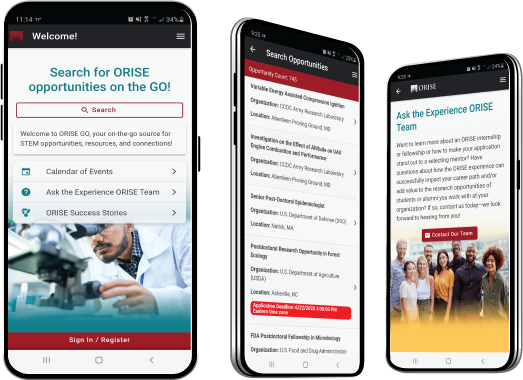
The ORISE GO mobile app helps you stay engaged, connected and informed during your ORISE experience – from application, to offer, through your appointment and even as an ORISE alum!