

USGS National Synthesis of Prescribed Fire under Nonstationarity
To submit your application, scroll to the bottom of this opportunity and click APPLY.
A complete application consists of:
- An application
- Transcript(s) – For this opportunity, an unofficial transcript or copy of the student academic records printed by the applicant or by academic advisors from internal institution systems may be submitted. Click here for detailed information about acceptable transcripts.
- A current resume/CV, including academic history, employment history, relevant experiences, and publication list
- Two educational or professional recommendations. At least one recommendation must be submitted in order for the mentor to view your application.
All documents must be in English or include an official English translation.
Connect with ORISE...on the GO! Download the new ORISE GO mobile app in the Apple App Store or Google Play Store to help you stay engaged, connected, and informed during your ORISE experience and beyond!”
*Applications will be reviewed on a rolling-basis.
USGS Office/Lab and Location: This opportunity is based at the National Climate Adaptation Science Center (NCASC), located at USGS headquarters in Reston, Virginia. Hybrid arrangements are available.
The USGS mission is to monitor, analyze, and predict current and evolving dynamics of complex human and natural Earth-system interactions and to deliver actionable intelligence at scales and timeframes
The National and Regional Climate Adaptation Science Center (NRCASC) Network, based at USGS headquarters in Reston, Virginia, is a partnership-driven program that teams scientific researchers with natural and cultural resource managers and local communities to help fish, wildlife, waters, and lands across the country adapt to changing conditions. The National Climate Adaptation Science Center (NCASC) provides leadership on administration, partnerships, information management, and communications, and conducts research on climate-change impacts to ecosystems, fish, and wildlife at national and multi-regional scales. One of NCASC's primary roles is to convene subject-matter experts on the application of best-available ecological science to pressing land- and ecosystem-management challenges, and to provide synthesis assessments at a national scale relevant to decision makers. As the Nation's largest water, earth, and biological science and civilian mapping agency, USGS collects, monitors, analyzes, and provides science about natural resource conditions, issues, and problems.
Research Project: This project will provide training on the development, implementation, and analysis of a national research initiative to assess barriers and opportunities surrounding the effective use of intentional fire (prescribed fire, cultural burning, and managed wildfire) under non-stationarity. You will gain experience in technical skills, analytical skills, and coordination to advance understanding of current information needs and research priorities for intentional fire in a changing climate; explore the decision and management barriers to its effective use; and synthesize opportunities for effective implementation. Key research and technical activities include:
- Learn about collaborative wildfire science, prescribed fire research, and science-to-management partnerships through participation in a national group involving federal and academic scientists, fire managers, and partners across multiple agencies.
- Gain experience and skills in planning and coordination under mentor guidance, including agenda development, meeting materials, facilitator support, committee activities, and logistical coordination.
- Collaborate on a national assessment focused on barriers and opportunities for prescribed fire implementation under non-stationary environmental conditions while learning how actionable science and decision-theoretic approaches inform management and policy decisions.
- Gain skills through literature review, organization of scientific information, and support for associated data analysis and communication materials, including peer-reviewed publications.
- Gain professional development and mentorship in collaborative research, scientific synthesis, science communication, and the application of science to on-the-ground fire management information needs.
Results of this will inform the future of prescribed fire management by clarifying ecological, social, and governance constraints and identifying decision-informed research opportunities to support resilient ecosystems. There will be additional opportunities for you to collaborate with Regional CASCs on fire-related research projects, as well as to explore other areas with applications to decision-relevant research topics.
Learning Objectives:
- Strengthen expertise in fire science and fire-use decision models. You will gain additional insight and experience applying fire use decision models, multi criteria decision analysis, scenario planning, and other actionable science tools to advance robust decision making in the field of prescribed fire management.
- Strengthen research and synthesis capabilities. Gain hands-on experience applying adaptation menus, decision frameworks, and science-based guidance for land and fire management.
- Gain experience designing a national synthesis assessment of the barriers and opportunities related to the effective use of prescribed fire under climate change.
- Gain experience in scientific facilitation by collaborating on working-group meetings and thematic subgroup sessions.
- Collaboration and communication: Collaborate closely with NCASC science staff and partners and contribute to dissemination of findings to the fire and ecosystem manager community.
Mentor: The mentor for this opportunity is Madeleine Rubenstein (mrubenstein@usgs.gov). If you have questions about the nature of the research please contact the mentor(s).
Anticipated Appointment Start Date: September 1, 2026. Start date is flexible and will depend on a variety of factors.
Appointment Length: The appointment will initially be for one year, but may be renewed upon recommendation of DOI and is contingent on the availability of funds.
Level of Participation: The appointment is full time.
Participant Stipend: Stipend rates may vary based on numerous factors, including opportunity, location, education, and experience. If you are interviewed, you can inquire about the exact stipend rate at that time and if selected, your appointment offer will include the monthly stipend rate.
Citizenship Requirements: This opportunity is available to U.S. citizens only.
ORISE Information: This program, administered by ORAU through its contract with the U.S. Department of Energy (DOE) to manage the Oak Ridge Institute for Science and Education (ORISE), was established through an interagency agreement between DOE and USGS. Participants do not become employees of USGS, DOE or the program administrator, and there are no employment-related benefits. Proof of health insurance is required for participation in this program. Health insurance can be obtained through ORISE.
Questions: If you have questions about the application process please email USGS@orau.org and include the reference code for this opportunity.
The qualified candidate should be currently pursuing or have received a master's or doctoral degree in the one of the relevant fields (ecology, fire science, environmental science, geography, natural resource management, environmental policy, or a closely related field).
Preference is for doctoral, however candidates with a master’s degree and relevant experience may also be considered if their background strongly aligns with the opportunity.
Preferred skills:
- Experience with fire ecology and fire-management concepts, including topics such as uncertainty and non-stationarity in ecological systems.
- Experience applying tools of decision analysis and structured decision making to complex natural resource management concepts, including translating technical concepts to management planning and decisions and experience conducting synthesis research assessments and translating scientific findings for policy or management.
- Fluency conducting spatial or ecological analysis using R, Python, GIS, or similar tools.
- Knowledge of the pressing issues in fire science and ecosystem management, including baseline knowledge of ecology and the effects of climate change on ecosystem management.
- Highly motivated self-starter with demonstrated ability to act independently and well as part of a collaborative team, including experience convening and facilitating collaborative groups.
- Strong scientific writing and communication skills.
- Citizenship: U.S. Citizen Only
- Degree: Master's Degree or Doctoral Degree.
- Discipline(s):

 ORISE GO
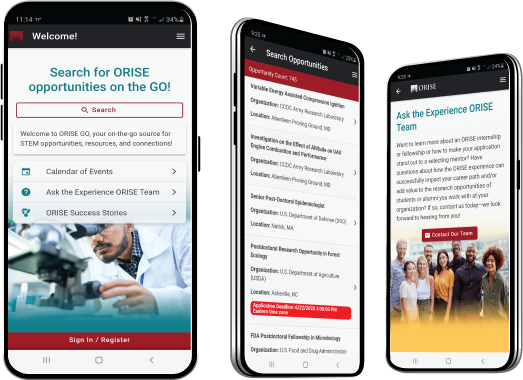
The ORISE GO mobile app helps you stay engaged, connected and informed during your ORISE experience – from application, to offer, through your appointment and even as an ORISE alum!