

USGS Assessing Transcriptomic Effects of Chemical and Biological Stressors on Wildlife
To submit your application, scroll to the bottom of this opportunity and click APPLY.
A complete application consists of:
- An application
- Transcript(s) – For this opportunity, an unofficial transcript or copy of the student academic records printed by the applicant or by academic advisors from internal institution systems may be submitted. Click here for detailed information about acceptable transcripts.
- A current resume/CV, including academic history, employment history, relevant experiences, and publication list
- Two educational or professional recommendations. At least one recommendation must be submitted in order for the mentor to view your application.
All documents must be in English or include an official English translation.
Connect with ORISE...on the GO! Download the new ORISE GO mobile app in the Apple App Store or Google Play Store to help you stay engaged, connected, and informed during your ORISE experience and beyond!”
*Applications will be reviewed on a rolling-basis.
USGS Office/Lab and Location: A research opportunity is currently available with the U.S. Geological Survey (USGS) located in Laurel, Maryland.
The USGS mission is to monitor, analyze, and predict current and evolving dynamics of complex human and natural Earth-system interactions and to deliver actionable intelligence at scales and timeframes relevant to decision makers. As the Nation's largest water, earth, and biological science and civilian mapping agency, USGS collects, monitors, analyzes, and provides science about natural resource conditions, issues, and problems.
Research Project: Exposure to chemical and biological stressors can profoundly influence organismal health by reshaping gene regulation at the cellular level. This project investigates how contaminants such as PFAS and pesticides, along with environmental hazards like algal toxins, alter host transcriptomic profiles. By integrating high-resolution molecular analyses with environmental context, the study aims to identify disrupted pathways, characterize early indicators of physiological stress, and improve our understanding of mechanistic links between contaminant exposure and adverse outcomes. The research will also advance our understanding of the interplay between host and microbial genomics/transcriptomics and responses to contaminant exposure. This fellowship will facilitate interpretation of these data to train to inform science-based natural resource management by Federal, Tribal and State agencies, including the Department of War (DOW), US Fish and Wildlife Service, and US Department of Agriculture (APHIS).
Learning Objectives: This fellowship offers a unique opportunity to practice your skills in bioinformatics and develop new skills for analysis of transcriptomic and metatranscriptomic data sets collected from multiple avian species exposed to chemical (e.g. PFAS, pesticides) and/or biological/environmental (e.g. algal toxins) stressors under controlled and field conditions. Under the guidance of two mentors, you will gain experience with state-of-the-art 'omics' technologies to train to integrate field, lab, and computational datasets to address questions in wildlife toxicology and ecosystem health.
Mentor: The mentor for this opportunity is Natalie Karouna-Renier (nkarouna@usgs.gov). If you have questions about the nature of the research please contact the mentor(s).
Anticipated Appointment Start Date: August 3, 2026. Start date is flexible and will depend on a variety of factors.
Appointment Length: The appointment will initially be for one year, but may be renewed upon recommendation of DOI and is contingent on the availability of funds.
Level of Participation: The appointment is full time.
Participant Stipend: Stipend rates may vary based on numerous factors, including opportunity, location, education, and experience. If you are interviewed, you can inquire about the exact stipend rate at that time and if selected, your appointment offer will include the monthly stipend rate. The anticipated stipend is $8,535 monthly.
Citizenship Requirements: This opportunity is available to U.S. citizens and Lawful Permanent Residents (LPR) only.
ORISE Information: This program, administered by ORAU through its contract with the U.S. Department of Energy (DOE) to manage the Oak Ridge Institute for Science and Education (ORISE), was established through an interagency agreement between DOE and USGS. Participants do not become employees of USGS, DOE or the program administrator, and there are no employment-related benefits. Proof of health insurance is required for participation in this program. Health insurance can be obtained through ORISE.
Questions: If you have questions about the application process please email USGS@orau.org and include the reference code for this opportunity.
The qualified candidate should be currently pursuing or have received a master's or doctoral degree in the one of the relevant fields.
Preferred skills:
- A background in toxicology and bioinformatics is desired

 ORISE GO
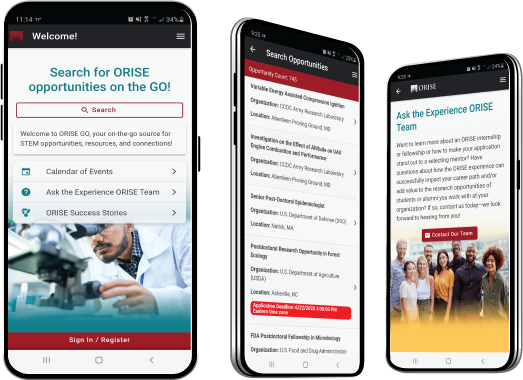
The ORISE GO mobile app helps you stay engaged, connected and informed during your ORISE experience – from application, to offer, through your appointment and even as an ORISE alum!