

USGS Postdoctoral Wildlife Health Research Fellowship
To submit your application, scroll to the bottom of this opportunity and click APPLY.
A complete application consists of:
- An application
- Transcript(s) – For this opportunity, an unofficial transcript or copy of the student academic records printed by the applicant or by academic advisors from internal institution systems may be submitted. Click here for detailed information about acceptable transcripts.
- A current resume/CV, including academic history, employment history, relevant experiences, and publication list
- Two educational or professional recommendations. At least one recommendation must be submitted in order for the mentor to view your application.
- A copy of an abstract or reprint of an article
All documents must be in English or include an official English translation.
Connect with ORISE...on the GO! Download the new ORISE GO mobile app in the Apple App Store or Google Play Store to help you stay engaged, connected, and informed during your ORISE experience and beyond!”
*Applications will be reviewed on a rolling-basis and this posting could close before the deadline listed.
USGS Office/Lab and Location: A research opportunity is currently available with the U.S. Geological Survey (USGS) located in Bozeman, Montana.
The USGS mission is to monitor, analyze, and predict current and evolving dynamics of complex human and natural Earth-system interactions and to deliver actionable intelligence at scales and timeframes relevant to decision makers. As the Nation's largest water, earth, and biological science and civilian mapping agency, USGS collects, monitors, analyzes, and provides science about natural resource conditions, issues, and problems.
Scientists at the Northern Rocky Mountain Science Center (NOROCK) in Bozeman, Montana conduct research on five general research themes: 1) Biosurveillance of Biological Threats, 2) Wildlife Disease, 3) Fisheries and Water Resources, 4) Wildlife and Terrestrial Habitat, and 5) Cryosphere Science.
Research Project: USGS collaborates with National Park Service, US Fish and Wildlife Service, US Forest Service and State wildlife agencies on disease issues at the wildlife and livestock interface around the Greater Yellowstone Region. The current focus of the wildlife disease team is on chronic wasting disease (CWD) in deer and elk, supplemental feeding grounds, bison, and climate interactions with epizootic hemorrhagic disease virus (EHDV). Many of the projects combine field data collection with quantitative statistical and modeling analyses and are collaborations with natural resource managers, veterinarians, and academics. You will learn to develop and conduct research on wildlife disease impacts in ungulates around the Greater Yellowstone Ecosystem.
Mentor: The mentor for this opportunity is Paul Cross (pcross@usgs.gov). If you have questions about the nature of the research please contact the mentor(s).
Anticipated Appointment Start Date: September 15, 2026. Start date is flexible and will depend on a variety of factors.
Appointment Length: The appointment will initially be for two years, but may be renewed upon recommendation of DOI and is contingent on the availability of funds.
Level of Participation: The appointment is full time.
Participant Stipend: Stipend rates may vary based on numerous factors, including opportunity, location, education, and experience. If you are interviewed, you can inquire about the exact stipend rate at that time and if selected, your appointment offer will include the monthly stipend rate. The anticipated stipend range is $74,000 - $89,500 annually.
Citizenship Requirements:
ORISE Information: This program, administered by ORAU through its contract with the U.S. Department of Energy (DOE) to manage the Oak Ridge Institute for Science and Education (ORISE), was established through an interagency agreement between DOE and USGS. Participants do not become employees of USGS, DOE or the program administrator, and there are no employment-related benefits. Proof of health insurance is required for participation in this program. Health insurance can be obtained through ORISE.
Questions: If you have questions about the application process please email USGS@orau.org and include the reference code for this opportunity.
The qualified candidate should have received a doctoral degree in one of the relevant fields. Degree must have been received within the past four years.
Preferred skills:
- Research experience within the fields of wildlife ecology and/or infectious disease dynamics outside of a lab setting and collaborating with management agencies.
- Previous experience organizing spatial data, animal tracking data, publishing scientific papers, using ArcPro, R programming, statistical analysis and ecological field research is also preferred.
- Analyzing animal movement/GPS-collar data, collaborating with natural resource agencies on wildlife management issues, analyzing disease surveillance data, and publishing peer-reviewed articles

 ORISE GO
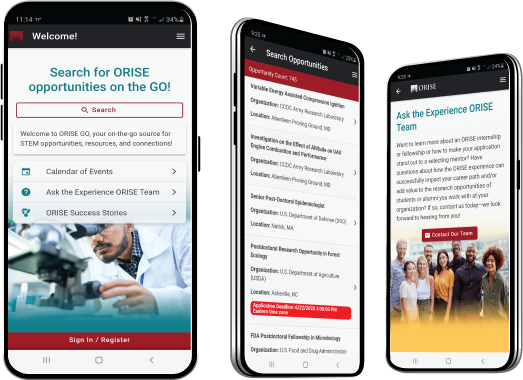
The ORISE GO mobile app helps you stay engaged, connected and informed during your ORISE experience – from application, to offer, through your appointment and even as an ORISE alum!