

USGS Using eDNA to Monitor Wildlife Communities Associated with the Presence of Zoonotic Viral Pathogens
To submit your application, scroll to the bottom of this opportunity and click APPLY.
A complete application consists of:
- An application
- Transcript(s) – For this opportunity, an unofficial transcript or copy of the student academic records printed by the applicant or by academic advisors from internal institution systems may be submitted. Click here for detailed information about acceptable transcripts.
- A current resume/CV, including academic history, employment history, relevant experiences, and publication list
- Two educational or professional recommendations.
All documents must be in English or include an official English translation.
Connect with ORISE...on the GO! Download the new ORISE GO mobile app in the Apple App Store or Google Play Store to help you stay engaged, connected, and informed during your ORISE experience and beyond!”
*Applications will be reviewed on a rolling-basis.
USGS Office/Lab and Location: A research opportunity is currently available with the U.S. Geological Survey (USGS) located in Lansing, Michigan.
The USGS mission is to monitor, analyze, and predict current and evolving dynamics of complex human and natural Earth-system interactions and to deliver actionable intelligence at scales and timeframes relevant to decision makers. As the Nation's largest water, earth, and biological science and civilian mapping agency, USGS collects, monitors, analyzes, and provides science about natural resource conditions, issues, and problems.
Research Project: USGS scientists are assembling a field and laboratory-based toolbox to improve the detection of zoonotic viral pathogens in the environment (i.e. surface water and air). Zoonotic viruses are naturally spread from wildlife and livestock to humans and can lead to outbreaks and occasionally global pandemics. USGS’s toolbox aims to improve environmental surveillance for these viruses and associated host environmental DNA (eDNA) facilitating timely communication for early warning and improved response strategies. Incorporation and use of wildlife eDNA molecular markers with viral surveillance will provide valuable information for phylogenetic analysis and species identification of wildlife contributing to or at risk from the viral outbreak. Results will inform how wildlife migration and movement influence spread of viruses and disease, help identify susceptible wildlife species, and improve risk modelling for shared environmental corridors used by wildlife, livestock, and humans. You will have the opportunity to review scientific literature to identify genetic markers based on target wildlife species’ genome and then test the specificity of those genetic markers for the target species.
You will gain experience in laboratory testing with genetic markers against known target species DNA to determine assay limit of detection, sensitivity, and accuracy. Next, you will test the developed assay with environmental samples to assess detection and inhibition. Collaborating with the project team, you will test how environmental variables (i.e. water temperature, pH) and time influences detection and persistence of eDNA markers in environmental samples. Under the guidance of a mentor you will have the opportunity to draft a standard operating protocol and present project results.
Learning Objectives: You will train with a USGS team focused on environmental surveillance and research engaged in developing and applying solutions for an ongoing viral outbreak with real-world economic, health, and environmental implications. You will gain experience in field sampling protocols, laboratory analysis, and data interpretation. You will gain experience in a Federal environmental microbiology research laboratory gaining experience developing molecular detection of host eDNA from surface water and air. You will be encouraged to present project results and collaborate on scientific information products (papers, presentations) resulting from theproject. You will network with an interdisciplinary group of USGS scientists allowing the opportunity to learn more about USGS science and methods, and gain valuable research experience.
Mentor: The mentor for this opportunity is Carrie Givens (cgivens@usgs.gov). If you have questions about the nature of the research please contact the mentor(s).
Anticipated Appointment Start Date: June 15, 2026. Start date is flexible and will depend on a variety of factors.
Appointment Length: The appointment will initially be for 10 weeks, but may be renewed upon recommendation of DOI and is contingent on the availability of funds.
Level of Participation: The appointment is full time.
Participant Stipend: Stipend rates may vary based on numerous factors, including opportunity, location, education, and experience. If you are interviewed, you can inquire about the exact stipend rate at that time and if selected, your appointment offer will include the monthly stipend rate.
Citizenship Requirements: This opportunity is available to U.S. citizens, Lawful Permanent Residents (LPR), and foreign nationals. Non-U.S. citizen applicants should refer to the Guidelines for Non-U.S. Citizens Details page of the program website for information about the valid immigration statuses that are acceptable for program participation.
ORISE Information: This program, administered by ORAU through its contract with the U.S. Department of Energy (DOE) to manage the Oak Ridge Institute for Science and Education (ORISE), was established through an interagency agreement between DOE and USGS. Participants do not become employees of USGS, DOE or the program administrator, and there are no employment-related benefits. Proof of health insurance is required for participation in this program. Health insurance can be obtained through ORISE.
Questions: If you have questions about the application process please email USGS@orau.org and include the reference code for this opportunity.
The qualified candidate should be currently pursuing or have received a bachelor's or master's degree in the one of the relevant fields. Degree must have been received within the past four years, or anticipated to be received by 6/1/2029.
- Degree: Bachelor's Degree or Master's Degree received within the last 48 months or anticipated to be received by 6/1/2029 12:00:00 AM.
-
Discipline(s):
- Chemistry and Materials Sciences (12 )
- Communications and Graphics Design (2 )
- Computer, Information, and Data Sciences (17 )
- Earth and Geosciences (21 )
- Engineering (29 )
- Environmental and Marine Sciences (14 )
- Life Health and Medical Sciences (51 )
- Mathematics and Statistics (11 )
- Physics (16 )
- Science & Engineering-related (2 )
- Social and Behavioral Sciences (29 )

 ORISE GO
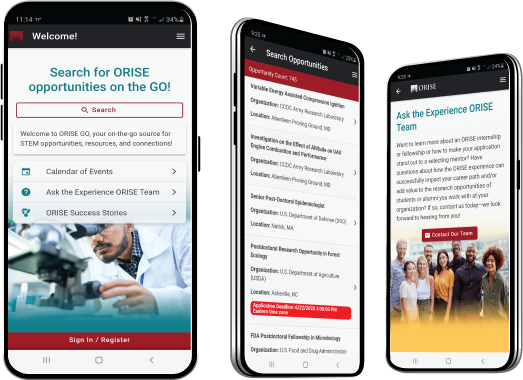
The ORISE GO mobile app helps you stay engaged, connected and informed during your ORISE experience – from application, to offer, through your appointment and even as an ORISE alum!