

USGS Developing New, Sustainable Control Strategies for an Invasive Wetland Grass (Phragmites australis)
To submit your application, scroll to the bottom of this opportunity and click APPLY.
A complete application consists of:
- An application
- Transcript(s) – For this opportunity, an unofficial transcript or copy of the student academic records printed by the applicant or by academic advisors from internal institution systems may be submitted. Click here for detailed information about acceptable transcripts.
- A current resume/CV, including academic history, employment history, relevant experiences, and publication list
- Two educational or professional recommendations.
All documents must be in English or include an official English translation.
Connect with ORISE...on the GO! Download the new ORISE GO mobile app in the Apple App Store or Google Play Store to help you stay engaged, connected, and informed during your ORISE experience and beyond!”
*Applications will be reviewed on a rolling-basis.
USGS Office/Lab and Location: A research opportunity is currently available with the U.S. Geological Survey (USGS) located in Ann Arbor, Michigan.
The USGS mission is to monitor, analyze, and predict current and evolving dynamics of complex human and natural Earth-system interactions and to deliver actionable intelligence at scales and timeframes relevant to decision makers. As the Nation's largest water, earth, and biological science and civilian mapping agency, USGS collects, monitors, analyzes, and provides science about natural resource conditions, issues, and problems.
Research Project: Control of invasive plant species is important to preserve native habitats and is a high priority for many land management agencies. The non-native Phragmites australis (common reed) is an aggressive invader of high-quality wetlands and lakeshores and a major nuisance species along roadsides and public access areas. Conventional treatment approaches such as burning, manipulating water levels, mowing, and herbicides are expensive, not species-specific, and generally not effective long-term. Therefore, the development of novel management strategies is of significant value and interest to land managers across North America. The USGS Great Lakes Science Center (GLSC) is developing more sustainable control mechanisms for non-native Phragmites and other invasive aquatic species. Scientists are currently testing:
- Alterations to the microbial communities that occur in and around invasive plants and;
- Species-specific molecular approaches (e.g., RNA interference) to control the most aggressive traits of Phragmites and Hydrocharis morsus-ranae (European Frog-bit, EFB).
Additionally, GLSC researchers are exploring the impact of changing climate and the effects it may have on the distribution of Phragmites, EFB, and culturally important native plant species. This supports the objectives of the Great Lakes Fishery Research Reauthorization Act 2025 and is responsive to multiple goals and priorities identified in DOI’s 2026-2030 draft Strategic Plan.
The successful candidate will train on on-going projects advancing new control strategies for non-native Phragmites, EFB, and other invasive plants. Specifically learning to:
- Develop and characterize novel, low-toxicity strategies for management of invasive wetland plants
- Identify and test manipulable genetic pathways to decrease Phragmites and EFB invasion success
- Describe the influence of invasive species on wetland structure and function
- Explore the impacts of fluctuating water levels on Phragmites’ growth and possible relevance to invasion management
Microbial manipulation experiment:
- Collaborate closely with USGS scientists, contractors, and partners to plan and deploy field experiments exploring novel invasive plant treatments targeting plant-microbe symbioses, metabolic pathways, and plant growth performance,
- Collaborate with team members to develop and implement standardized field methods,
- Collaborate on preparation and application of potential treatments,
- Monitor health and growth of Phragmites and competing plant species over the duration of experiments,
- Harvest and process plants at conclusion of field studies,
- Prepare plant matter for final analyses (e.g., clean, dry, weigh),
- Analyze field data as part of a collaborative team, and;
- Prepare findings for poster and/or internal presentation for GLSC and partners (as time allows).
General greenhouse and growth chamber operations / maintenance:
- Grow plants from seeds, rhizomes, stems, or turions to supply current control experiments, and;
- Maintain basic greenhouse operation including overall plant care, watering, pruning, and basic greenhouse maintenance.
Exploring genetic pathways:
- Collaborate with USGS and U.S. Army Corps of Engineer scientists to develop new treatments targeting the molecular processes that drive Phragmites and EFB performance. Specifically, help plan and implement field experiments exploring the effects of novel species-specific biopesticides.
This collaborative project will yield insights into alternative, innovative invasive species management strategies for the land management community within and beyond the Great Lakes basin.
Learning Objectives: Through this mentored research experience at the Great Lakes Science Center, you will gain hands-on training in invasive plant ecology by contributing to field, greenhouse, and laboratory studies focused on developing innovative, low-toxicity management strategies for non-native species such as Phragmites. You will build skills in experimental design, field data collection, plant propagation and maintenance, data management and analysis, and collaborative research with federal scientists and partners. Regular interactions with USGS mentors and participation in team and center-wide meetings will provide exposure to partner-focused federal science and resource management applications. The opportunity to contribute to a poster or presentation will further strengthen your scientific communication and professional development.
Mentor: The mentor for this opportunity is Kurt Kowalski (kkowalski@usgs.gov). If you have questions about the nature of the research please contact the mentor(s).
Anticipated Appointment Start Date: June 15, 2026. Start date is flexible and will depend on a variety of factors.
Appointment Length: The appointment will initially be for 10 weeks, but may be renewed upon recommendation of DOI and is contingent on the availability of funds.
Level of Participation: The appointment is full time.
Participant Stipend: Stipend rates may vary based on numerous factors, including opportunity, location, education, and experience. If you are interviewed, you can inquire about the exact stipend rate at that time and if selected, your appointment offer will include the monthly stipend rate.
Citizenship Requirements: This opportunity is available to U.S. citizens, Lawful Permanent Residents (LPR), and foreign nationals. Non-U.S. citizen applicants should refer to the Guidelines for Non-U.S. Citizens Details page of the program website for information about the valid immigration statuses that are acceptable for program participation.
ORISE Information: This program, administered by ORAU through its contract with the U.S. Department of Energy (DOE) to manage the Oak Ridge Institute for Science and Education (ORISE), was established through an interagency agreement between DOE and USGS. Participants do not become employees of USGS, DOE or the program administrator, and there are no employment-related benefits. Proof of health insurance is required for participation in this program. Health insurance can be obtained through ORISE.
Questions: If you have questions about the application process please email USGS@orau.org and include the reference code for this opportunity.
The qualified candidate should be currently pursuing or have received a bachelor's or master's degree in the one of the relevant fields. Degree must have been received within the past four years, or anticipated to be received by 6/1/2029.
- Degree: Bachelor's Degree or Master's Degree received within the last 40 months or anticipated to be received by 6/1/2029 12:00:00 AM.
-
Discipline(s):
- Chemistry and Materials Sciences (12 )
- Communications and Graphics Design (2 )
- Computer, Information, and Data Sciences (17 )
- Earth and Geosciences (21 )
- Engineering (28 )
- Environmental and Marine Sciences (14 )
- Life Health and Medical Sciences (49 )
- Mathematics and Statistics (11 )
- Physics (16 )
- Science & Engineering-related (2 )

 ORISE GO
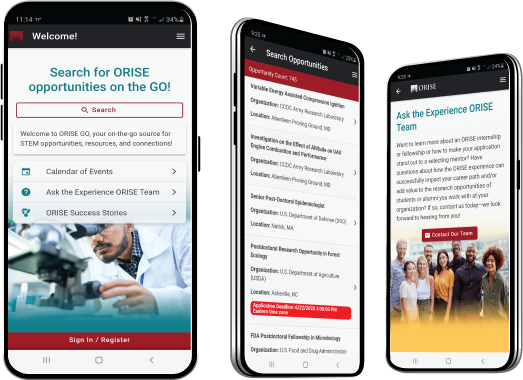
The ORISE GO mobile app helps you stay engaged, connected and informed during your ORISE experience – from application, to offer, through your appointment and even as an ORISE alum!