DOE Energy Water Resource Science, Technology, and Policy Fellow
Click the Apply button below
The U.S. Department of Energy (DOE) catalyzes the transformative growth of basic and applied scientific research and the discovery and development of new energy technologies, and prioritizes scientific innovation as a cornerstone of U.S. economic prosperity. DOE is the leading federal agency for the advancement of energy technologies through research, development, demonstration, and commercial application (RDD&CA) activities. The Office of Critical Minerals and Energy Innovation (CMEI) leads a large network of National Laboratories, researchers, industry partners, and communities across the nation to develop and deploy innovative technologies that deliver affordable, reliable, and secure energy. This fellowship is located in CMEI’s Hydropower and Hydrokinetic Office (H2O) in Washington, DC. H2O is committed to developing and deploying a portfolio of innovative technologies for power generation from water resources, including hydropower, waves, and tides. H2O drives critical research and development efforts to expand electricity generation from these resources and, through its Energy-Water Resources (EWR) program, to strengthen the resilience and efficiency of the nation’s interdependent energy and water systems.
- Seek to better understand EWR program and office strategies
- Learn about funding processes, including grants, National Laboratory agreements, prizes, and other partnerships
- Meet with other DOE offices, federal agencies, National Laboratories, and other sectors/stakeholders, including NEWS partner agencies
- Research and analyze communication of EWR program outcomes and impact
- Participate in and report back on conferences and literature relating to the energywater nexus, desalination and alternative water sources, and/or other relevant topics
- Research and inform publications such as white papers, government reports, briefing materials, or stakeholder outreach materials related to energy-water resources
- Review grant/funding proposals and projects
- Contribute ideas in strategy meetings, including planning for regional energy-water technology pilots
- Engage in interagency coordination activities, including meeting preparation and briefing materials
- Connect with fellows in other DOE offices, and at other agencies
- Proactively identify and coordinate participation in office activities of interest to the fellow
Nature of Appointment
The Science, Technology, and Policy (STP) Fellowships are administered by Oak Ridge Institute for Science and Education (ORISE). The participant will not enter into an employee/employer relationship with ORISE, the Oak Ridge Associated Universities, DOE, or any other office or agency. Instead, the participant will be affiliated with ORISE for the administration of the appointment through the ORISE letter of appointment and terms of appointment. The initial appointment period will be for one year, with the possibility to extend the appointment for additional years at the discretion of the mentor and sponsoring office.
Candidates should have received a doctoral degree in a relevant science, engineering, economics, or policy discipline or be currently pursuing the degree with completion before the appointment start date.
- Policy Analysis
- Program Management
- Strategic Planning
- Modeling and Simulation
- Monitoring & Evaluation
- Water Quality Analysis
- Water resources and environmental engineering
- Hydrology and watershed science
- Agricultural and irrigation engineering
- Desalination and membrane science
- Water reuse
- Water quality and public health
- Power/energy systems
- Techno-economic analysis
- Life cycle assessment
- Data science and visualization
- Economics
- Program evaluation
- Risk analysis and decision science,
- Water and energy law and policy
How to Apply
A complete application consists of:
- A Zintellect profile and responses to opportunity-specific questions
- Note: Applicants must submit a personal statement detailing their interests and qualifications. The statement should be original; use AI tools only for grammar or basic feedback.
- Academic Records/Transcript(s) - For this opportunity, an unofficial transcript or copy of the student academic records printed by the applicant or by academic advisors from internal institution systems may be submitted. Selected candidates may be required to provide proof of completion of the degree before the appointment can start.
- A current resume/curriculum vitae (CV)
- One Recommendation - Applicants are required to provide contact information for one recommender to submit the application. You are encouraged to request a recommendation from professionals who can speak to your abilities and potential for success, as well as your scientific capabilities and personal characteristics. Recommenders will be asked to complete a recommendation in Zintellect. Recommendation requests must be sent through the Zintellect application system. Letters of recommendation submitted via email will not be accepted.
All documents must be submitted via Zintellect in order to be considered and must be in English or include an official English translation. Submitted documents must have all social security numbers, student identification numbers, and/or dates of birth removed (blanked out, blackened out, made illegible, etc.) prior to uploading into the application system.
The resume/CV must include the following:
- Basic applicant Information: Name, address, phone, email, and other contact information.
- Work and Research Experience: List all relevant work and research experiences beginning with current or most recent. Include the name of the employer, location, position held, and time period involved.
- Leadership Experience: List experiences (e.g., work, civic, volunteer, research) that demonstrate your leadership skills. Detail your role, type of experience, organization, location, and duration.
- Educational History: List all institutions from which you received or expect to receive a degree, beginning with current or most recent institution. Include the name of the academic institution, degree awarded or expected, date of awarded or expected degree, and academic discipline.
- Honors & Awards: List in chronological order (most recent first) any awards or public recognitions. Include the name of awarding institution, title of the award or honor, and date of award or honor.
If you have questions, please send an email to DOE-STP@orise.orau.gov and list the reference code [DOE-STP-CMEI-H2O-EWR] in the subject line of your email.
Expected Review of Applications:
Applications will be accepted until all fellowship opportunities have been filled.
- Degree: Doctoral Degree.
-
Discipline(s):
- Business (11 )
- Chemistry and Materials Sciences (12 )
- Communications and Graphics Design (6 )
- Computer, Information, and Data Sciences (17 )
- Earth and Geosciences (21 )
- Engineering (29 )
- Environmental and Marine Sciences (14 )
- Life Health and Medical Sciences (51 )
- Mathematics and Statistics (11 )
- Other Non-Science & Engineering (13 )
- Physics (16 )
- Science & Engineering-related (2 )
- Social and Behavioral Sciences (30 )
- Age: Must be 18 years of age

 ORISE GO
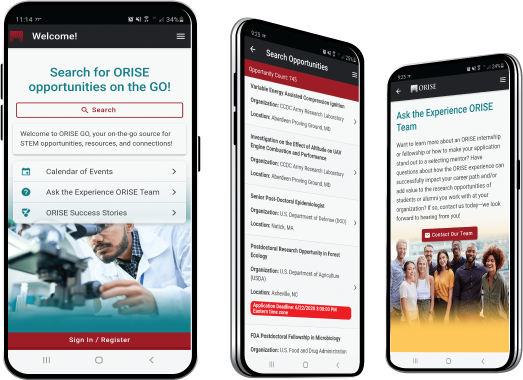
The ORISE GO mobile app helps you stay engaged, connected and informed during your ORISE experience – from application, to offer, through your appointment and even as an ORISE alum!