

Research Fellow - CDC
A complete application consists of:
- An application
- Transcripts – Click here for detailed information about acceptable transcripts
- A current resume/CV, including academic history, employment history, relevant experiences, and publication list
- Two educational or professional references
All documents must be in English or include an official English translation.
If you have questions, send an email to CDCrpp@orau.org. Please include the reference code for this opportunity in your email.
A fellowship opportunity is available within the Division of Applied Research and Technology (DART) located in the National Institute for Occupational Safety and Health (NIOSH) of the Centers for Disease Control and Prevention (CDC). DART provides national and international leadership in research focused on the prevention of occupational illness and injury by developing and evaluating: methods and tools to identify and quantify workplace hazards (chemical, physical, organizational); and strategies and technologies to control exposures to workplace hazards.
The overarching goal of this fellowship opportunity is assisting in the development, evaluation and implementation of improved measurement methodologies that contribute to the reduction of adverse health effects associated with exposure to hazardous materials in the workplace. The opportunity will involve conducting laboratory and field research to develop and evaluate methods for assessing exposures to compounds of interest. Direct-reading sensors, traditional industrial hygiene sampling, and analytical laboratory methodologies will be investigated in the laboratory and field settings.
The selected participant will be trained in the operation and maintenance of a laboratory vapor generation system for analytical method development research related to the compound peracetic acid (PAA). The learning activities may include, but are not limited to, preparing the system for generating atmospheres containing peracetic acid, injecting chemical mixtures into the system, ensuring the temperature and humidity are at the correct levels, ensuring the system is maintaining a constant concentration during the experiments, and ensuring the analytical instrumentation is operating correctly. The participant will assist with the measurement of chemical concentrations in generated atmospheres using multiple measurement instruments. The participant will assist with designing and carrying out experiments to evaluate the accuracy and precision of multiple techniques and instruments for measuring peracetic acid vapors. The participant will assist with troubleshooting and correcting problems with the vapor generation system and ensure it is operating properly.
The participant will be trained in the operation and maintenance of laboratory analytical instruments, including mass spectrometry (MS) instruments, FTIR spectrometers, direct reading portable gas analyzer instruments and other instrumentation for chemical analysis and measurement typically found in an analytical laboratory setting. The participant will assist in all data analysis.
The participant will be expected to travel with NIOSH employees to field sites and participate in field measurements of occupational exposures to peracetic acid. At least 2 field investigations characterizing potential exposures will be conducted. This includes assisting with on-site exposure assessments of chemical hazards and characterizing potential exposures across a variety of PAA use scenarios. Assessments of chemical hazards will include: environmental sampling and personal breathing zone measurements via direct reading instruments and traditional industrial hygiene sampling methods (sorbent tubes). Sample collection strategies may include both shift- and task-based with the goal of assessing transient short-term exposures, full shift exposures, and measuring ambient air concentrations within and away from areas where chemicals may be used in the course of operational tasks.
The participant will assist with research related to a Closed System Transfer Device (CSTD) leak testing protocol. The participant will evaluate mixtures of compounds to determine their suitability as markers for CSTD leaks. This participant will assist in creating simulated CSTD leaks of these marker compounds in a glove chamber and measuring the leaks via the use of mass spectrometry.
The participant should have experience in communicating research results through written reports and publications.
** Desired Appointment Start Date: June 1, 2018 **
This program, administered by ORAU through its contract with the U.S. Department of Energy to manage the Oak Ridge Institute for Science and Education, was established through an interagency agreement between DOE and CDC. The initial appointment is for one year, but may be renewed upon recommendation of CDC contingent on the availability of funds. The participant will receive a monthly stipend commensurate with educational level and experience. Proof of health insurance is required for participation in this program. The appointment is full-time at CDC in the Cincinnati, Ohio, area. Participants do not become employees of CDC, DOE or the program administrator, and there are no employment-related benefits.
- Ph.D. in Chemistry, Chemical Engineering, or other physical sciences. Although consideration will be given to all physical sciences, preference will be given to applicants with a Ph.D. in Chemistry. Degree must be received prior to start date of appointment.
- Knowledge of common laboratory instruments and techniques i.e. pipetting, balances
- Knowledge of laboratory methods and standard operating procedures
- Knowledge of gas chromatographs, liquid chromatographs and other instruments
- Basic computer skills and understanding of data management
- Knowledge of quality assurance/quality control procedures

 ORISE GO
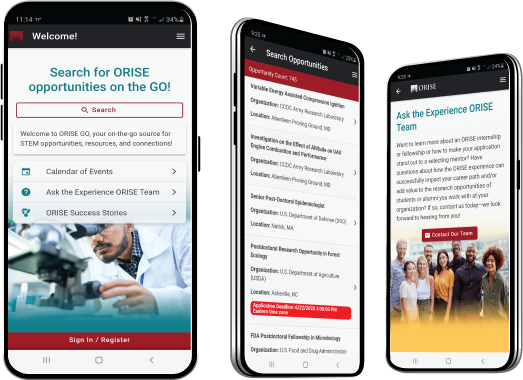
The ORISE GO mobile app helps you stay engaged, connected and informed during your ORISE experience – from application, to offer, through your appointment and even as an ORISE alum!