

CDC EDEB Surveillance Epidemiology Fellowship
Connect with ORISE...on the GO! Download the new ORISE GO mobile app in the Apple App Store or Google Play Store to help you stay engaged, connected, and informed during your ORISE experience and beyond!
- An application
- A current resume/CV, including academic history, employment history, relevant experiences, and publication list
- One educational or professional recommendation. Your application will be considered incomplete, and will not be reviewed until one recommendation is submitted.
All documents must be in English or include an official English translation.
*Applications will be reviewed on a rolling basis.
CDC Office and Location: A research opportunity is available in the Enteric Diseases Epidemiology Branch (EDEB) in the Division of Foodborne, Waterborne, and Environmental Diseases (DFWED) in the National Center for Emerging and Zoonotic Infectious Diseases (NCEZID) at the Centers for Disease Control and Prevention (CDC) located in Atlanta, Georgia.
The Centers for Disease Control and Prevention (CDC) is one of the major operation components of the Department of Health and Human Services. CDC works to protect America from health, safety and security threats, both foreign and in the U.S. Whether diseases start at home or abroad, are chronic or acute, curable or preventable, human error or deliberate attack, CDC fights disease and supports communities and citizens to do the same.
EDEB works with state and local health departments and other federal agencies to conduct surveillance for illness caused by bacterial enteric (intestinal) pathogens in the United States. The branch leads CDC’s epidemiology work in preventing illness caused by these pathogens, by monitoring trends in illness and antimicrobial resistance, tracking and responding to outbreaks, and identifying risk factors for these infections. EDEB staff members track illnesses caused by Clostridium botulinum, Campylobacter, Shiga toxin-producing Escherichia coli, Listeria, Salmonella, Shigella, Vibrio, and Yersinia. EDEB staff routinely collect and analyze surveillance data, present and publish, and collaborate with partners to improve the branch’s nine surveillance systems. EDEB is organized into five Teams: Analytics, Foodborne Disease Active Surveillance Network (FoodNet), National Antimicrobial Resistance Monitoring System (NARMS), National Surveillance Team (NST), and the National Outbreak Reporting System (NORS).
Research Project: The participant will train on the National Surveillance Team (NST). The team collects, analyzes, and disseminates national surveillance data on bacterial enteric illnesses to provide a national snapshot of the occurrence of infections transmitted commonly through food. The participant will communicate with reporting partners, learn to analyze data, participate in meetings within and outside CDC, and contribute to scientific reports. The participant will train closely with people in state health departments and on other teams in the Enteric Diseases Epidemiology Branch (EDEB).
Learning Objectives: Under the guidance of a mentor, the participant will be trained in the following activities:
- Analyze and interpret surveillance data and communicate findings to a variety of audiences through annual summary reports, scientific papers, abstracts, posters, meetings, oral and written presentations to scientific and nonscientific audiences, and calls with state and federal partners.
- Learn to manage a subset of national bacterial enteric disease surveillance data, which include data on illnesses caused by Clostridium botulinum (Botulism), Salmonella serotype Typhi and Paratyphi (Typhoid and Paratyphoid Fever), Vibrio, Listeria, non-typhoidal Salmonella, Shigella, Shiga toxin-producing E. coli, and Campylobacter.
- Participate in outbreak investigations for select bacterial enteric diseases.
- Train with NST team members to update data dictionaries, data collection forms, guidance documents, and training documents, as needed
- Collaborate across teams within CDC and with state and federal partners
- Participate in informatics activities to improve NST data systems (e.g., assist state partners with electronic transmission of data to NST data systems; perform user acceptance testing [UAT]; troubleshoot informatics issues with state, local, and federal partners; assist with data linkage between multiple surveillance systems; train with IT development teams to prioritize and refine data descriptions and criteria), and provide recommendations when needed
- Use software tools to automate reporting and cleaning of data
Mentor(s): The mentor(s) for this opportunity Michael Hughes (wuw8@cdc.gov). If you have questions about the nature of the research, please contact the mentor(s).
Anticipated Appointment Start Date: July 5, 2023. Start date is flexible and will depend on a variety of factors.
Appointment Length: The appointment will initially be for one year, but may be renewed upon recommendation of CDC and is contingent on the availability of funds.
Level of Participation: The appointment is full-time.
Participant Stipend: The participant will receive a monthly stipend commensurate with educational level and experience.
Citizenship Requirements: This opportunity is available to U.S. citizens, Lawful Permanent Residents (LPR), and foreign nationals. Non-U.S. citizen applicants should refer to the Guidelines for Non-U.S. Citizens Details page of the program website for information about the valid immigration statuses that are acceptable for program participation.
ORISE Information: This program, administered by ORAU through its contract with the U.S. Department of Energy (DOE) to manage the Oak Ridge Institute for Science and Education (ORISE), was established through an interagency agreement between DOE and CDC. Participants do not become employees of CDC, DOE or the program administrator, and there are no employment-related benefits. Proof of health insurance is required for participation in this program. Health insurance can be obtained through ORISE.
The successful applicant(s) will be required to comply with Environmental, Safety and Health (ES&H) requirements of the hosting facility, including but not limited to, COVID-19 requirements (e.g. facial covering, physical distancing, testing, vaccination).
Questions: Please visit our Program Website. After reading, if you have additional questions about the application process please email ORISE.CDC.NCEZID@orau.org and include the reference code for this opportunity.
The qualified candidate should have received a master's degree in one of the relevant fields, or be currently pursuing the degree with completion before June 30, 2023. The degree must have been received within five years of the appointment start date.
Interested and qualified applicants would preferably possess the following skills and abilities:
- Experience with data integration and analytics (e.g., R or Python)
- Experience with data management including data cleaning
- Ability to work on projects independently with minimal supervision
- Experience managing relationships among interdisciplinary teams
- Highly organized and attentive to detail
- Ability to identify information gaps/needs and opportunities.
I certify that I have not previously been employed by CDC or by a contractor working directly for CDC. I understand that CDC does not permit individuals with a prior employment relationship with CDC or its contractors to participate as trainees in the ORISE program. (Exceptions may be granted for individuals who, since the previous CDC employment, have obtained a new STEM degree which necessitates training in a new field.)

 ORISE GO
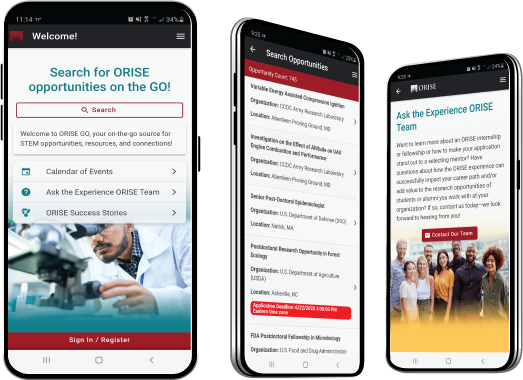
The ORISE GO mobile app helps you stay engaged, connected and informed during your ORISE experience – from application, to offer, through your appointment and even as an ORISE alum!