

CDC Genome Analysis of Elizabethkingia Anophelis Internship
Connect with ORISE...on the GO! Download the new ORISE GO mobile app in the Apple App Store or Google Play Store to help you stay engaged, connected, and informed during your ORISE experience and beyond!
A complete application consists of:
- An application
- Transcripts – Click here for detailed information about acceptable transcripts
- A current resume/CV, including academic history, employment history, relevant experiences, and publication list
- One educational or professional recommendation. Your application will be considered incomplete, and will not be reviewed until one recommendation is submitted.
All documents must be in English or include an official English translation.
If you have questions, send an email to ORISE.CDC.NCEZID@orau.org. Please include the reference code for this opportunity in your email.
*Applications will be reviewed on a rolling-basis.
A research opportunity is currently available with the Bacterial Special Pathogens Branch (BSPB), Division of High Consequence Pathogens and Pathology (DHCPP), at the National Center for Emerging and Zoonotic Infectious Diseases (NCEZID) at the Centers for Disease Control and Prevention (CDC) in Atlanta, Georgia.
The Centers for Disease Control and Prevention (CDC) is one of the major operation components of the Department of Health and Human Services. CDC works to protect America from health, safety and security threats, both foreign and in the U.S. Whether diseases start at home or abroad, are chronic or acute, curable or preventable, human error or deliberate attack, CDC fights disease and supports communities and citizens to do the same.
The Special Bacterial Reference Laboratory (SBRL) has over 200 strains of Elizabethkingia anophelis. Many of the isolates are from clinical infections, with a few environmental strains. They were collected from all around the world and contain samples that date back to the 1960’s. Many of these strains pre-date sequencing technology, and were first identified as Elizabethkingia meningoseptica based on phenotypic chararacteristics. The collection also includes strains involved in several recent E. anophelis outbreaks in the United States. Their genomes have been sequenced using Illumina MiSeq and/or PacBio instruments, and the reads were assembled and uploaded to Genbank.
The strain JM-87 was originally published as the type strain of a novel species Elizabethkingia endophytica, but genome analysis revealed it to belongs to the species E. anophelis, and represents a previously unrecognized subspecies. Preliminary analyses of the genomes in our collection indicate that we do have representatives of the subspecies E. anophelis subsp. endophytica in our collection, which was surprising as the type strain had been isolated from plant surfaces (Zea mays). Under the guidance of a mentor, the participant will use Genome to Genome Distance Calculation (GGDC) to clarify which subspecies each of the strains belongs to, and identify any genes that are specific to subsp. endophytica, with particular focus on virulence factors and contributors to antibiotic resistance. The participant will then perform a comparative genome analysis on the historic collection of E. anophelis by annotating the genomes with Prokka and then using Roary to identify elements of the core genome and any subspecies-specific sets of genes.
Anticipated Appointment Start Date: Fall 2020
This program, administered by ORAU through its contract with the U.S. Department of Energy to manage the Oak Ridge Institute for Science and Education, was established through an interagency agreement between DOE and CDC. The initial appointment can be up to one year, but may be renewed upon recommendation of CDC contingent on the availability of funds. The participant will receive a monthly stipend commensurate with educational level and experience. Proof of health insurance is required for participation in this program. The appointment is part-time (15 hours per week) at CDC in the Atlanta, Georgia, area. Participants do not become employees of CDC, DOE or the program administrator, and there are no employment-related benefits.
The qualified candidate should have received their bachelor's degree in one of the relevant fields, or be currently pursuing their master's degree.
Preferred skills:
- Experience/background in biological sciences
- The ability to identify, learn and apply new methods for genome analysis
- Strong communication skills, both oral and written
- Ability to multi-task efficiently and pay close attention to detail
- Skill in maintaining accurate and detailed records of bioinformatic procedures, dataset versions and results
- Ability to interpret results for quality, validity and scientific meaning
- Ability to present the results in clear and concise form and participate in scientific discussions and planning
- Ability to operate in team-oriented and respectful working environment
- Citizenship: U.S. Citizen Only
- Degree: Bachelor's Degree or Master's Degree received within the last 60 months or currently pursuing.
- Minimum Overall GPA: 4.00
-
Discipline(s):
- Life Health and Medical Sciences (2 )
I have received my bachelor's degree, or I am currently pursuing my master's degree.

 ORISE GO
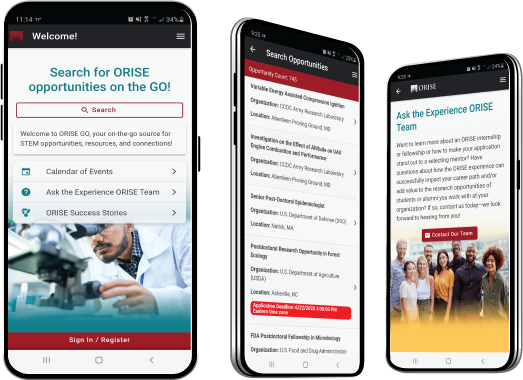
The ORISE GO mobile app helps you stay engaged, connected and informed during your ORISE experience – from application, to offer, through your appointment and even as an ORISE alum!