

CDC Birth Defects Monitoring and Research Branch Fellowship
To submit your application, scroll to the bottom of this opportunity and click APPLY.
A complete application consists of:
- An application
- Transcripts – Click here for detailed information about acceptable transcripts
- A current resume/CV, including academic history, employment history, relevant experiences, and publication list
- One educational or professional recommendation. Your application will be considered incomplete, and will not be reviewed until one recommendation is submitted.
All documents must be in English or include an official English translation.
Connect with ORISE...on the GO! Download the new ORISE GO mobile app in the Apple App Store or Google Play Store to help you stay engaged, connected, and informed during your ORISE experience and beyond!
*Applications will be reviewed on a rolling-basis.
CDC Office and Location: A research opportunity is available in the Birth Defects Monitoring and Research Branch (BDMRB), Division of Birth Defects and Infant Disorders (DBDID) of the National Center on Birth Defects and Developmental Disabilities (NCBDDD) at the Centers for Disease Control and Prevention (CDC) in Atlanta, Georgia. The fellowship is located on the CDC Chamblee Campus, Building 106, 3rd Floor.
The Centers for Disease Control and Prevention (CDC) is one of the major operation components of the Department of Health and Human Services. CDC protects America from health, safety and security threats, both foreign and in the U.S. Whether diseases start at home or abroad, are chronic or acute, curable or preventable, human error or deliberate attack, CDC fights disease and supports communities and citizens to do the same. CDC increases the health security of our nation. As the nation’s health protection agency, CDC saves lives and protects people from health threats. To accomplish its mission, CDC conducts important science and provides health information that protects our nation against expensive and dangerous health threats, and responds when these arise.
The National Center on Birth Defects and Developmental Disabilities (NCBDDD)'s mission is to improve the health of children and adults by preventing birth defects and developmental disabilities, and complications of heredity blood disorders; promoting optimal child development, and the health and wellness among children and adults living with disabilities.
Research Project: Participants under this fellowship opportunity will train within the Birth Defects Monitoring and Research Branch (BDMRB), Division of Birth Defects and Infant Disorders (DBDID) of the National Center on Birth Defects and Developmental Disabilities (NCBDDD) at the Centers for Disease Control and Prevention (CDC) in Atlanta, Georgia. The BDMRB conducts birth defects surveillance and research into the possible causes and long term outcomes of birth defects, and conducts scientific activities related to intervention and prevention research. Training will occur under the direction of an assigned Mentor.
The purpose of this fellowship program is to provide an educational experience to individuals interested in the field of public health and reproductive and birth defects epidemiology. Opportunities are aimed at furthering your health communication science, epidemiological and analytical knowledge. Your training involves some or all of the following:
- Develop skills in conducting literature searches and synthesizing scientific evidence relevant to birth defects, stillbirth, and related public-health topics.
- Gain experience learning how surveillance and research projects are conducted, including case-control studies designed to identify risk factors for birth defects and/or stillbirth.
- Learn to translate scientific research and data into clear, accurate, and accessible public-facing materials.
- Learn about website content development and approaches used to support scientific communication.
- Strengthen proficiency using statistical software, such as SAS, R, or similar tools, to manage, analyze, and summarize data, including large genetic datasets.
- Learn how spina bifida patient registries are organized and analyzed, and gain experience contributing to analytic activities under mentor guidance.
- Gain experience analyzing large administrative healthcare datasets, such as MarketScan.
- Develop skills in linking and analyzing U.S. Census data to support population-based research and public-health analyses.
- Collaborate with clinical-site partners to learn about processes for collecting, organizing, and interpreting medical-record data.
- Build capacity to summarize and present findings for internal and external scientific, public-health, and community audiences.
- Prepare scientific abstracts, manuscripts, posters, presentations, fact sheets, and other materials that communicate research and surveillance findings.
Learning Objectives: You will train on various projects and can expect to gain learning experiences that increase your knowledge of birth defects and other infant disorders; apply systematic approaches to conducting literature reviews; learn data management and data-quality methods; enhance quantitative analytic skills using SAS, R, or similar tools; strengthen written and oral scientific communication abilities through manuscripts and presentations; and build organizational and professional skills.
Mentor(s): The mentor for this opportunity is Jennita Reefhuis (nzr5@cdc.gov), Elizabeth Ailes (eha0@cdc.gov), and Jacqueline Mix (ort1@cdc.gov), with sub-mentor Denise Boggs (cln1@cdc.gov). If you have questions about the nature of the research please contact the mentor(s).
Anticipated Appointment Start Date: November 4, 2026. Start date is flexible and will depend on a variety of factors.
Appointment Length: The appointment will initially be for one year year, but may be renewed upon recommendation of CDC and is contingent on the availability of funds.
Level of Participation: The appointment is full time.
Citizenship Requirements: This opportunity is available to U.S. citizens, Lawful Permanent Residents (LPR), and foreign nationals. Non-U.S. citizen applicants should refer to the Guidelines for Non-U.S. Citizens Details page of the program website for information about the valid immigration statuses that are acceptable for program participation.
ORISE Information: This program, administered by ORAU through its contract with the U.S. Department of Energy (DOE) to manage the Oak Ridge Institute for Science and Education (ORISE), was established through an interagency agreement between DOE and CDC. Participants do not become employees of CDC, DOE or the program administrator, and there are no employment-related benefits. Proof of health insurance is required for participation in this program. Health insurance can be obtained through ORISE.
The successful applicant(s) will be required to comply with Environmental, Safety and Health (ES&H) requirements of the hosting facility.
Questions: Please visit our Program Website. After reading, if you have additional questions about the application process please email CDCrpp@orau.org and include the reference code for this opportunity.
The qualified candidate should be currently pursuing or have received a master's degree in the one of the relevant fields (e.g. Epidemiology or another public health-related field). Degree must have been received within the past five years, or anticipated to be received by 12/31/2026. Preference is on those who have already received their degree.
Preferred skills:
- An interest in maternal and child health;
- A strong quantitative/programming background;
- Excellent written, verbal, and interpersonal skills;
- Background in epidemiology and/or maternal and child health;
- Education or experience analyzing data using SAS, R, Python and/or other statistical software;
- Education or experience conducting analyses in epidemiology, nutritional epidemiology, and/or genetics;
- Experience conducting scientific literature reviews;
- Education or experience producing technical/scientific reports, presentations, and/or manuscripts;
- Excellent written communication skills
- Degree: Master's Degree received within the last 60 months or anticipated to be received by 12/31/2026 12:00:00 AM.
- Discipline(s):
- Age: Must be 18 years of age
I certify that I have not previously been employed by CDC or by a contractor working directly for CDC. I understand that CDC does not permit individuals with a prior employment relationship with CDC or its contractors to participate as trainees in the ORISE program. (Exceptions may be granted for individuals who, since the previous CDC employment, have obtained a new STEM degree which necessitates training in a new field.)

 ORISE GO
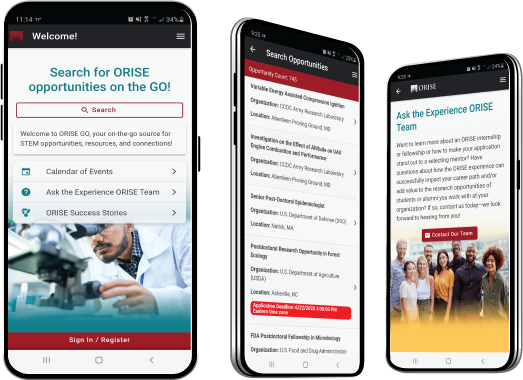
The ORISE GO mobile app helps you stay engaged, connected and informed during your ORISE experience – from application, to offer, through your appointment and even as an ORISE alum!