

CDC Development of Long-Read DNA Sequencing for Newborn Screening Disorders
To submit your application, scroll to the bottom of this opportunity and click APPLY.
A complete application consists of:
- An application
- Transcripts – Click here for detailed information about acceptable transcripts
- A current resume/CV, including academic history, employment history, relevant experiences, and publication list
- One educational or professional recommendation. Your application will be considered incomplete, and will not be reviewed until one recommendation is submitted.
- A copy of an abstract or reprint of an article
All documents must be in English or include an official English translation.
Connect with ORISE...on the GO! Download the new ORISE GO mobile app in the Apple App Store or Google Play Store to help you stay engaged, connected, and informed during your ORISE experience and beyond!
*Applications are reviewed on a rolling-basis and applications may close before the deadline.
CDC Office and Location: A Fellowship opportunity is available in the Newborn Screening and Molecular Biology Branch (NSMBB), Division of Laboratory Sciences (DLS), National Center for Environmental Health (NCEH), at the Centers for Disease Control and Prevention (CDC) in Atlanta, Georgia.
The Centers for Disease Control and Prevention (CDC) is one of the major operation components of the Department of Health and Human Services. CDC protects America from health, safety and security threats, both foreign and in the U.S. Whether diseases start at home or abroad, are chronic or acute, curable or preventable, human error or deliberate attack, CDC fights disease and supports communities and citizens to do the same. CDC increases the health security of our nation. As the nation’s health protection agency, CDC saves lives and protects people from health threats. To accomplish its mission, CDC conducts important science and provides health information that protects our nation against expensive and dangerous health threats, and responds when these arise.
The MQIP laboratory supports newborn screening laboratories through the development of molecular assays for the detection of newborn screening disorders, technology transfer, training, production of quality assurance materials, and assistance to state programs expanding screening disorder testing. NSMBB is an ISO-accredited laboratory, and all tasks are performed in compliance with ISO standards as well as CDC and DLS policies and regulations.
Research Project: You will focus on application of long-range next-generation sequencing technologies to complement current short-read whole genome sequencing approaches used in newborn screening quality assurance and assay development. The goal is to characterize gene deletions and resolve complex haplotypes in regions where highly similar pseudogenes complicate accurate variant calling and interpretation. Research will involve the development and validation long-read sequencing workflows capable of accurately distinguishing functional genes from pseudogenes and resolving structural variants that are difficult to characterize with short-read data alone, with the ultimate aim of learning how research advancements can improve the accuracy and reliability of molecular reference materials and testing methods used by state and local public health laboratories.
Example disorders include:
- Duchenne muscular dystrophy (detection and analysis of common deletions and insertions in the DMD gene)
- Spinal muscular atrophy (SMN1/SMN2 discrimination)
- Hemoglobinopathies (e.g., alpha-globin gene cluster deletions and HBB-related pseudogene regions)
Learning Objectives:
- Gain hands-on experience performing long-range PCR and preparing long-read sequencing libraries for platforms such as Oxford Nanopore and PacBio.
- Develop proficiency in bioinformatic analysis of long-read sequencing data, including structural-variant calling, haplotype phasing, and pseudogene resolution.
- Learn to compare long-read and short-read whole-genome sequencing data to evaluate applications for newborn screening.
- Build experience developing and validating molecular assays for gene deletions and complex genomic regions associated with newborn-screening disorders.
- Strengthen skills in processing, managing, and analyzing genomic data using complex bioinformatics pipelines and specialized software.
- Develop scientific communication skills by presenting findings at scientific meetings and preparing manuscripts for peer-reviewed publication.
- Gain experience on continuous quality-improvement activities.
Mentor(s): The mentor for this opportunity is Christopher Greene (crg0@cdc.gov). If you have questions about the nature of the research please contact the mentor(s).
Anticipated Appointment Start Date: Late 2026 - Early 2027. Start date is flexible and will depend on a variety of factors.
Appointment Length: The appointment will initially be for one year, but may be renewed upon recommendation of CDC and is contingent on the availability of funds.
Level of Participation: The appointment is full time.
Participant Stipend: Stipend rates may vary based on numerous factors, including opportunity, location, education, and experience. If you are interviewed, you can inquire about the exact stipend rate at that time and if selected, your appointment offer will include the monthly stipend rate.
Citizenship Requirements: This opportunity is available to U.S. citizens and Lawful Permanent Residents (LPR) only.
ORISE Information: This program, administered by ORAU through its contract with the U.S. Department of Energy (DOE) to manage the Oak Ridge Institute for Science and Education (ORISE), was established through an interagency agreement between DOE and CDC. Participants do not become employees of CDC, DOE or the program administrator, and there are no employment-related benefits. Proof of health insurance is required for participation in this program. Health insurance can be obtained through ORISE.
The successful applicant(s) will be required to comply with Environmental, Safety and Health (ES&H) requirements of the hosting facility.
Questions: Please visit our Program Website. After reading, if you have additional questions about the application process please email CDCrpp@orau.org and include the reference code for this opportunity.
The qualified candidate should have received a doctoral degree in one of the relevant fields (genetics, molecular biology, genomics, bioinformatics, or a related field). Degree must have been received within the past five years.
Preferred skills:
- Experience with next-generation sequencing technologies and experience with long-read sequencing platforms (e.g., Oxford Nanopore, PacBio) strongly preferred
- Experience with bioinformatic analysis of sequencing data, including variant calling, structural variant analysis, and/or haplotype phasing
- Familiarity with genomic regions containing pseudogenes or high sequence homology (e.g., SMN1/SMN2, globin gene clusters, CYP21A2, GBA) is a plus
- Experience and proficiency in molecular techniques (DNA extraction, PCR, real-time PCR, sequencing)
- Capable of performing tasks independently and within a team to manage multiple projects and timelines; strong organizational skills
- Excellent written and oral communication skills
- Citizenship: LPR or U.S. Citizen
- Degree: Doctoral Degree received within the last 60 month(s).
-
Discipline(s):
- Life Health and Medical Sciences (7 )
I certify that I have not previously been employed by CDC or by a contractor working directly for CDC. I understand that CDC does not permit individuals with a prior employment relationship with CDC or its contractors to participate as trainees in the ORISE program. (Exceptions may be granted for individuals who, since the previous CDC employment, have obtained a new STEM degree which necessitates training in a new field.)

 ORISE GO
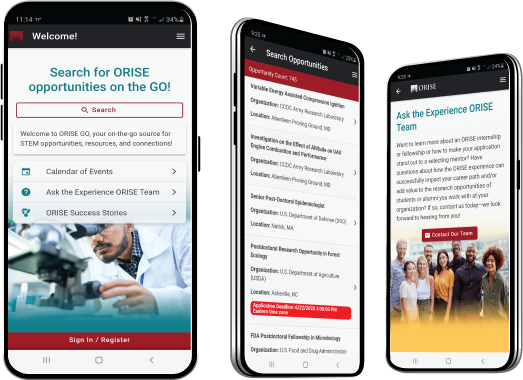
The ORISE GO mobile app helps you stay engaged, connected and informed during your ORISE experience – from application, to offer, through your appointment and even as an ORISE alum!