

CDC Fellowship in Bioactive Dietary Compound Biomarker Method Development, Validation, and Implementation
To submit your application, scroll to the bottom of this opportunity and click APPLY.
A complete application consists of:
- An application
- Transcripts – Click here for detailed information about acceptable transcripts
- A current resume/CV, including academic history, employment history, relevant experiences, and publication list
- One educational or professional recommendation. Your application will be considered incomplete, and will not be reviewed until one recommendation is submitted.
All documents must be in English or include an official English translation.
Connect with ORISE...on the GO! Download the new ORISE GO mobile app in the Apple App Store or Google Play Store to help you stay engaged, connected, and informed during your ORISE experience and beyond!
*Applications will be reviewed on a rolling-basis.
CDC Office and Location: A research opportunity is available with the National Center for Environmental Health (NCEH) at the Centers for Disease Control and Prevention (CDC) in Atlanta, Georgia.
The Centers for Disease Control and Prevention (CDC) is one of the major operation components of the Department of Health and Human Services. CDC protects America from health, safety and security threats, both foreign and in the U.S. Whether diseases start at home or abroad, are chronic or acute, curable or preventable, human error or deliberate attack, CDC fights disease and supports communities and citizens to do the same. CDC increases the health security of our nation. As the nation’s health protection agency, CDC saves lives and protects people from health threats. To accomplish its mission, CDC conducts important science and provides health information that protects our nation against expensive and dangerous health threats, and responds when these arise.
Research Project: The Bioactive Dietary Compounds Laboratory (BDCL), within the Nutritional Biomarkers Branch (NBB), Division of Laboratory Sciences (DLS), National Center for Environmental Health (NCEH), develops and applies analytical methods for measuring biomarkers of exposure to bioactive dietary compounds in human specimens. The project focuses on improving the assessment of dietary exposures and supporting research on their relationships with health. Mentor-guided learning activities may draw upon biomonitoring projects associated with CDC’s National Health and Nutrition Examination Survey (NHANES) and similar epidemiological studies of the U.S. population. You may gain experience with state-of-the-art liquid chromatography-tandem mass spectrometry (LC-MS/MS) and, when available and appropriate, the laboratory’s unique gas chromatography-isotope ratio mass spectrometry (GC-IRMS) capabilities. The project connects analytical chemistry theory with practice through method development, validation, documentation, quality systems, data interpretation, laboratory safety, and scientific communication. All activities will occur under the mentorship of sponsor laboratory scientists in a Clinical Laboratory Improvement Amendments (CLIA)-accredited setting and are intended to provide experiential learning rather than fulfill essential agency functions.
Learning Objectives: This 1-year fellowship, with a possible extension as funding permits, may provide the following mentor-guided learning opportunities. You may not receive exposure to every objective; specific experiences will be selected based on scientific relevance, your preparation, available learning activities, and the stage of the biomonitoring project associated with the appointment.
- Analytical method development and optimization – You may gain experience designing and carrying out mentor-guided experiments for biomarker measurement, including sample preparation, chromatographic separation, mass spectrometric detection, calibration, and evaluation of matrix effects, sensitivity, selectivity, and potential analytical interferences.
- Method evaluation and validation – You may learn to prepare validation plans, assess performance characteristics such as accuracy, precision, analytical measurement range, limits of detection, specificity, recovery, stability, and carryover, interpret experimental findings, and prepare a validation summary under mentor guidance.
- Translation of validated methods to epidemiological studies – You may learn the scientific and quality considerations involved in transitioning a validated method to appropriate use in NHANES or similar studies, including specimen processing sequences, calibration and quality-control materials, analytical review criteria, repeat-testing criteria, and evaluation of data reliability.
- Laboratory documentation and risk assessment – You may gain experience developing project-appropriate documentation under mentor review, including analytical procedure manuals, standard operating procedures, method risk assessments, validation protocols, data-recording forms, and training materials, while learning principles of document control, reproducibility, and traceability.
- Quality control and quality assurance – You may learn how quality-control data are assessed, how trends and shifts are recognized, and how nonconforming events and corrective and preventive actions are documented and evaluated within a CLIA quality system.
- Laboratory information management systems and data integrity – You may gain guided exposure to laboratory information management systems (LIMS) and learn how electronic systems support specimen tracking, analytical data transfer, record completeness, traceability, and protection of data integrity.
- Laboratory and instrument safety – You may learn laboratory-specific chemical, biological, and instrument safety practices; practice preparing project-appropriate risk assessments under mentor review; and develop an understanding of safe practices for LC-MS/MS, GC-IRMS, specimen handling, reagents, and laboratory equipment.
- Scientific communication and team engagement – You may strengthen oral and written communication, quantitative reasoning, critical thinking, and team engagement skills through mentor-guided data discussions, technical summaries, presentations, and possible contributions to abstracts, reports, manuscripts, or scientific meetings.
Mentor(s): The mentor for this opportunity is Michael Rybak (szr8@cdc.gov). If you have questions about the nature of the research please contact the mentor(s).
Anticipated Appointment Start Date: November 2, 2026. Start date is flexible and will depend on a variety of factors.
Appointment Length: The appointment will initially be for one year, but may be renewed upon recommendation of CDC and is contingent on the availability of funds.
Level of Participation: The appointment is full time.
Participant Stipend: Stipend rates may vary based on numerous factors, including opportunity, location, education, and experience. If you are interviewed, you can inquire about the exact stipend rate at that time and if selected, your appointment offer will include the monthly stipend rate.
Citizenship Requirements: This opportunity is available to U.S. citizens only.
ORISE Information: This program, administered by ORAU through its contract with the U.S. Department of Energy (DOE) to manage the Oak Ridge Institute for Science and Education (ORISE), was established through an interagency agreement between DOE and CDC. Participants do not become employees of CDC, DOE or the program administrator, and there are no employment-related benefits. Proof of health insurance is required for participation in this program. Health insurance can be obtained through ORISE.
The successful applicant(s) will be required to comply with Environmental, Safety and Health (ES&H) requirements of the hosting facility, including but not limited to, COVID-19 requirements (e.g. facial covering, physical distancing, testing, vaccination).
Questions: Please visit our Program Website. After reading, if you have additional questions about the application process please email CDCrpp@orau.org and include the reference code for this opportunity.
The qualified candidate should have received a bachelor's or master's degree in one of the relevant fields (e.g. chemistry, preferably with a concentration, focus, or substantial coursework in analytical chemistry and instrumental analysis). Degree must have been received within the past five years.
Preferred Skills:
- Academic or laboratory experience with instrumental techniques, particularly liquid chromatography, gas chromatography, and mass spectrometry; experience with liquid chromatography-tandem mass spectrometry (LC-MS/MS) or gas chromatography-isotope ratio mass spectrometry (GC-IRMS) is beneficial.
- Foundational knowledge of quantitative analytical chemistry, including calibration, accuracy, precision, sensitivity, selectivity, detection limits, and matrix effects.
- Experience or coursework in sample preparation, chromatographic separations, instrument operation, analytical data review, or method development and validation.
- Strong attention to detail, scientific communication skills, and an interest in laboratory quality systems, documentation, data integrity, and safety.
- Experience with biological specimens, biomonitoring, nutritional biomarkers, LIMS, or regulated clinical laboratories is beneficial but not required.
Applicants are not expected to have prior experience in every area.
- Citizenship: U.S. Citizen Only
- Degree: Bachelor's Degree or Master's Degree received within the last 60 month(s).
-
Discipline(s):
- Chemistry and Materials Sciences (12 )
I certify that I have not previously been employed by CDC or by a contractor working directly for CDC. I understand that CDC does not permit individuals with a prior employment relationship with CDC or its contractors to participate as trainees in the ORISE program. (Exceptions may be granted for individuals who, since the previous CDC employment, have obtained a new STEM degree which necessitates training in a new field.)

 ORISE GO
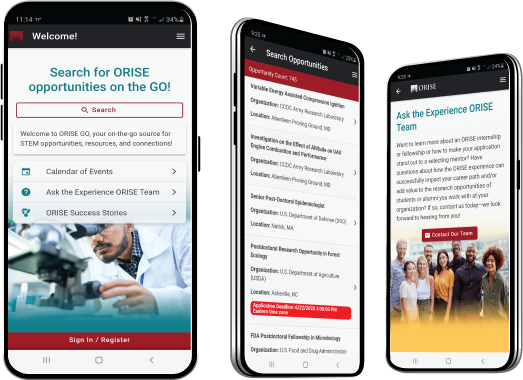
The ORISE GO mobile app helps you stay engaged, connected and informed during your ORISE experience – from application, to offer, through your appointment and even as an ORISE alum!