

ATSDR Evidence-Based Research Strategy Fellowship
To submit your application, scroll to the bottom of this opportunity and click APPLY.
A complete application consists of:
- An application
- Transcripts – Click here for detailed information about acceptable transcripts
- A current resume/CV, including academic history, employment history, relevant experiences, and publication list
- One educational or professional recommendation. Your application will be considered incomplete, and will not be reviewed until one recommendation is submitted.
All documents must be in English or include an official English translation.
Connect with ORISE...on the GO! Download the new ORISE GO mobile app in the Apple App Store or Google Play Store to help you stay engaged, connected, and informed during your ORISE experience and beyond!
*Applications will be reviewed on a rolling-basis.
CDC Office and Location: A research opportunity is currently available with the Agency for Toxic Substances and Disease Registry (ATSDR) at the Centers for Disease Control and Prevention (CDC) in Atlanta, Georgia.
The Centers for Disease Control and Prevention (CDC) is one of the major operation components of the Department of Health and Human Services. CDC protects America from health, safety and security threats, both foreign and in the U.S. Whether diseases start at home or abroad, are chronic or acute, curable or preventable, human error or deliberate attack, CDC fights disease and supports communities and citizens to do the same. CDC increases the health security of our nation. As the nation’s health protection agency, CDC saves lives and protects people from health threats. To accomplish its mission, CDC conducts important science and provides health information that protects our nation against expensive and dangerous health threats, and responds when these arise.
Research Project: This mentored research experience will allow you to participate in evidence-based approaches for shaping scientific priorities within the Agency for Toxic Substances and Disease Registry (ATSDR). Guided by experienced ATSDR scientists, you will explore how public health research needs are identified, evaluated, and aligned with agency goals. You will begin by gaining experience conducting an environmental scan of current research activities, learning how to organize and synthesize information from diverse scientific programs. Under the guidance of a mentor you will perform a structured gap analysis to identify unmet research needs and emerging opportunities. you will also gain experience interviewing subject-matter experts to understand how public health priorities are translated into research questions and strategic planning. Using insights gained throughout the appointment, you will learn to apply evidence-based methods to develop a research-prioritization matrix and collaborate on a draft a five-year research agenda for the ATSDR Office of Science. With mentor guidance, you will also gain experience in recommending approaches for regularly reviewing and updating research priorities in response to evolving challenges. Overall, this project offers a hands-on training experience in research strategy development and provides you with valuable exposure to how federal public health agencies evaluate and prioritize scientific work to maximize impact.
Learning Objectives:
- Develop advanced competency in evaluating scientific portfolios using evidence-based assessment methods.
- Strengthen ability to identify and articulate research gaps, unmet needs, and emerging scientific opportunities.
- Build proficiency in synthesizing qualitative and quantitative data to inform strategic research decision-making.
- Enhance skill in translating scientific insights into structured, prioritized research recommendations.
- Deepen understanding of research-priority frameworks used within federal public health agencies.
- Strengthen scientific communication capabilities, including preparing clear, analytically grounded technical summaries.
- Expand expertise in research planning concepts such as agenda development, prioritization logic, and strategic alignment.
- Grow professional judgment and critical-thinking skills needed to support long-term scientific strategy.
Mentor(s): The mentor for this opportunity is Lina Ballouz (Lballouz@cdc.gov). If you have questions about the nature of the research please contact the mentor.
Anticipated Appointment Start Date: Fall 2026. Start date is flexible and will depend on a variety of factors.
Appointment Length: The appointment will initially be for one year, but may be renewed upon recommendation of CDC and is contingent on the availability of funds.
Level of Participation: The appointment is full time.
Participant Stipend: Stipend rates may vary based on numerous factors, including opportunity, location, education, and experience. If you are interviewed, you can inquire about the exact stipend rate at that time and if selected, your appointment offer will include the monthly stipend rate.
Citizenship Requirements: This opportunity is available to U.S. citizens and LPR only.
ORISE Information: This program, administered by ORAU through its contract with the U.S. Department of Energy (DOE) to manage the Oak Ridge Institute for Science and Education (ORISE), was established through an interagency agreement between DOE and CDC. Participants do not become employees of CDC, DOE or the program administrator, and there are no employment-related benefits. Proof of health insurance is required for participation in this program. Health insurance can be obtained through ORISE.
The successful applicant(s) will be required to comply with Environmental, Safety and Health (ES&H) requirements of the hosting facility, including but not limited to, COVID-19 requirements (e.g. facial covering, physical distancing, testing, vaccination).
Questions: Please visit our Program Website. After reading, if you have additional questions about the application process please email CDCrpp@orau.org and include the reference code for this opportunity.
Qualifications: The qualified candidate should have received a doctoral degree in one of the relevant fields. Degree must have been received within the past 6 months or anticipated to be received by January 1, 2027.
Preferred Skills/Experience:
- Doctoral degree.
- Knowledge of environmental and epidemiological study design.
- Ability to critically appraise scientific literature and apply knowledge-translation concepts.
- Experience conducting systematic, scoping, or rapid literature reviews and synthesizing scientific evidence.
- Skill in identifying research gaps, emerging issues, and applying research-prioritization frameworks.
- Experience developing scoring or ranking systems.
- Proficiency in data analysis using R, SPSS, Stata, and basic descriptive statistics.
- Experience analyzing surveillance, epidemiologic, or environmental health datasets.
- Ability to conduct interviews and synthesize qualitative findings.
- Strong scientific writing skills, including preparing reports and technical summaries.
- Effective organization and timeline management.
- Ability to collaborate within multidisciplinary teams.
- Citizenship: LPR or U.S. Citizen
- Degree: Doctoral Degree received within the last 6 months or anticipated to be received by 1/1/2027 1:46:33 PM.
- Minimum Overall GPA: 3.70
- Discipline(s):
I certify that I have not previously been employed by CDC or by a contractor working directly for CDC. I understand that CDC does not permit individuals with a prior employment relationship with CDC or its contractors to participate as trainees in the ORISE program. (Exceptions may be granted for individuals who, since the previous CDC employment, have obtained a new STEM degree which necessitates training in a new field.)

 ORISE GO
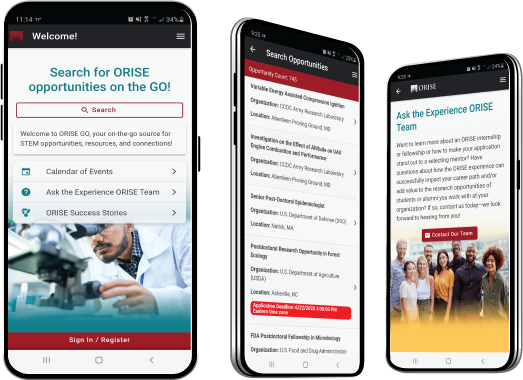
The ORISE GO mobile app helps you stay engaged, connected and informed during your ORISE experience – from application, to offer, through your appointment and even as an ORISE alum!