

CDC Respiratory Virus Bioinformatics and Genomic Surveillance Fellowship
To submit your application, scroll to the bottom of this opportunity and click APPLY.
A complete application consists of:
- An application
- Transcripts – Click here for detailed information about acceptable transcripts
- A current resume/CV, including academic history, employment history, relevant experiences, and publication list
- One educational or professional recommendation. Your application will be considered incomplete, and will not be reviewed until one recommendation is submitted.
- A copy of an abstract or reprint of an article
All documents must be in English or include an official English translation.
Connect with ORISE...on the GO! Download the new ORISE GO mobile app in the Apple App Store or Google Play Store to help you stay engaged, connected, and informed during your ORISE experience and beyond!
Description
*Applications will be reviewed on a rolling-basis.
CDC Office and Location: A research opportunity is available in the Centers for Disease Control and Prevention (CDC), National Center for Immunization and Respiratory Diseases (NCIRD), Division of Cancer Prevention and Control (DCPC), Coronavirus and Other Respiratory Viruses Division (CORVD) located in Atlanta, Georgia.
The Centers for Disease Control and Prevention (CDC) is one of the major operation components of the Department of Health and Human Services. CDC protects America from health, safety and security threats, both foreign and in the U.S. Whether diseases start at home or abroad, are chronic or acute, curable or preventable, human error or deliberate attack, CDC fights disease and supports communities and citizens to do the same. CDC increases the health security of our nation. As the nation’s health protection agency, CDC saves lives and protects people from health threats. To accomplish its mission, CDC conducts important science and provides health information that protects our nation against expensive and dangerous health threats, and responds when these arise.
Research Project: This fellowship provides mentor-guided training in respiratory virus genomics, bioinformatics, data science, and scientific computing. The fellowship will focus on using genomic and laboratory data to strengthen respiratory virus surveillance, improve analytical reporting, and develop practical tools and infrastructure for laboratory scientists. You will collaborate with bioinformaticians, laboratorians, epidemiologists, data scientists, and other public health professionals.
Under the guidance of a CDC mentor, you may:
Analyze respiratory virus sequence data and associated surveillance metadata; Gain experience preparing routine and ad hoc genomic surveillance reports; Summarize lineage, clade, variant, mutation, temporal, and geographic trends; Develop reproducible workflows for sequence quality control, genome; assembly, variant identification, lineage assignment, and phylogenetic analysis; Automate the production of tables, figures, visualizations, and quality-control summaries; Integrate genomic, laboratory, and epidemiologic data from multiple sources; Train to develop or improve databases and analytical infrastructure supporting genomic surveillance; Explore distributed data-processing technologies, including Apache Hadoop or related platforms; Build dashboards and applications that allow laboratory users to query, visualize, and interpret data; Develop scripts, application programming interfaces, and other tools supporting laboratory workflows; Test, document, validate, and maintain analytical pipelines and software; Evaluate emerging bioinformatics tools, datasets, and analytical methods; Collaborate on scientific presentations, technical documentation, posters, and manuscripts; Activities may be tailored to the fellow’s background, interests, and professional development goals.
Projects may include: Automated respiratory virus genomic surveillance reporting; Analysis of emerging variants and genomic trends; Laboratory dashboards displaying sequence status, quality metrics, and genomic findings; Tools for querying and visualizing laboratory and surveillance data; Development or modernization of genomic analytics databases; Evaluation of Apache Hadoop or related technologies for large-scale genomic analysis; Integration of genomic, laboratory, and epidemiologic datasets; Development and validation of scalable respiratory virus bioinformatics workflows; Evaluation of methods for assembly, variant detection, lineage assignment, or phylogenetic analysis; Development of new analytical approaches for respiratory virus genomics; Final projects will be developed jointly by the mentor and fellow.
Learning Objectives: During the fellowship, you will learn to:
- Apply bioinformatics and data science methods to respiratory virus genomic surveillance.
- Analyze and interpret genomic, laboratory, and epidemiologic data.
- Develop reproducible analyses and automated genomic surveillance reports.
- Identify and communicate emerging variants, mutations, lineages, and genomic trends.
- Design databases and scalable analytical infrastructure for large genomic datasets.
- Develop laboratory-focused dashboards, visualizations, and software tools.
- Translate scientific and laboratory needs into functional computational solutions. Evaluate and develop new methods for respiratory virus genomics.
- Apply software development practices, including version control, testing, documentation, and workflow automation.
- Communicate complex genomic findings to scientific and public health audiences.
- Collaborate effectively within an interdisciplinary public health laboratory environment.
Mentor(s): The mentor for this opportunity is Clint Paden (fep2@cdc.gov). If you have questions about the nature of the research please contact the mentor.
Anticipated Appointment Start Date: November, 2026. Start date is flexible and will depend on a variety of factors.
Appointment Length: The appointment will initially be for 1 year, but may be renewed upon recommendation of CDC and is contingent on the availability of funds.
Level of Participation: The appointment is full time.
Participant Stipend: Stipend rates may vary based on numerous factors, including opportunity, location, education, and experience. Anticipated stipend range is $5,439 - $6,581 monthly.
Citizenship Requirements: This opportunity is available to U.S. citizens only.
ORISE Information: This program, administered by ORAU through its contract with the U.S. Department of Energy (DOE) to manage the Oak Ridge Institute for Science and Education (ORISE), was established through an interagency agreement between DOE and CDC. Participants do not become employees of CDC, DOE or the program administrator, and there are no employment-related benefits. Proof of health insurance is required for participation in this program. Health insurance can be obtained through ORISE.
The successful applicant(s) will be required to comply with Environmental, Safety and Health (ES&H) requirements of the hosting facility, including but not limited to, COVID-19 requirements (e.g. facial covering, physical distancing, testing, vaccination).
Questions: Please visit our Program Website. After reading, if you have additional questions about the application process please email CDCrpp@orau.org and include the reference code for this opportunity.
Applicants should have received a master's or doctorate in a relevant field, such as, Bioinformatics, Data science, Biostatistics, Microbiology, Virology, Molecular biology, or a related scientific or quantitative discipline. Degree must have been received within the past five years.
Preferred skills: Applicants should also have experience in using in some sort of genomics, bioinformatics, or advanced statistical analyses.
Strong applicants will have experience in one or more of the following areas:
- Next-generation sequencing or genomic data analysis; Viral genomics, infectious diseases, or genomic epidemiology.
- Python, R, Bash, SQL, or another relevant language; Linux or Unix-based computing environments.
- Creating or maintaining reproducible bioinformatics workflows; Sequence processing, genome assembly, variant analysis, lineage assignment, or phylogenetics.
- Analytical reporting, visualization, or dashboard development; Apache Hadoop, Apache Spark, cloud computing, or high-performance computing.
- Git, software testing, code review, or technical documentation; Translating scientific requirements into usable analytical tools.
Applicants are not expected to have experience in every area.
I certify that I have not previously been employed by CDC or by a contractor working directly for CDC. I understand that CDC does not permit individuals with a prior employment relationship with CDC or its contractors to participate as trainees in the ORISE

 ORISE GO
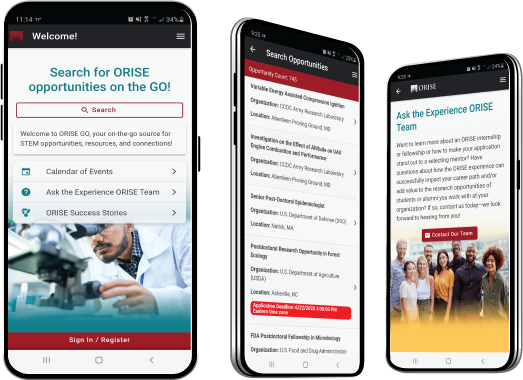
The ORISE GO mobile app helps you stay engaged, connected and informed during your ORISE experience – from application, to offer, through your appointment and even as an ORISE alum!